The Orbital Trajectory Problem
Spaceflight logistics is fundamentally a problem of orbital mechanics, energy management, and time optimization. When a crew vehicle launches toward the International Space Station, the objective is not merely to reach a specific point in space, but to match the velocity, altitude, and orbital plane of a target moving at approximately 28,000 kilometers per hour in low Earth orbit. Traditional mission profiles historically relied on multi-day rendezvous sequences, utilizing dozens of orbital burns and extended phasing orbits to gradually close the distance between the chaser and the target.
This multi-day approach introduced compounding operational friction. Extended time in cramped spacecraft modules elevates physiological stress on crew members, increases consumables consumption, and lengthens the critical path for mission operations. Transitioning to a fast-track rendezvous profile compresses this timeline significantly, reducing transit duration to a fraction of a day. Achieving this operational acceleration requires rigorous precision in launch timing, real-time trajectory optimization, and advanced autonomous navigation systems that minimize human intervention during the final closing phases.
The physics governing this transition dictate that launch windows are instantaneous. Unlike legacy profiles where minor launch delays could be absorbed by adjusting phasing orbits over several days, a rapid rendezvous demands near-perfect insertion accuracy from the launch vehicle. The propulsion stage must inject the spacecraft into an initial transfer orbit whose energy state intersects the station's orbital path precisely at the designated waypoint. Any deviation requires immediate mid-course correction burns, trading fuel mass for timeline adherence.
The Cost Function of Transit Acceleration
Optimizing any aerospace logistics pipeline involves balancing competing variables: time, fuel mass, structural load, and operational risk. In the context of human spaceflight, transit duration acts as a primary cost driver for both biological and mechanical systems.
Total Mission Cost = f(Transit Duration) + g(Propellant Consumption) + h(Operational Risk)
Compressing the transit phase alters this equation in distinct ways:
- Physiological Degradation: Extended confinement in microgravity environments exacerbates space motion sickness, fluid shifts, and sleep disruption. Shorter transit windows reduce cumulative crew fatigue before operational activities begin on station.
- Consumables Overhead: Life support systems, power generation, and thermal regulation demand continuous resource expenditure. While the marginal savings of a two-day reduction may seem modest, eliminating redundant orbital loops reduces propellant reserves needed for station-keeping and attitude control during phasing.
- Mechanical Reliability: Every propulsive maneuver represents a probabilistic risk of component failure. Reducing the total number of orbital adjustment burns simplifies the operational mission profile and limits exposure to anomaly windows.
The trade-off lies in the propellant mass fraction required for aggressive orbital insertion. Steeper trajectories and faster catch-up profiles demand higher initial velocity changes from the launch vehicle, placing stricter performance constraints on the first and second stages, as well as the upper-stage restart capabilities.
Execution Architecture of Rapid Rendezvous
Executing a compressed transit profile requires a synchronized sequence of autonomous milestones, executed with deterministic precision. The architecture relies on three distinct operational phases: precision injection, differential phasing, and terminal proximity operations.
[Launch Vehicle Insertion] ---> [Autonomous Differential Phasing] ---> [Terminal Proximity Operations] ---> [Structural Hard Dock]
Precision Insertion and Initial Navigation
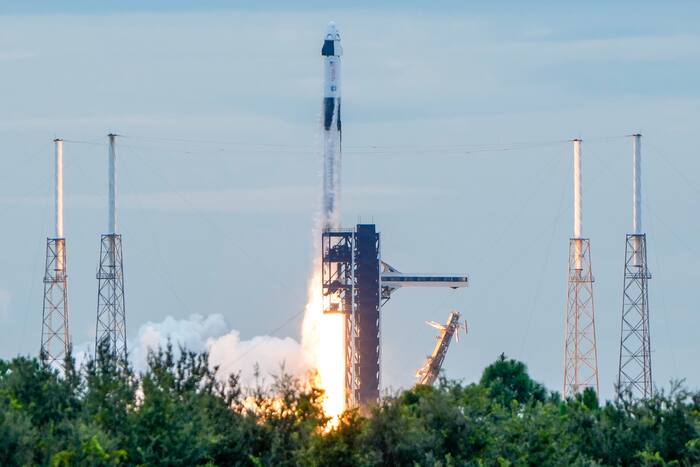
The process begins on the launch pad, where the countdown clock is managed to the exact second. The orbital plane of the International Space Station precesses continuously due to the Earth's oblateness. The launch vehicle must clear the tower at an precise azimuth to eliminate plane-change maneuvers later, which are prohibitively expensive in terms of propellant.
Upon second-stage cutoff and spacecraft separation, onboard inertial navigation systems initialize relative GPS positioning. The spacecraft computes its ephemeris data relative to the station's state vector, establishing an immediate baseline for trajectory corrections.
Autonomous Differential Phasing
Once in the initial pursuit orbit, the spacecraft utilizes onboard guidance algorithms to execute a series of targeted burns. Unlike historical missions where ground control teams calculated every vector adjustment and uploaded them via voice or data links, modern rapid-transit vehicles run onboard optimization routines. These systems evaluate sensor telemetry, calculate optimal fuel-to-time burn parameters, and execute maneuvers autonomously.
The differential altitude between the chaser and the target creates a natural drift rate. By maintaining a slightly lower orbit, the chaser travels faster due to Keplerian mechanics, catching up to the station along the longitudinal axis. The art of the fast track lies in timing the termination of this drift so that the chaser arrives at the station's local vertical and horizontal approach corridor with near-zero relative velocity.
Terminal Proximity Operations and Docking
The final phase shifts from orbital mechanics to relative navigation sensors. Within a ten-kilometer radius, optical tracking systems, LiDAR, and relative GPS take over. The spacecraft transitions from open-loop orbital guidance to closed-loop relative navigation.
Collision avoidance maneuvers are pre-programmed into the flight computer. If sensor data indicates an anomalous closing rate or trajectory divergence, the system automatically initiates a retreat burn to a safe parking orbit. When nominal parameters are maintained, the vehicle guides itself along the R-bar or V-bar approach vector, matching rotation rates with the station before contact, attenuation, and structural latching occur.
Operational Constraints and System Limitations
While compressed transit profiles offer clear operational advantages, they are bounded by immutable physical and engineering constraints. Recognizing these limitations is essential for understanding why rapid rendezvous is not applied universally across all missions.
- Launch Window Vulnerability: The instantaneous launch window constraint creates high schedule fragility. Meteorological disturbances, range telemetry issues, or minor avionics checks that push the launch outside a second-level window require a 24-hour scrub, as orbital mechanics do not permit immediate recovery of the phasing geometry.
- Avionics Redundancy Requirements: Because human life is onboard and the automated timeline leaves zero margin for ground-control intervention during critical burn phases, flight software and hardware must maintain triple-modular redundancy. A single computer fault during a high-energy insertion burn could lead to irreversible trajectory errors.
- Thermal and Power Limits: Aggressive profiles often require non-standard spacecraft orientations during the transfer phase to optimize solar array positioning or protect sensitive optical sensors from direct solar radiation. Thermal dissipation models must be validated for these transient attitudes.
Systemic Integration and Future Flight Operations
The transition toward rapid crew rotation models represents a broader maturation of orbital logistics. By treating transit time as a critical variable to be minimized rather than an unavoidable operational delay, space agencies and commercial providers have redefined mission efficiency.
The underlying engineering discipline relies on eliminating manual touchpoints, trusting autonomous system architectures, and maintaining rigorous tolerances across the entire propulsion and guidance chain. As launch cadence increases and orbital congestion grows, the ability to execute precise, rapid insertions will transition from an advanced operational capability to the baseline standard for human spaceflight logistics.