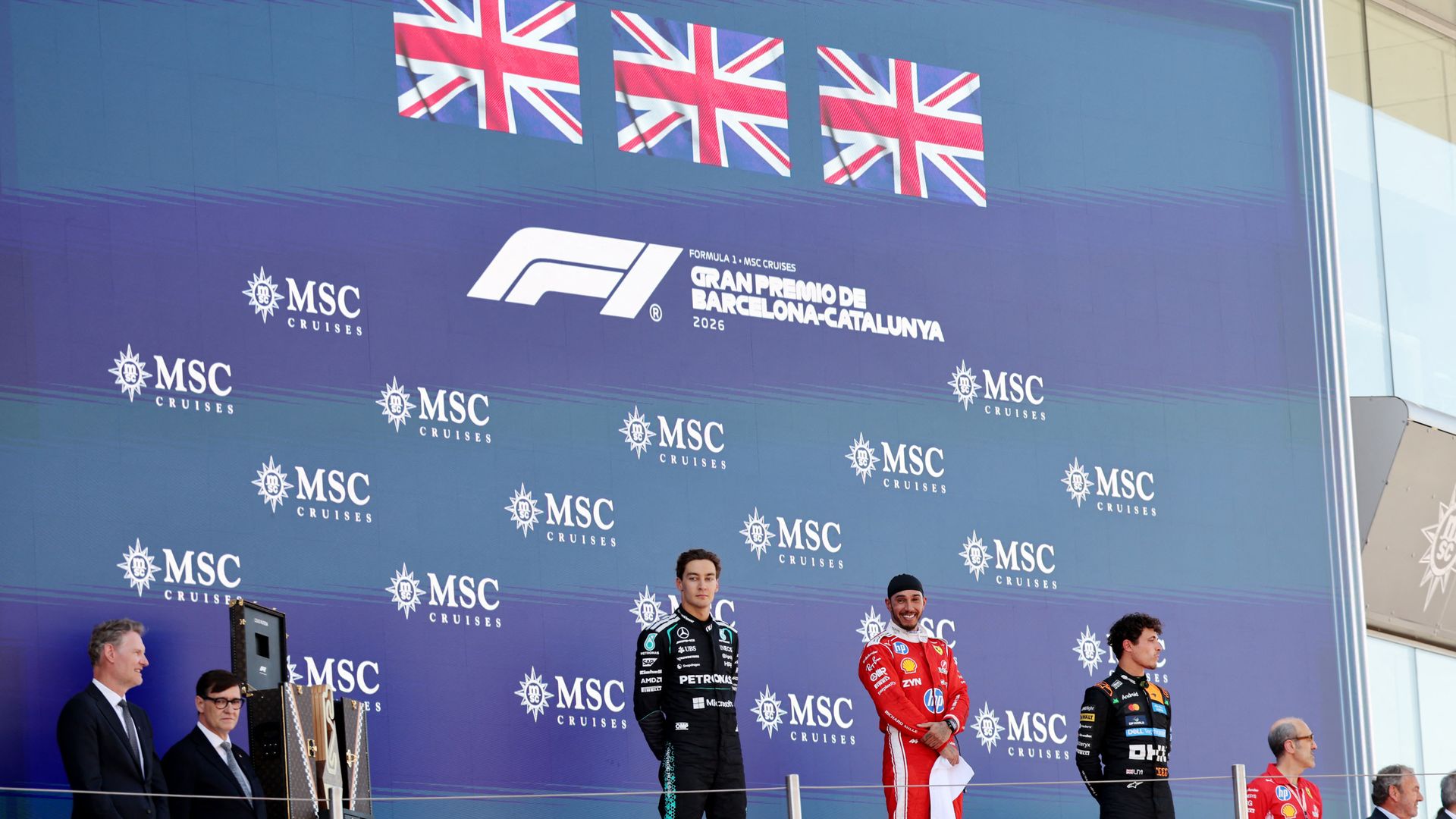
The 2026 Barcelona-Catalunya Grand Prix will be recorded in popular commentary as a historical anomaly—the first all-British podium finish since Jackie Stewart, Graham Hill, and John Surtees stood together at the 1968 United States Grand Prix. Yet, attributing Lewis Hamilton’s maiden Ferrari victory, George Russell’s second-place finish, and Lando Norris’s third-place podium lock to national resurgence obscures the precise engineering and operational variables that drove the outcome.
The result was not a product of historical symmetry, but a textbook optimization problem solved across three distinct variables: thermal degradation management, asymmetric pit-window exploitation, and a critical variance in mechanical reliability under high-load conditions.
The Tri-Component Vector of the Barcelona Outcome
To understand how the podium structural configuration occurred, the race must be deconstructed into three operational phases: initial tyre offset initialization, the Virtual Safety Car (VSC) optimization window, and the late-stage thermal failure of the baseline leader.
[Phase 1: Tyre Offset Init] ---> [Phase 2: VSC Window Exploitation] ---> [Phase 3: Thermal Failure of Leader]
    - Hamilton: Soft Compound         - Alonso DNF triggers VSC            - Antonelli Power Unit Fault
    - Russell/Antonelli: Mediums      - Hamilton executes 3rd Stop         - Podium Order Settles (HAM-RUS-NOR)
1. Compound Selection and Initial Stint Asymmetry
The Circuit de Barcelona-Catalunya features a high-energy lateral load profile, particularly through Turn 3 and the Turn 14 final sweeper. This profile generates extreme bulk tyre temperatures, making structural degradation the primary performance bottleneck.
- The Mercedes Strategy: Mercedes chose a conservative baseline, starting polesitter George Russell and championship leader Kimi Antonelli on the Medium compound. The objective was stint elongation to secure a comfortable two-stop window.
- The Ferrari Strategy: Ferrari opted for an aggressive, high-delta strategy by starting Lewis Hamilton on the Soft compound. The objective was early track-position conversion, forcing an offset pit-stop sequence.
Hamilton’s early stop on Lap 11 served as the catalyst. By undercutting the medium-tyre runners early, Ferrari forced Mercedes into a defensive posture. Mercedes brought Russell and Antonelli in prematurely to protect track position, effectively compromising the natural lifespan of their second stints. This mechanical pressure accelerated the wear cycle across all front-running chassis.
2. The Asymmetric Pit-Window Exploitation
The defining strategic pivot occurred on Lap 40. Fernando Alonso’s Aston Martin suffered an on-track retirement, triggering a Virtual Safety Car. In a standard racing environment, a three-stop strategy carries a prohibitive pit-lane time penalty ($22\text{ seconds}$ under green-flag conditions at Barcelona). Under the VSC, the delta penalty is reduced by approximately $45%$, dropping the effective time loss to roughly $12\text{ seconds}$.
Hamilton held a sufficient time cushion to execute his third and final stop under the VSC restriction. Rejoining the track with a fresh compound advantage against the older, thermally stressed tyres of Russell and Antonelli shifted the performance delta heavily in Ferrari's favor. The strategy converted a high-risk three-stop profile into a high-efficiency performance advantage.
3. Structural Reliability Failures Under Thermal Loading
The final variable was mechanical endurance. Barcelona's high ambient heat combined with dirty-air wakes creates an extreme cooling challenge for internal combustion units and energy recovery systems.
While Antonelli managed to clear Russell for second place late in the race, the sustained thermal load of running in tight dirty-air sequences during his recovery charge caused a catastrophic mechanical failure with five laps remaining. The retirement of the race leader fundamentally reshuffled the podium hierarchy:
- Hamilton inherited a clean, unpressured lead to secure his 106th career victory.
- Russell was promoted to second, clear of the trailing pack but unable to close the delta to the leader.
- Norris, executing a quiet but highly efficient tyre-preservation strategy in the McLaren MCL40, inherited third place to complete the historical configuration.
Comparative Vehicle Dynamics and Track Adaptation
The finishing order directly reflected how each chassis interacted with the track architecture. Barcelona acts as an aerodynamic audit; cars with balanced downforce distribution excel, while cars reliant on specific ride-height windows suffer from mechanical balance shifts as tyres degrade.
| Chassis Profile | Aerodynamic Traits | Tyre Degradation Characteristics | Race Execution Performance |
|---|---|---|---|
| Ferrari SF-26 | Superior low-speed mechanical grip; highly stable front axle under braking. | Low front-left thermal spiking; excellent traction management out of Turn 9. | Optimized high-wear strategy via short, aggressive stints. |
| Mercedes W17 | High peak downforce in high-speed sectors; sensitive to crosswinds and track temperature shifts. | Prone to rear-axle overheating when sliding in dirty air. | Compromised by defensive strategy; vulnerable to late-stage power unit thermal stress. |
| McLaren MCL40 | Exceptionally linear aerodynamic platform; highly predictable tyre energy input. | Lowest baseline degradation across extended stints; highly stable balance. | Sustained median pace allowed clean exploitation of front-runner attrition. |
The McLaren MCL40’s performance profile is particularly notable. While lacking the absolute single-lap qualifying peak of the Mercedes, its linear aero-mapping prevented the sudden thermal spikes that ruined Antonelli's defense and forced Russell into management mode. Norris’s third-place finish confirms that McLaren’s platform remains the most stable baseline for tracks with high lateral energy requirements.
Long-Term Strategic Implications for the 2026 Championship
The operational outcomes of the Barcelona Grand Prix alter the trajectory of both the Drivers' and Constructors' Championships through two primary mechanisms: the compression of the leadership margin and the exposure of technical vulnerabilities.
The Erosion of the Leadership Cushion
Prior to this round, Kimi Antonelli maintained a comfortable points cushion at the top of the standings. His late-race retirement combined with Hamilton’s maximum points haul slashes that margin down to 41 points. Concurrently, Russell’s second-place finish moves him to within 50 points of the lead.
This creates a dual-front defensive requirement for Mercedes. They can no longer maximize a single driver's strategy without risking the secondary car falling into the clutches of a resurgent Ferrari or a metronomically consistent McLaren team.
Technical Reliability Cascades
Antonelli’s mechanical failure indicates an underlying cooling or component lifecycle miscalculation within the current Mercedes power unit architecture when subjected to maximum thermal stress. Because engine maps and cooling configurations are highly restricted once a race weekend begins, any fundamental mistake in heat rejection calculations will reappear at high-temperature venues like Budapest and Monza.
Ferrari’s ability to run an aggressive three-stop strategy without showing signs of thermal degradation suggests their cooling packaging achieves a better margin of safety. This technical cushion allows their strategic pit wall to operate with significantly more freedom than their immediate rivals.
The immediate tactical requirement for all three teams heading into the next technical cycle involves a hard reallocation of simulation assets. Mercedes must isolate the root cause of the power unit failure under high-load trailing conditions to avoid recurring point losses. Ferrari must verify if their VSC exploitation was a repeatable tactical victory or an isolated variable alignment that masked lingering long-stint pace deficits. McLaren’s directive is simpler: they must unlock one to two tenths of an execution delta in Saturday qualifying to convert their superior Sunday tyre preservation into direct track position, removing the requirement to rely on competitor attrition for podium finishes.