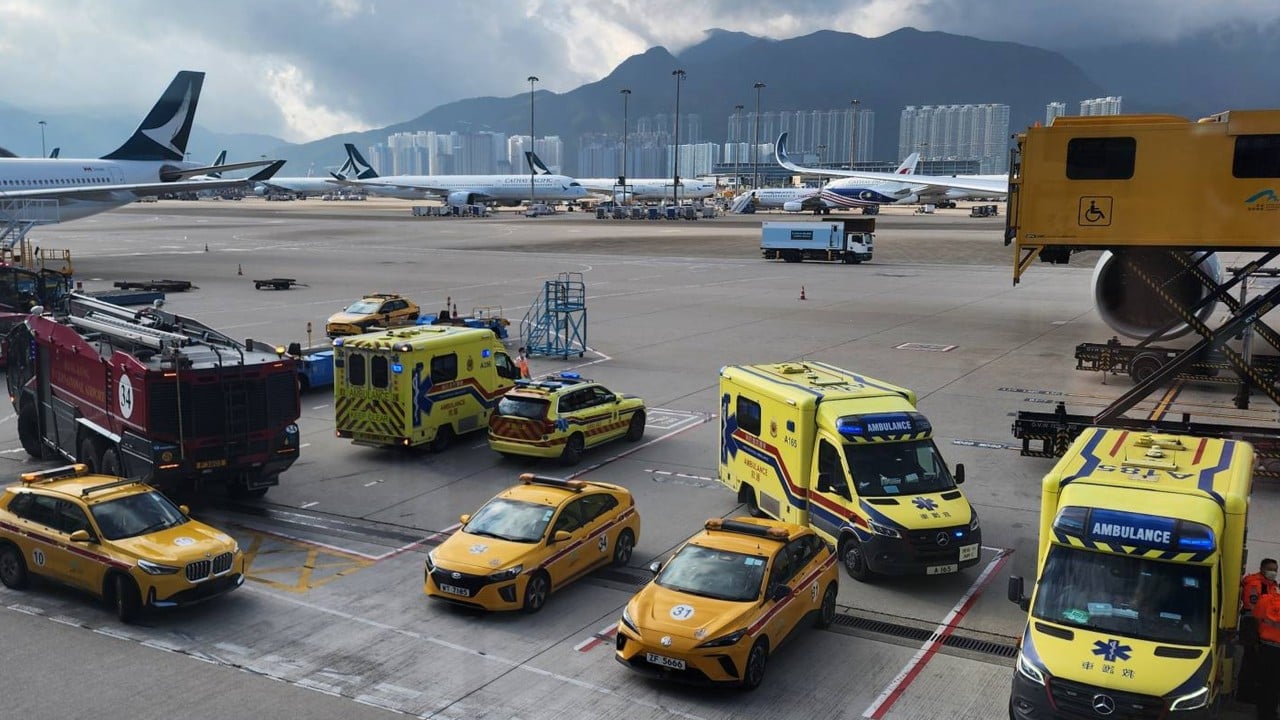
The immediate transition of a commercial aircraft from a standard cruise phase to an emergency descent following a localized thermal event in a propulsion unit is not a failure of aviation safety, but a demonstration of redundant system integrity. When a Delta Air Lines flight experiences an engine fire and subsequent emergency landing, the event serves as a case study in the mechanical, thermal, and procedural protocols that prevent a localized component failure from escalating into a hull loss. Understanding the severity of these incidents requires moving beyond the visual spectacle of flames to analyze the specific failure modes of high-bypass turbofan engines and the aerodynamic trade-offs inherent in single-engine operations.
The Mechanics of Thermal Containment
Modern jet engines are designed with the assumption that internal fires will occur. The structural integrity of the nacelle—the housing around the engine—is the primary line of defense. This enclosure is engineered to contain "uncontained" failures, such as a turbine blade release, and to isolate thermal energy from the fuel-rich environment of the wing. Expanding on this theme, you can also read: Your Viral Baby Elephant Video is Actually a Masterclass in Animal Warfare.
The Anatomy of an Engine Fire
Thermal events typically originate in one of three zones within the propulsion system:
- The High-Pressure Compressor (HPC) and Combustion Chamber: Failures here often result from a surge or stall, where the airflow through the engine is disrupted, causing flames to "lick" out of the back or front of the engine. This is often more visual than structurally damaging.
- The External Accessory Gearbox: Leaks in hydraulic lines or fuel manifolds can ignite upon contact with the hot casing of the engine. This represents a more significant threat to the structural airframe if not extinguished immediately.
- The Turbine Section: High-exhaust gas temperatures (EGT) can indicate internal melting or disintegration of components.
The "fire" observed by passengers is frequently the result of fuel being pumped into a compromised combustion environment. Once the flight crew initiates the Fire Handle or "Fire Wall" shut-off, the mechanical link to the fuel pumps is severed, and a dedicated high-pressure fire suppression agent (Halon) is discharged into the nacelle. This chemical interruption of the combustion triangle—fuel, oxygen, and heat—is designed to neutralize the threat within seconds. Observers at The Points Guy have shared their thoughts on this trend.
The Aerodynamic Cost of Asymmetric Thrust
When an engine is shut down in flight, the aircraft enters a state of asymmetric thrust. The physics of this state dictates every subsequent pilot action and the eventual flight path to an emergency landing.
The Yaw-Roll Coupling
The primary challenge of losing one engine on a twin-engine aircraft is the offset of the thrust vector from the longitudinal axis. With the left engine dead, the right engine’s thrust creates a powerful yawing moment to the left. If uncorrected, this leads to a roll in the same direction due to the increased lift on the right wing (the "advancing" wing) and decreased lift on the left.
Pilots counteract this using the Minimum Control Speed (Vmc) framework. This is the calibrated airspeed below which the rudder can no longer provide enough aerodynamic force to counteract the yawing moment of the operating engine at full power. Maintaining an airspeed above $V_{mc}$ is the absolute priority during the descent and approach phases.
Glide Ratios and Energy Management
A commercial aircraft such as a Boeing 737 or Airbus A320 possesses a glide ratio of approximately 17:1. This means for every 1,000 feet of altitude, the aircraft can travel 17,000 feet (roughly 3 miles) forward without any engine power. With one engine functioning, the aircraft does not "fall"; it simply enters a "driftdown" phase where it can no longer maintain its initial cruise altitude but can sustain level flight at a lower, denser altitude—typically between 15,000 and 25,000 feet, depending on weight and atmospheric conditions.
The Human Factor: Decision Matrix for Emergency Diversion
The transition from a standard flight plan to an emergency landing is governed by the QRH (Quick Reference Handbook). The crew does not "decide" what to do in a creative sense; they execute a pre-validated logic gate.
The NTSB-Modeled Priority Sequence
- Aviate: Maintain $V_{mc}$ and trim the aircraft to neutralize the asymmetric drag.
- Navigate: Identify the "Nearest Suitable Airport." This is a technical term. "Nearest" refers to time, not distance. "Suitable" refers to runway length, fire-fighting capabilities (ARFF Category), and weather minima.
- Communicate: Declare "Mayday" to clear the airspace. This grants the aircraft priority over all other traffic, reducing the risk of mid-air conflicts during a high-workload descent.
The "Emergency Landing" is often characterized by the media as a desperate scramble, but in reality, it is a stabilized approach. The aircraft will typically land at a higher-than-normal speed because the crew may choose to use a lower flap setting to minimize drag in case a "go-around" (a rare but possible secondary maneuver) is required on one engine.
Structural and Financial Consequences of Thermal Events
An engine fire is a catastrophic financial event for an airline, regardless of the physical safety of the passengers. The "Cost of Failure" extends far beyond the repair of the unit.
Component Life-Cycle Disruption
A high-bypass turbofan engine, such as a CFM56 or a Pratt & Whitney GTF, represents a capital investment of $10 million to $30 million. A fire event often results in:
- Total Loss of the Core: High-heat exposure can warp the engine pylons and the wing's internal ribs, potentially totaling the airframe if the heat soak was prolonged.
- FOD (Foreign Object Damage) Assessment: If the fire was caused by an internal disintegration, the runway must be closed and inspected for debris to prevent secondary incidents for other aircraft.
- Operational Chain Reaction: The removal of a single airframe from a tightly optimized hub-and-spoke network creates a multi-day disruption in crew scheduling and tail routing.
The Regulatory Audit
Following a Delta engine fire, the Federal Aviation Administration (FAA) and the National Transportation Safety Board (NTSB) initiate a "Part 121" investigation. They analyze the Maintenance, Repair, and Overhaul (MRO) records of that specific engine. If a pattern of "Premature Blade Deterioration" or "Seal Failure" is found, it can trigger an Airworthiness Directive (AD), forcing the entire industry to ground or inspect similar engine models. This is the "systemic risk" phase where a single emergency landing impacts global aviation liquidity.
Tactical Response Systems and the Maintenance Horizon
The shift in modern aviation is away from "Reactive Maintenance" (fixing it when it burns) toward "Predictive Maintenance" using ACARS (Aircraft Communications Addressing and Reporting System).
Real-Time Data Telemetry
During the flight, the engine's FADEC (Full Authority Digital Engine Control) monitors thousands of data points per second. In many modern fire incidents, the airline’s ground-based engineering team receives an "Exceedance Alert" before the pilots even see a master warning light. This data stream includes:
- N1 and N2 Speeds: The rotational velocity of the fan and core.
- Fuel Flow (FF): Sudden spikes indicate a leak or manifold breach.
- Vibration Sensors: High-frequency oscillations that precede a mechanical breakup.
The limitation of these systems is the "latency of physics." While sensors can detect a trend, they cannot always prevent a sudden catastrophic fatigue crack in a turbine disk.
Strategic Imperatives for Fleet Management
Airlines must treat every engine fire as a data-mining opportunity rather than a PR crisis. The objective is to move the "Mean Time Between Failures" (MTBF) further into the future by refining the thermal tolerances of high-pressure components.
The reliance on ETOPS (Extended-range Twin-engine Operational Performance Standards) means that aircraft are now certified to fly up to 370 minutes away from the nearest airport on a single engine. This certification is built on the statistical probability that a modern engine will fail less than once every 100,000 flight hours. When a fire occurs, it is a data outlier that must be reconciled with these statistical models.
The final strategic play for any operator facing these incidents is the immediate synchronization of the MRO data with the flight data recorder. If the thermal event occurred within the "Expected Wear Envelope," the issue is operational. If it occurred outside that envelope, the liability shifts to the Original Equipment Manufacturer (OEM). The difference between these two outcomes represents hundreds of millions of dollars in insurance recovery and fleet-wide safety modifications. Operators must prioritize the preservation of the "Cold Section" components for metallurgical analysis to determine if the fire was a result of environmental ingestion or an internal manufacturing defect. This distinction is the pivot point for future fleet reliability.