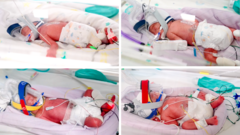
The Impossible Odds of Natural Monozygotic Division
When a single fertilized egg splits into four distinct, identical embryos without assisted reproductive technology, medical science confronts a statistical miracle with odds estimated at one in 70 million. The recent birth of rare identical quadruplets in Australia has refocused global attention on the delicate mechanics of high-order multiple pregnancies. Beyond the immediate celebration lies a complex biological mystery that challenges our understanding of cellular division and pushes maternal-fetal medicine to its absolute limits.
Spontaneous identical quadruplets—monozygotic quadruplets—occur when a single zygote divides three successive times during early cleavage. Unlike dizygotic or multizygotic multiples resulting from several fertilized eggs, a monozygotic quadruplet set shares an identical genetic blueprint.
Understanding how this happens requires examining the earliest days of human embryonic development.
Cellular Cleavage and the Mystery of Late Splitting
To grasp the magnitude of a spontaneous quadruplet pregnancy, one must track the timeline of the blastocyst. During standard reproduction, a single sperm fertilizes an egg to create a zygote. In typical monozygotic twinning, this initial cellular mass divides once within the first week after fertilization.
If the division happens within the first three days, each embryo develops its own placenta and amniotic sac (dichorionic-diamniotic). If the split occurs between days four and eight, the embryos share a placenta but remain in separate inner sacs (monochorionic-diamniotic).
For identical quadruplets to form, this splitting process must repeat.
                  [ Single Fertilized Zygote ]
                               |
                        ( First Split )
                       /               \
              [ Embryo A ]           [ Embryo B ]
                   |                      |
            ( Second Split )       ( Second Split )
            /              \       /              \
       [ Quad 1 ]     [ Quad 2 ] [ Quad 3 ]    [ Quad 4 ]
A double-split scenario creates four genetically uniform individuals. The precise biochemical trigger that prompts a single cell mass to fracture multiple times remains unknown. Theories point to temporary disruptions in cellular adhesion molecules or slight mechanical variations during blastocyst hatching, but concrete proof remains elusive.
The Genetic Identity Paradox
While identical quadruplets inherit matching DNA sequences, they are not exact carbon copies at birth. Epigenetic modifications—chemical tags that dictate how genes are expressed—begin diverging in the uterus. Micro-environmental differences inside the womb, such as variable blood flow and structural positioning, ensure that even monozygotic quadruplets emerge with unique fingerprint patterns and subtle physical distinctions.
The High-Stakes Physics of Monochorionic Gestation
Carrying four fetuses simultaneously places unprecedented physiological stress on the maternal body. The risks compound exponentially when multiple fetuses share placental architecture.
| Gestational Parameter | Single Twin Pregnancy | Monozygotic Quadruplet Pregnancy |
|---|---|---|
| Average Gestational Age at Delivery | 36–37 weeks | 28–32 weeks |
| Placental Sharing Risk | Moderate | Severe (High risk of TTTS) |
| Maternal Blood Volume Expansion | 40%–50% increase | Up to 100% increase |
| Postpartum Hemorrhage Risk | Standard baseline | Significantly elevated |
The primary medical hurdle in higher-order monozygotic pregnancies is maintaining equitable blood flow. When embryos share a single placenta, vascular connections can create dangerous fluid imbalances.
Twin-to-Twin Transfusion Syndrome (TTTS): A serious condition where abnormal blood vessel connections in a shared placenta cause disproportionate blood flow, leaving one fetus undernourished while the other faces heart strain from fluid overload.
In a quadruplet scenario, these vascular networks become a tangled maze. Maternal-fetal specialists must monitor fetal growth via high-resolution ultrasound almost daily to catch perfusion issues before irreversible damage occurs.
Maternal Adaptation and Mechanical Strain
The human uterus is naturally designed to harbor one fetus. Adapting to four requires extreme physical expansion. Maternal plasma volume expands dramatically, forcing the heart to work exponentially harder to maintain organ perfusion.
[ Maternal Cardiac Load ]
  ├── Hypervolemia (100% expansion)
  ├── Uterine Displacement of Diaphragm
  └── Elevated Risk of Preeclampsia & Gestational Diabetes
Diaphragmatic elevation reduces lung capacity, turning simple breathing into a rigorous physical task by the second trimester.
Hospital Protocols and Neonatal Intensive Care Management
Delivering quadruplets safely demands months of multi-disciplinary coordination. Obstetric teams do not wait for spontaneous labor. They plan a controlled Cesarean section long before full term, usually targeting 28 to 32 weeks gestation. Extending the pregnancy past this window dramatically increases the risk of intrauterine growth restriction and stillbirth.
The logistics inside the delivery suite resemble a military operation.
Delivery Room Logistics
For a quadruplet delivery, the surgical suite is partitioned into dedicated medical stations:
- Four distinct resuscitation teams, each consisting of a neonatologist, a respiratory therapist, and a primary care nurse.
- Color-coded equipment zones assigned to each newborn upon extraction to prevent administrative or medication errors.
- Advanced neonatal transport incubators pre-warmed and lined up outside the sterile field.
Each infant is delivered seconds apart, immediately assessed, stabilized, and transferred to the Neonatal Intensive Care Unit (NICU).
[ Delivery Suite Setup ]
  ├── Surgical Field (Obstetricians, Anesthesiologist)
  ├── Resuscitation Station A (Blue Team -> Baby A)
  ├── Resuscitation Station B (Green Team -> Baby B)
  ├── Resuscitation Station C (Yellow Team -> Baby C)
  └── Resuscitation Station D (Red Team -> Baby D)
Prematurity remains the single largest threat to identical quadruplets. At 30 weeks, an infant's lungs lack sufficient surfactant—the complex compound of lipids and proteins that keeps microscopic air sacs from collapsing during exhalation. Artificial surfactant administration and continuous positive airway pressure (CPAP) are standard protocols to support fragile, underdeveloped lungs.
Reproductive Technology versus Natural Spontaneous Division
Public discussions often conflate naturally occurring identical quadruplets with multiple births resulting from In Vitro Fertilization (IVF) or ovulation induction drugs. The distinction is critical.
Assisted reproductive technologies historically caused higher rates of fraternal multiples because practitioners routinely transferred multiple embryos to boost success rates. Modern fertility medicine has shifted heavily toward Single Embryo Transfer (SET) to minimize these exact risks.
[ Spontaneous Cleavage ] ──> 1 Egg + 1 Sperm ──> Multiple Splits ──> Identical DNA
[ Multi-Embryo Transfer ] ─> Multiple Eggs + Multiple Sperm ───────> Fraternal DNA
While IVF slightly increases the background rate of monozygotic splitting—possibly due to micro-manipulation of the outer shell (zona pellucida) during procedures like ICSI (Intracytoplasmic Sperm Injection)—spontaneous identical quadruplets remain an unprompted biological occurrence.
Long-Term Development and Health Outcomes
Surviving the NICU is only the first milestone for identical quadruplets. Long-term medical care requires ongoing tracking of physical and neurological development.
- Neurodevelopmental Monitoring: Early delivery increases the risk of intraventricular hemorrhage (bleeding in the brain) and cerebral palsy. Comprehensive physical therapy interventions begin in infancy.
- Nutritional Demands: Catch-up growth requires carefully calibrated caloric intake to ensure brain development keeps pace with peripheral body growth.
- Immunological Vulnerability: Premature infants carry underdeveloped immune systems, requiring strict infection control measures during the first two years of life.
Modern neonatal care has transformed outcomes for micro-preemies and higher-order multiples. Thirty years ago, the survival rate for all four infants in an identical quadruplet pregnancy was extremely low. Today, targeted laser surgery to treat vessel imbalances in the placenta, paired with modern ventilation techniques, allows all four siblings to thrive.
The birth of identical quadruplets stands as a rare intersection of extreme biological anomaly and high-intensity modern medicine. It showcases both the unpredictable nature of human cellular division and the remarkable precision of modern fetal therapy.