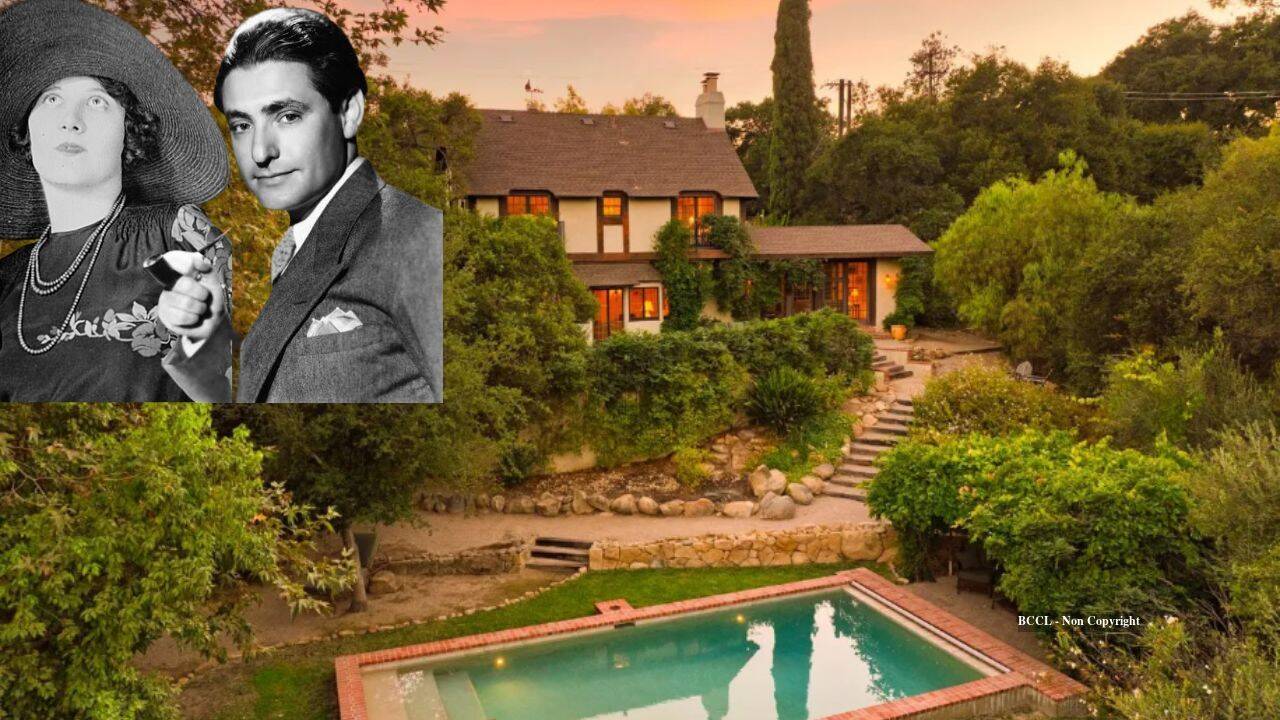
Paying $4.6 million for a 3,474-square-foot house sounds steep until you walk under barrel ceilings, step onto 1920s oak and mahogany parquet, and realize you're standing in a piece of Golden Age showbiz history. That's what happened when the historic Ojai Tudor at 520 Foothill Road closed on October 13, 2026. It wasn't a bargain by average Ventura County standards, yet it landed nearly $1.9 million shy of its original $6.495 million asking price.
Competitor writeups tend to treat sales like this as neat little fairy tales. A silent star builds a house, a famous songwriter moves in, and presto, vintage magic. Real life—and real estate—is messier. If you follow luxury historic homes in California, you know a steep price cut usually tells two stories at once: the property has real, irreplaceable bones, and the first asking price tested how much nostalgia the market would actually pay for.
How a 1928 Ojai Tudor Ended Up at $4.6 Million
Look closely at the listing history and the numbers get interesting fast. After trading for $1,465,000 back in July 2014 (roughly $422 per square foot), the estate came back out in June 2025 at $6,495,000, or $1,870 per square foot. From there came a familiar luxury dance: price trims to $5,995,000 in late 2025, down to $5,300,000 in May 2026, a pause in July, a relist at $4,750,000, and finally a closed deal at $4,600,000—about $1,324 per square foot.
Redfin data shows that $4.6 million figure sat roughly 133% above the $2.01 million average sale price of six nearby comparable homes. Even in Ojai, where Foothill Road carries serious cachet and views toward the Topa Topa mountains, paying more than double typical neighborhood comps means the buyer wasn't pricing drywall and square footage.
When an asking price drops nearly 30% over more than a year before closing, the seller wasn't giving the house away—they were meeting reality where "story value" stops stretching.
Why did the initial $6.495 million push stall? High interest rates, pickier high-net-worth buyers, and the sheer cost of maintaining an almost century-old residence all weigh on checks written in the mid-seven figures. Historic charm draws crowds to open houses. Writing a check for $4.6 million takes conviction.
Silent Cinema, Songwriting, and Austin Pierpont
Commissioned in 1928 for silent-screen actress Estelle Clark and designed by architect Austin Pierpont, the estate grew out of an era when Hollywood creatives treated Ojai as a quiet escape from studio noise. Later, Clark and lyricist Leo Robin—famous for writing "Thanks for the Memory," Bob Hope's signature song—were tied to the property during the 1930s.
One small detail worth flagging before you repeat pub trivia: public property listings associate both Clark and Robin with the 1930s household, while historical records for Clark and Robin's marriages and careers span overlapping Hollywood circles. In luxury real estate marketing, oral history and MLS blurbs often compress decades into a single romantic sentence. That doesn't make the provenance fake, just worth verifying through local landmark files and archives rather than taking every brochure line at face value.
Inside and out on roughly 1.18 acres, the appeal goes beyond names from old playbills:
- Interior craft: Venetian plaster walls, a large living room with a barrel ceiling, leaded and stained glass windows, and original oak and mahogany parquet floors.
- Flexible outbuildings: Accounts describe a mix of guest cottage space, a barn, and a detached yoga or creative studio alongside a pool and gardens.
- Valley setting: Foothill Road puts you close to hiking trails, farmers' markets, downtown dining, and the Ojai Valley Inn while keeping a tucked-away feel.
What Historic Landmark Status Actually Means for Buyers
People often assume a historic landmark designation automatically jacks up resale value like a magic multiplier. Honestly, it's a double-edged sword.
Yes, landmark status protects architectural character and signals rarity. Buyers who love 1920s Tudor Revival details—steep gables, leaded glass, textured plaster—want assurance that the neighborhood's soul won't get bulldozed into cookie-cutter boxes.
On the flip side, historic rules can slow down exterior changes, require specialized tradespeople, and turn simple updates into longer permitting conversations. Having spent years looking at older California homes, the biggest trap isn't loving the past. It's underestimating hidden mechanical, roofing, drainage, or wildfire-hardening upgrades while falling in love with a chandelier and a mountain view.
Should You Chase a Historic Home or Build New?
If you're shopping in Ojai or any design-driven California town, you're weighing two completely different headaches. An older home gives you soul you can't fake with a mood board, plus mature trees and established character. A newer or ground-up build gives you modern insulation, predictable layouts, and fewer surprise repairs—at the cost of starting from scratch.
A practical way to judge a property like this before making an offer:
- Pull the actual landmark and permit file. Don't rely on listing remarks alone; check what is protected, what was previously altered, and whether past work was permitted.
- Budget for both lifestyle and upkeep. Factor in insurance, landscaping on roughly an acre-plus, pool and outbuilding maintenance, and specialized craftspeople.
- Compare against unbranded comps. Look at what non-historic homes of similar size and acreage sell for nearby so you know the exact dollar premium you're paying for history.
The $4.6 million sale shows Ojai still prizes character over flash, even when the market pushes back on sky-high asking prices. Buy the house for how you'll live in it every Tuesday morning, not just for the ghosts of Hollywood past.
Historic Ojai Tudor once home to composer Leo Robin sells for $4.6 million
This video shows the 520 Foothill Road Tudor Revival property on the market in Ojai, helping you visualize the architecture and grounds discussed above.