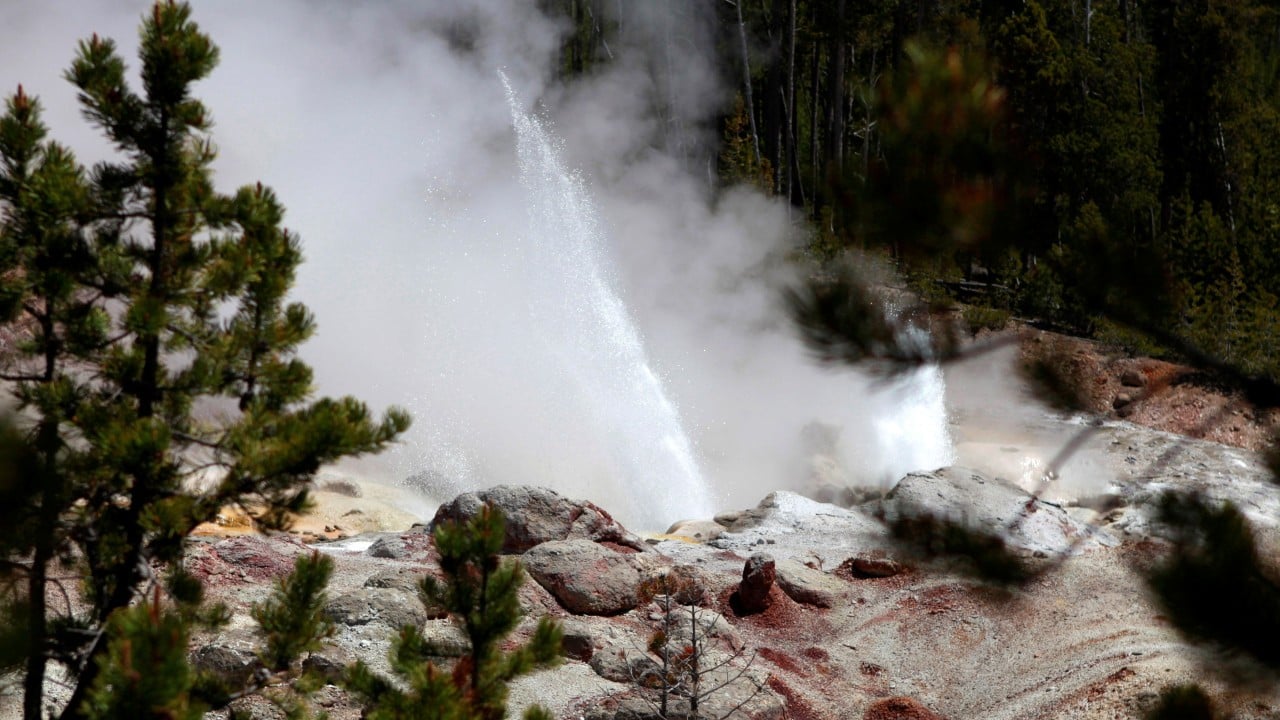
The headlines are singing a familiar, digital tune. "Chinese Supercomputers Crack Yellowstone Mystery." It sounds like progress. It looks like a victory for big data. It is actually a symptom of a scientific community that has traded physical intuition for silicon-based comfort. We are obsessed with high-resolution models of the Earth’s plumbing, but we are ignoring the fundamental reality that a higher-resolution map of a guess is still just a guess.
The recent hype surrounding the use of Sunway-class supercomputers to map the magma chambers beneath Yellowstone National Park misses the forest for the pixels. The industry consensus is that more FLOPS (floating-point operations per second) equals more safety. If we can just simulate the seismic wave propagation with enough granularity, we think we can predict the behavior of a supervolcano. This is a fallacy. We aren't "cracking the mystery." We are just building a more expensive hall of mirrors. If you liked this post, you should look at: this related article.
The Resolution Trap
Traditional seismic imaging is like trying to reconstruct the shape of a grand piano by throwing a thousand rubber balls at it and listening to the echoes. The "lazy consensus" says that if you throw a million balls instead of a thousand, you’ll see the keys. In reality, you just get a louder noise.
Researchers are currently using Full Waveform Inversion (FWI) to model the crustal structure. It’s an incredibly demanding computational process. It requires petabytes of data and weeks of runtime on the world's fastest machines. The goal? To find the exact location of the "mush" zones—those pockets of partially molten rock that feed the system. For another angle on this event, see the latest update from The Next Web.
But here is the nuance the tech-evangelists ignore: Model uniqueness is a myth. In geophysics, we deal with the "inverse problem." You have the result (the seismic data), and you are trying to guess the cause (the underground structure). The math dictates that multiple different underground configurations can produce the exact same seismic signature. You can throw all the Chinese or American supercomputing power in the world at the data, but if your starting assumptions are off by 5%, the supercomputer will simply refine that error into a high-definition lie.
Stop Asking if it Will Erupt
If you look at "People Also Ask" sections or general news commentary, the question is always: "When will Yellowstone erupt?"
The supercomputing papers lean into this fear because it secures funding. They claim that by understanding the "plumbing," we get closer to a warning system. This is a fundamental misunderstanding of volcanic physics.
Yellowstone’s plumbing is not a series of pipes. It is a trans-crustal magmatic system—a complex, crystalline sponge.
The "mystery" isn't where the magma is; we’ve known roughly where it is for decades. The mystery is the trigger mechanism. Knowing the volume of a fuel tank doesn't tell you when someone is going to strike a match. By focusing on the "plumbing" via supercomputers, we are neglecting the chemical and thermodynamic triggers that actually initiate a move toward eruption. We are measuring the size of the bomb while ignoring the state of the fuse.
The Cost of Digital Hubris
I have seen research teams burn through millions in grant money and thousands of "core hours" to produce a 3D model that confirms what we already knew: there is a lot of hot rock under Wyoming.
We are currently in a "Compute Arms Race" between the US and China. The use of the Sunway TaihuLight or its successors to model Yellowstone isn't just about geology; it's about showing off architectural muscle. When the paper highlights that "the simulation ran 50% faster than previous models," that is a metric of computer science, not volcanology. It doesn't make the people living in the Mountain West any safer.
The obsession with these models creates a false sense of security. It suggests that the "beast" is being watched by an all-seeing digital eye. In reality, seismic sensors are sparse, the data is noisy, and the earth is heterogeneous in ways that even an exascale machine cannot represent.
The Thermodynamics of the Real World
If we want to actually understand Yellowstone, we need to stop looking at static maps of magma and start looking at the flux.
- Heat Flow vs. Image Resolution: A high-resolution image of a magma chamber is a snapshot in time. What matters is the rate of heat transfer from the mantle plume into the crust.
- Volatile Content: The "explosivity" of a volcano is determined by gas—mostly water vapor and $CO_2$. You cannot see gas saturation on a seismic map created by a supercomputer.
- Rheology: How the rock deforms under pressure is more important than the shape of the chamber.
Imagine a scenario where a supercomputer predicts a 15% increase in partial melt in the lower crust. Does that mean an eruption is imminent? No. It could stay in that state for 50,000 years. Conversely, a tiny injection of basaltic magma—too small for current "super-simulations" to catch—could destabilize the system in weeks.
The Data We Actually Need
The push for bigger simulations is sucking the air out of the room for cheaper, more effective science. We don't need more "refined" seismic images. We need:
- In-situ gas monitoring: Real-time analysis of helium-4 isotopes and carbon-to-sulfur ratios. These are the "breath" of the volcano.
- Deformation studies: Using InSAR (Interferometric Synthetic Aperture Radar) to track millimeter-level changes in ground height.
- Muon Tomography: A technique that uses cosmic rays to "X-ray" volcanoes. It's computationally lighter and provides a much more direct look at density than seismic waves ever will.
The current trend is to treat the Earth like a software problem. If the code is slow, buy more RAM. If the model is blurry, buy more GPUs. But the Earth is not code. It is a messy, nonlinear, chemical engine.
The Uncomfortable Truth
The reason we love the supercomputer narrative is because it suggests control. It suggests that if we can build a digital twin of Yellowstone, we can master it.
The uncomfortable truth is that Yellowstone is a system of such scale and complexity that our best models are still cartoons. We are using the world's most advanced hardware to color in the lines of a drawing we started in the 1970s.
We are so busy marveling at the processing power required to simulate a seismic wave that we’ve forgotten to ask if the simulation actually correlates with reality. In many cases, it doesn't. We "tune" the models until they match the data. That isn't discovery; that’s curve-fitting on a billion-dollar scale.
The next time you see a headline about a supercomputer "solving" a natural disaster, remember that the hardware is often the story, not the science. We are mapping the plumbing while the basement is already starting to shake, and no amount of teraflops will change the fact that we are still looking at the wrong map.
Get out of the server room and back into the field. The answers aren't in the bits; they're in the basalt.