You've probably noticed that every time a hot new retail startup promises to be the next Amazon killer, it vanishes or shrinks into a niche within a few years. Think about it. We have intense rivalries in almost every other tech sector. Apple fights Google. Microsoft battles Sony. Meta competes with TikTok.
Yet when it comes to a Western company that can match Amazon's scale, selection, and delivery speed across everything from toilet paper to enterprise cloud computing, the field is empty. Walmart online is growing, but it's still fundamentally a grocery chain with a website. eBay is an digital flea market. Shopify isn't a marketplace at all; it's a software provider powering individual storefronts.
Why hasn't a true Western equivalent emerged to challenge Amazon head-on?
The answer isn't that Western entrepreneurs lack ambition or funding. It's that Amazon spent two decades executing a brutal, low-margin strategy that built a physical and technological infrastructure moat so massive that copying it today is a financial suicide mission. They didn't just build a website. They rewrote the rules of physical logistics.
The Astronomical Cost of Building a Physical Moat
Most software startups scale because code is cheap to duplicate. You write an app, and a million people can download it overnight without you needing to build a million physical products.
Amazon does the exact opposite. It anchors its digital dominance in heavy, expensive, concrete reality.
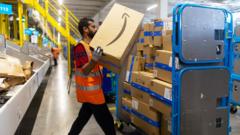
To understand why a competitor doesn't just pop up, look at the sheer scale of Amazon’s fulfillment network. According to data from supply chain consultants, Amazon operates over 1,000 active facilities in the United States alone. We're talking fulfillment centers, sorting centers, and delivery stations.
If a rival wanted to match Amazon’s two-day or same-day shipping guarantees nationally, they couldn't just buy Facebook ads. They would need to spend tens of billions of dollars upfront building out a identical footprint. They would need to lease millions of square feet of real estate near major metropolitan areas, buy fleets of delivery vans, hire hundreds of thousands of workers, and write incredibly complex routing software.
Shopify tried to build its own fulfillment network a few years ago to help its merchants compete with Amazon's logistics machine. It quickly realized the capital expenditure was a terrifying cash drain and sold off the logistics arm to Flexport in 2023. If a massive company like Shopify couldn't make the math work, a regular startup stands zero chance.
Surviving on Pennies for Two Decades
The second reason Amazon stands alone is its historical tolerance for zero profit. Jeff Bezos famously said, "Your margin is my opportunity." For the first twenty years of its existence, Amazon basically ran at a breakeven point. It took every single dollar it made from selling books, electronics, and clothing, and immediately funneled it back into building more warehouses and expanding its infrastructure.
Wall Street gave Amazon a free pass to do this because Bezos was a master at selling the long-term vision. Today's venture capitalists and public markets are way too impatient for that. If a startup tried to burn billions of dollars for twenty consecutive years without showing a net profit, investors would mutiny.
A new Western rival would have to charge higher prices or delivery fees to survive. But consumers are hooked on the cheap convenience of Prime. You can't convince someone to use a newer, slower, more expensive service just because they want to support an underdog. Amazon created a trap where competing requires you to lose money indefinitely, and nobody else has the stomach or the funding for that.
The Invisible Engine Funding the Empire
Here is the biggest open secret in business. Amazon isn't actually a retail company anymore. It's a tech company that uses retail as a front to acquire customers.
The real reason Amazon can afford to run its e-commerce store on razor-thin margins is that it's being heavily subsidized by two incredibly profitable side businesses: Amazon Web Services (AWS) and its digital advertising network.
Look at the financial breakdowns from recent quarters. AWS regularly commands around 31% of the global cloud infrastructure market, competing directly with Microsoft Azure and Google Cloud. The profit margins on cloud computing are astronomical compared to shipping physical boxes.
- Retail margins: Kinda terrible. Think 1% to 3% on a good day.
- Cloud infrastructure margins: Absolutely glorious. Often north of 30%.
On top of that, Amazon's ad business has quieted turned into a juggernaut. When you search for a product on Amazon, the first four results are almost always sponsored ads. Brands pay through the nose to sit there.
Because AWS and the advertising arm generate billions in pure profit every quarter, Amazon can absorb rising fuel costs, supply chain disruptions, and expensive employee benefits in its retail division without blinking. A pure-play e-commerce competitor wouldn't have a giant cloud business or a massive ad network backing them up. They would have to make money on the actual retail transactions, which is almost impossible when you're fighting Amazon’s prices.
The Prime Lock-in Effect
Let's talk about consumer behavior. Amazon didn't just build a great store; they built a habit.
The Amazon Prime subscription model is a masterclass in psychological lock-in. Once you pay your annual fee for Prime, your brain undergoes a subtle shift. You start viewing shipping as "free." If you need a $10 phone charger, you don't look around at different websites or compare prices. You just go to Amazon because you feel like you need to get your money's worth out of your Prime subscription.
This creates a massive barrier for any new platform. To win you over, a rival can't just be as good as Amazon. They have to be so mind-blowingly better that they convince you to abandon the Prime subscription you already paid for.
Even legacy retailers with massive physical footprints have struggled to break this cycle. Walmart has made serious progress with Walmart+, using its massive grocery network to offer fast delivery. But even with a store within ten miles of 90% of the US population, Walmart's online marketplace market share hovers around 6.4%, while Amazon commands over 35%. It's a huge gap that isn't closing anytime soon.
Why the Rest of the World Looks Different
You might look at markets outside the West and point out that Amazon does have rivals there. In China, Alibaba and JD.com dominate. In Latin America, MercadoLibre rules the roost. In Southeast Asia, it's Shopee.
Why did those companies succeed where Western companies failed?
Timing and geography. Those regional giants grew up at the exact same time Amazon was expanding, but they operated in regions where Amazon hadn't yet built its infrastructure. They tailored their businesses to local payment methods, unique motorcycle-based delivery networks, and distinct cultural shopping habits.
By the time Amazon tried to enter those markets seriously, the local players already possessed the home-field advantage and the physical networks. In the West, however, Amazon got a massive head start. They locked down the US, the UK, Germany, and other major European markets before anyone else realized online shopping was going to be more than a passing fad.
How to Exist in a World Ruled by Amazon
If you're a business owner or an entrepreneur looking at this landscape, the reality seems grim. You're never going to build a general marketplace that beats Amazon at its own game. Don't even try.
But that doesn't mean you can't build a highly successful e-commerce brand. You just have to change the rules of engagement.
First, focus on community and vertical specialization. Amazon is a cold, transactional search engine. People go there when they know exactly what they want. They don't go there to browse, feel inspired, or join a community. Platforms that focus deeply on a specific niche—like Etsy for handmade goods or Chewy for pet owners—survive because they offer a curated experience that a giant digital warehouse can't replicate.
Second, own your customer data. When you sell through Amazon, those customers belong to Amazon, not you. You don't get their emails, you can't easily retarget them, and Amazon can launch a private-label version of your product tomorrow if it sees your sales spiking. Building your own independent site using tools like Shopify allows you to tell a brand story and build true loyalty.
Stop trying to build a wider selection or faster shipping than the monster in Seattle. Focus on making products that people love so much they're willing to wait three days for them to arrive in a custom-designed box. That's the only way to build a retail business that Amazon can't touch.