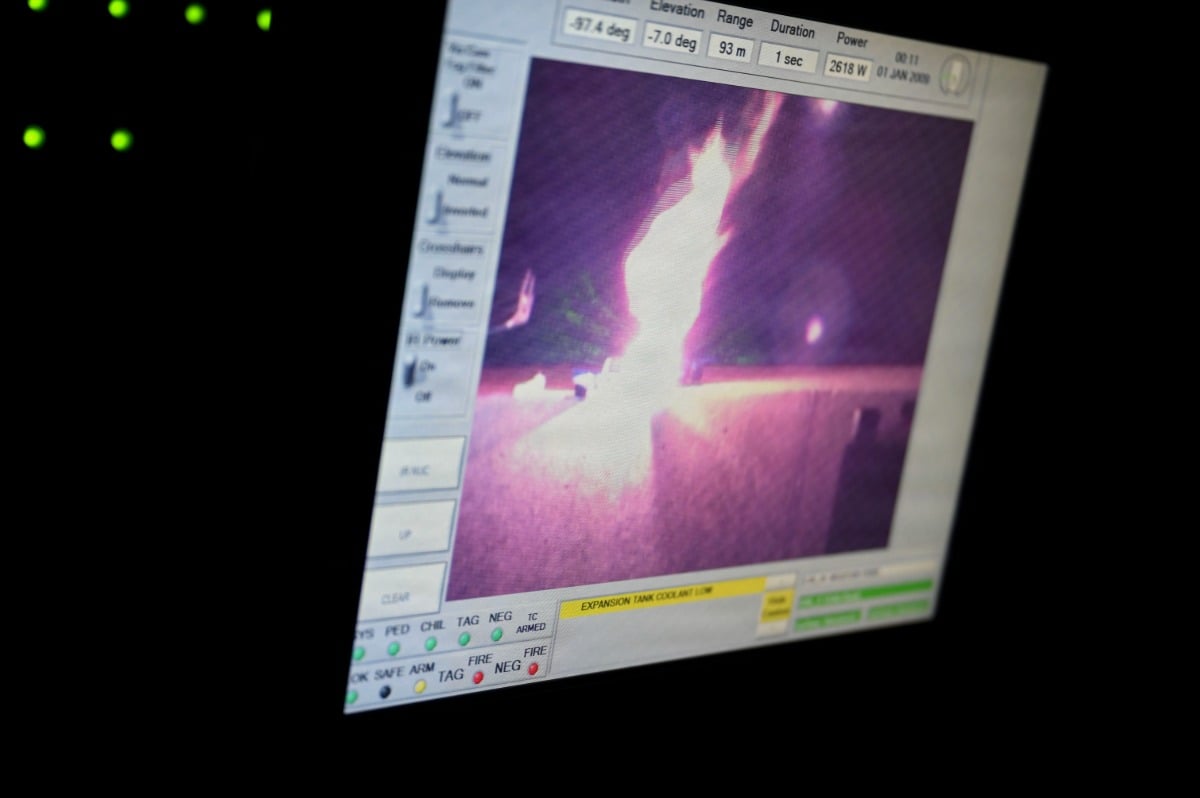
The Pentagon just dropped $95 million to study exactly how lasers destroy targets. If that sounds like progress, you have bought into the longest-running public relations campaign in defense procurement history.
Spending nearly a hundred million dollars in 2026 to analyze the lethality of directed energy is not a breakthrough. It is an admission of stagnation. We have been firing high-energy lasers at static aluminum sheets, carbon composites, and drone hulls since the days of the Strategic Defense Initiative in the 1980s. We know exactly how photons transfer thermal energy to a surface. The physics of thermal ablation are settled. Meanwhile, you can explore similar developments here: Sundar Pichai and the Monastic Batchmate Who Chose Peace Over Silicon Valley.
The defense establishment loves funding studies on target vulnerability because it conveniently diverts attention from the real, unsexy crisis. The problem isn't what the laser does when it hits the target. The problem is everything that happens between the mirror and the threat.
By framing the challenge as a need for more precise lethality data, the defense industrial complex secures another round of multi-year funding while avoiding the hard truth. Directed energy weapons are fundamentally bottlenecked by atmospheric thermodynamics, not by a lack of lab data. To explore the full picture, check out the excellent analysis by Engadget.
The Myth of the Infinite Magazine
The favorite talking point of directed energy advocates is the concept of a negligible cost-per-shot. They love to contrast a $500,000 interceptor missile with a laser burst that costs the price of a gallon of diesel fuel. It is a compelling narrative for bean-counters. It is also completely detached from operational reality.
An interceptor missile possesses its own guidance system, terminal seeker, and maneuvering fins. Once launched, it hunts the target. A laser possesses none of these things. A laser is a dumb beam of light that requires a massive, complex, and extraordinarily fragile supporting architecture to remain perfectly focused on a single square centimeter of a moving target for seconds at a time.
When you factor in the lifecycle costs of the megawatt-class generators, the liquid cooling systems, the adaptive optics mirrors that distort under their own thermal loads, and the specialized maintenance crews required to keep these systems operational in dusty, humid combat environments, the financial math changes completely.
You are not replacing a $500,000 missile with a $5 shot of electricity. You are replacing a modular, reliable missile canister with a multi-million dollar rolling science laboratory that breaks down if a speck of dust settles on its primary optic.
The Atmosphere Always Wins
Imagine trying to shoot a fire hose through a chaotic series of industrial fans, waterfalls, and heat lamps, while trying to hit a coin a mile away. That is the reality of firing a laser through the lower atmosphere.
The moment a high-energy laser beam leaves the output aperture, it begins to alter the air through which it travels. The intense localized energy heats the air molecules, creating a pocket of low-density air. This pocket acts as a negative lens, defocusing the beam and scattering the photons. This phenomenon is known as thermal blooming.
The harder you push the laser, the faster the atmosphere fights back.
[High-Power Laser Source] ---> [Heated Air / Thermal Blooming] ---> [Scattered, Defocused Energy] ---> [Ineffective Target Hit]
Then comes the issue of atmospheric jitter. Turbulences, humidity, smoke, dust, and marine salt spray all absorb and scatter specific wavelengths of light. A system that achieves clean target penetration in the dry, pristine air of the White Sands Missile Range will suffer massive power degradation in the humid, salt-heavy air of the South China Sea.
No amount of lethality modeling will change the refractive index of water vapor. Spending $95 million to better understand how a laser burns through steel does absolutely nothing to solve the reality that, on a foggy morning, the beam cannot even reach the steel.
The Dwell Time Dilemma
A missile destroys a target instantly through kinetic impact and explosive fragmentation. It transfers a massive amount of energy in a microsecond. A laser is an endurance weapon. It requires dwell time.
To defeat an incoming cruise missile or an artillery shell, a laser must hold its beam on the exact same spot for anywhere from two to ten seconds. During those seconds, the target is not sitting still. It is traveling at hundreds of meters per second. It may be spinning, rolling, or executing evasive maneuvers.
If the target is spinning, the laser's energy is distributed across the entire circumference of the hull rather than being concentrated on a single point. This turns a lethal thermal strike into a mild paint-scorching exercise.
Furthermore, modern adversaries are not stupid. They do not field bare aluminum drones. They apply reflective coatings, ablative heat shields, and carbon-carbon composites specifically engineered to dissipate thermal energy. If a drone can survive the thermal stress of atmospheric re-entry or high-speed flight, it can survive a low-wattage laser long enough to complete its mission.
The Real Numbers Behind the Propaganda
Let us look at the raw engineering requirements that the defense industry prefers to keep out of the headlines. To achieve a kill on a hardened target at tactical ranges, you generally need a beam with a power output of at least 100 to 300 kilowatts.
Solid-state fiber lasers operate at roughly 30% to 40% efficiency. This means that to generate a 300-kilowatt beam, the weapon system must draw nearly a megawatt of raw electrical power. The remaining 600 to 700 kilowatts do not disappear. They turn into waste heat inside the weapon vehicle.
Managing that level of instantaneous thermal load requires massive cooling rigs, heavy radiators, and large volumes of coolant. The result is a weapon system so heavy and bulky that it cannot be easily deployed on standard infantry vehicles or small naval vessels. You are left with a massive target that cannot move quickly, requires an immense logistical footprint, and becomes completely useless the moment a rainstorm moves in.
Where the Money Should Actually Go
If the goal is to counter cheap drone swarms and precision munitions, throwing money at laser lethality modeling is an exercise in futility. We are optimizing the wrong part of the kill chain.
Instead of trying to force lasers to do things that physics explicitly forbids, defense acquisition should pivot toward kinetic and electromagnetic options that handle atmospheric degradation without flinching.
- Hypervelocity Projectiles: Utilizing advanced propellant guns to fire low-cost, unguided guided projectiles at Mach 5+. They offer the same low cost-per-shot advantages as lasers but ignore weather, smoke, and reflective coatings.
- High-Power Microwaves (HPM): Unlike lasers, which must burn through a target's skin millimeter by millimeter, HPM systems emit a wide cone of energy that fries the internal electronics of an entire swarm simultaneously. They do not require precise dwell time, they do not care if the target is spinning, and they penetrate clouds far more effectively.
- Automated Kinetic Interceptors: Cheap, short-range counter-drone mini-missiles and smart ammunition that rely on mass production economics rather than exotic physics.
I have watched defense programs burn through billions over three decades promising that operational laser shields were just five years away. The timeline never changes because the core obstacles are dictated by the laws of physics, not the limits of our current engineering.
This latest $95 million contract is simply a bureaucratic placeholder. It keeps the engineering teams employed and the press releases flowing, while avoiding the uncomfortable realization that the laser revolution has been fundamentally grounded by the atmosphere.