The kitchen smelled like charred garlic and desperation.
It was a Tuesday in November, the kind of heavy, gray evening where the sun drops out of the sky at four in the afternoon and leaves behind an empty ache in your ribs. My hands were stained purple from a vegetable I secretly resented. Eggplant. For years, my relationship with it had been an exercise in quiet humiliation. You buy it because it looks like velvet royalty sitting on a wooden crate at the market. You slice it. You salt it, wait, rinse it, curse at it, and sweat over a hot pan, only to pull out something that tastes like a wet sponge soaked in motor oil. For a closer look into similar topics, we suggest: this related article.
Squishy. Bitter. Defeated.
I stood there staring at two glossy purple globes on the cutting board, listening to the radiator hiss its rhythmic threat. Across from me sat three bell peppers, hollowed out and waiting. They looked like empty little boats, begging for cargo. For broader details on this development, detailed coverage can also be found on CDC.
Food writers love to talk about culinary confidence as if it is something you are born with, like blue eyes or double-jointed thumbs. They write recipes that read like military contracts. Prep time: fifteen minutes. Sauté until tender. They never tell you about the times you ruined dinner so badly your partner ordered emergency pizza while avoiding eye contact. They never mention the humiliation of serving a meal that looks like a scientific accident.
Let us be honest about what eggplant actually is. It is a sponge with an attitude.
(Note: When I talk about its cellular structure, I am speaking as someone who spent three stubborn hours reading food science papers just to figure out why my dinner always turned to mush.)
An eggplant is roughly ninety-two percent water, held together by a porous matrix of air pockets and pectin. When you slap it into a hot pan with cold oil, it acts like a dry towel thrown into a swimming pool. It drinks every drop of fat in thirty seconds, leaves the pan bone dry, and then—refusing to brown—collapses into a hot, soggy disappointment.
That Tuesday, I decided to change the rules. Not because I am a chef, but because I was tired of wasting groceries.
The breakthrough did not come from a glossy cookbook. It came from abandoning the fry pan entirely.
If you want eggplant to love you back, you have to stop fighting its biology and surrender to it. You have to roast it whole, let its internal moisture turn to steam, and let it collapse on its own terms before it ever meets a spice.
The Anatomy of a Better Stuffed Pepper
Most stuffed pepper recipes treat the filling as an afterthought. Ground beef tossed with rice and a shake of generic Italian seasoning. The result is a monument to mediocrity. It is dinner made on autopilot.
To make stuffed peppers with eggplant actually worth the effort, you have to treat the vegetable filling not as a garnish, but as a velvet paste that binds the dish together.
Consider what happens when you roast an eggplant whole in a high-heat oven—say, four hundred degrees Fahrenheit. The skin chars and blisters, smelling faintly of woodsmoke. Inside, the flesh steams in its own juices, breaking down into a silky, custard-like puree. That is where the magic lives.
Here is how you build the filling, step by step, without a single corporate food-blog cliché:
- Roast two medium globe eggplants whole, pierced with a fork, until they completely deflate and feel like water balloons. This takes about forty-five minutes.
- Slice the tops off three large bell peppers—red or yellow work best because their natural sugars balance the earthy bitterness of the eggplant—and scoop out the seeds.
- Slice open the roasted eggplants once they are cool enough to handle, scrape out the steaming flesh, and discard the charred skins.
- Mince a yellow onion and four cloves of garlic. Sauté them in a heavy skillet with olive oil until they turn the color of old gold.
- Fold the eggplant pulp directly into the onions and garlic, adding toasted pine nuts, a handful of fresh oregano, and crumbled feta cheese that melts into creamy pockets against the heat.
Stuff that mixture tightly into the waiting pepper shells. Pack it down. Do not be gentle. These peppers need to hold their shape while the oven works its alchemy.
Why the Combination Works
There is a brilliant culinary collision happening inside a stuffed pepper when you introduce eggplant to the mix. Bell peppers provide structural integrity and a crisp, bright sweetness. Eggplant provides deep, savory umami richness—almost like meat, but without the heaviness.
Nutritionists often praise this pairing for its fiber density and low glycemic impact, but on a Tuesday night, you do not care about glycemic impact. You care about whether your kids will push it around their plates or actually eat it.
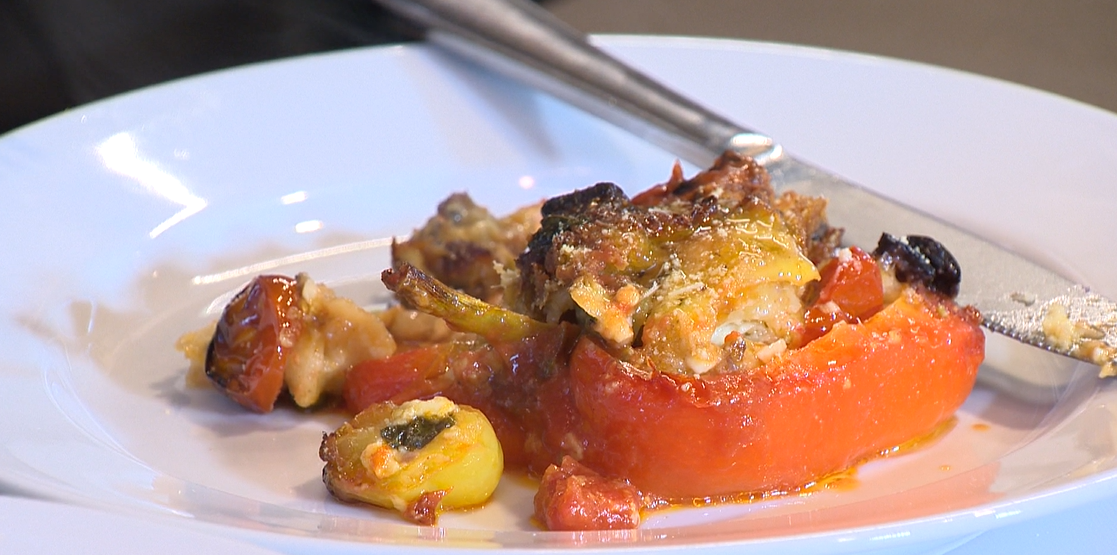
When you bake these stuffed peppers at three hundred and fifty degrees for thirty minutes, something remarkable occurs. The pepper softens just enough to yield to a fork, but stays firm enough to hold its vibrant color. The filling inside thickens, the feta turns golden and bubbly on top, and the juices from the pepper mingle with the rich eggplant paste at the bottom of the baking dish.
It smells like a Greek taverna tucked away on a side street where nobody speaks English and the wine comes out of an unmarked jug.
The Transformation
That night, we sat at the kitchen table. The house was finally warm.
I cut into my pepper. The knife slid through the charred skin of the bell pepper with a soft crunch, sinking effortlessly into the creamy, garlic-scented eggplant core. There was no grease pooling on the plate. No mush. Just clean, vibrant layers of flavor that tasted like patience rewarded.
My partner took a bite, closed her eyes, and chewed slowly.
"You didn't ruin it," she said, genuinely surprised.
"I didn't just not ruin it," I smiled, sliding a second pepper onto her plate. "I figured it out."
Cooking is rarely about following instructions perfectly. It is about understanding the stubborn nature of the ingredients in your hands and finding a way to dance with them instead of wrestling them to the floor. Eggplant is difficult because it demands your attention. It asks you to slow down, to roast instead of rush, to trust the process even when the kitchen smells like smoke and your hands are stained purple.
The next time you look at a lonely eggplant sitting next to a row of bell peppers at the market, do not walk past. Do not groan at the memory of past kitchen failures.
Buy them both. Turn on the oven. Let the house fill with smoke and garlic, and watch how a Tuesday night changes when you finally stop fighting the food.