The coffee is still warm in the cup, sitting on a wooden table that has survived three decades of family history, when the air changes. It is not a sound at first. It is a pressure. A sudden, heavy drop in barometric tension that raises the hairs on the back of your arms before the ear can even register what is coming.
Then, the siren begins.
It does not start politely. It is a mechanical scream that drags you out of the quiet intimacy of your home and hurls you back into the harsh, unyielding geometry of war. In Kyiv, everyone knows the cadence. You have seconds. Not minutes. Seconds to calculate whether the incoming streak of fire is aimed at the power grid, an apartment block, or the patch of pavement where your children were playing hopscotch just hours before.
According to the city’s mayor, Vitali Klitschko, the alerts are flashing red across every device. Ballistic missiles are inbound. The sky, which looked so serene and indifferent under a pale European moon, has turned into a highway of death.
To understand what happens next, you have to strip away the sterile vocabulary of military reports. News anchors on international networks use terms like "interception rates" and "ballistic trajectories" as if they are discussing weather patterns. But mathematics offers no comfort when you are standing in a hallway without windows, clutching a go-bag packed with passports, iodine pills, and a faded photograph of your grandfather.
A ballistic missile does not care about your history. Launched from deep within hostile territory, it punches upward into the stratosphere, curves over the dark contour of the earth, and then falls back down with the fury of a falling star. Traveling at supersonic or hypersonic speeds, it breaks the sound barrier after it impacts, meaning you hear the explosion before you ever hear the warning whistle of its descent. It is a reverse symphony of terror. First the flash. Then the concussion wave that rattles your teeth. Then the delayed, tearing roar of the sky ripping apart.
Down in the metro stations, deep beneath the limestone crust of the city, a different kind of life unfolds. This is the subterranean metropolis that Kyiv has built within itself. Concrete platforms transformed into makeshift bedrooms. Children doing geometry homework by the harsh glare of fluorescent bulbs while stray cats weave between folded cots.
Imagine living your life suspended between two entirely different dimensions. Upstairs is the city of history, of chestnut trees, of open-air cafes where people still argue passionately about literature and politics over espresso. Downstairs is the catacomb of survival, where every rumble from above is measured collectively. You look at your neighbor's eyes. You check for the micro-shudder in their hands. When someone smiles, it feels like an act of quiet rebellion.
Klitschko’s voice crackles over the radio waves, urgent, stripped of political polish. He commands people to stay in shelters. He does not need to threaten them with the consequences of disobedience; the cratered asphalt of streets hit in previous raids is reminder enough. Every resident of this capital carries a mental map of where the nearest basement, metro entrance, or load-bearing corridor is located. It becomes second nature. You walk down a street and your eyes instinctively scan for cellar doors, arches, and thick masonry.
Yet, habit does not breed immunity to fear. It only refines it.
Consider Olena, a forty-two-year-old high school physics teacher who has lived on the left bank of the Dnipro River her entire life. Before the invasion, her biggest worry was whether her students would pass their university entrance exams. Now, her world is dictated by the whine of air defense batteries and the jagged trajectory of shrapnel.
"The hardest part isn't the noise," Olena says, her voice steady in the dim light of a hallway corner. "It is the waiting. When the siren sounds, you freeze. You stop mid-sentence. You wonder if this is the time the roof caves in. And then, when the all-clear sounds, you have to restart your brain. You have to go back to teaching, back to cooking, back to pretending that the world still makes sense."
This psychological friction is the true battlefield. The kinetic war is fought with metal and explosives, but the war of attrition is fought in the human nervous system. To wake up every single morning in a city targeted by ballistic missiles requires an extraordinary expenditure of emotional capital. People sleep in their clothes. They keep their shoes by the door. They charge their power banks religiously, treating electricity like liquid gold.
And yet, the city refuses to break.
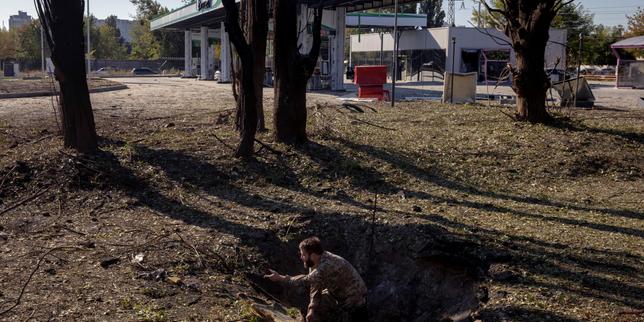
When a missile strike plunges a neighborhood into darkness, repair crews move in before the smoke has even cleared. Welders sparks illuminate the night sky like erratic fireflies. Municipal workers shovel glass off the sidewalks with quiet, methodical efficiency. Street sweepers push debris into neat piles while the smell of cordite still hangs heavy in the morning chill. It is a defiant choreography of normalcy. The message written into every repaired window and patched water pipe is simple: You can try to erase us, but we are already rebuilding.
The ballistic missile threat hanging over Kyiv is not just a tactical detail in a distant geopolitical struggle. It is a daily test of human endurance. It forces millions of ordinary people to make peace with the fragility of existence, converting routine existence into a series of conscious choices to live, to care, to resist, and to hope.
The night wears on. The explosions grow more distant as air defense systems parse the upper atmosphere with streaks of white fire, finding their targets, neutralizing the metal rain before it reaches the ground.
Dawn begins to bleed over the Dnipro River, painting the cathedral domes in shades of bruised gold and amber. The sirens finally fall silent. The doors of the metro stations creak open, and people stream back up into the morning light, squinting against the sun, breathing in the cold air, ready to start all over again.


