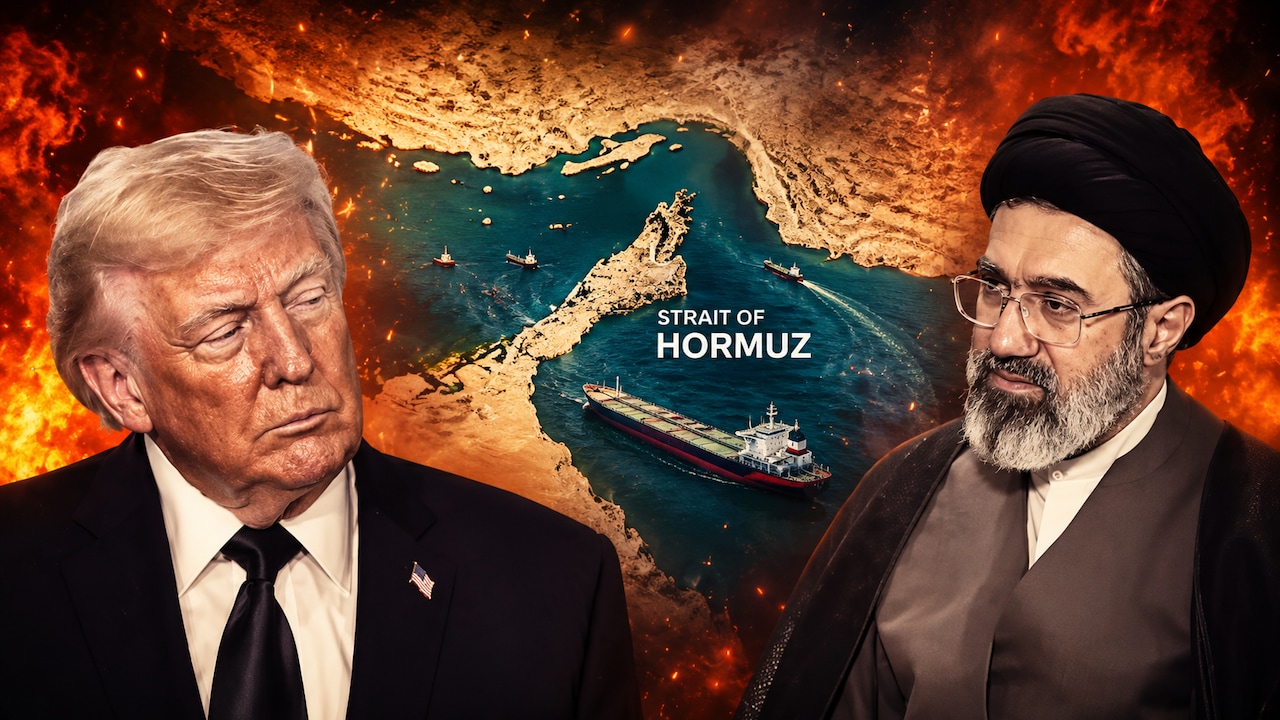
A fragile peace pact between Washington and Tehran lasted exactly nine days before the missiles started flying again. When President Donald Trump and Iranian President Masoud Pezeshkian signed a Pakistan-brokered Memorandum of Understanding (MoU) on June 17, 2026, it was supposed to end the brutal war that erupted back in February. Instead, the agreement has triggered a fresh round of explosive naval battles.
The main culprit is a single, deceptively simple clause hidden inside the pact: Article 5.
If you want to know why a Singapore-flagged container ship was hit by a drone, why US Central Command (CENTCOM) just bombed five coastal radar and missile sites inside Iran, and why the Islamic Revolutionary Guard Corps (IRGC) retaliated by targeting US military bases in Kuwait and Bahrain, you have to read the fine print of Article 5. It turns out both nations signed the exact same piece of paper while agreeing to two completely incompatible realities.
The Text That Sparked a Naval War
To understand why this clause is causing so much chaos, you have to look at what it actually dictates. Article 5 was written to solve a massive global emergency. When the war started on February 28, Iran imposed a total blockade on the Strait of Hormuz. Because roughly 20% of global oil and 20% of liquefied natural gas (LNG) pass through this tiny chokepoint, energy markets went into an absolute tailspin. Hundreds of commercial ships were left stranded.
The Pakistan-brokered MoU tried to patch things up quickly. The official text of Article 5 states:
"Upon the signing of this MOU, the Islamic Republic of Iran will make arrangements using its best efforts for the safe passage of commercial vessels with no charge, for 60 days only, from the Persian Gulf to the Sea of Oman and vice versa. The traffic of commercial vessels will immediately start, and considering the need for removing the technical and military obstacles, and demining by the Islamic Republic of Iran will be instated within 30 days."
The text also explicitly dictates that Iran must conduct a dialogue with Oman and other Gulf states to figure out the future long-term administration of the waterway. On paper, it sounds like a reasonable compromise. Iran clears the mines it dropped, ships start moving again, and everyone stops shooting.
In reality, the language is a diplomatic disaster.
One Text Two Completely Different Realities
The current crisis boils down to a fundamental disagreement over who actually runs the channel during this transition period.
Iranian Foreign Minister Abbas Araghchi made Tehran's stance clear during a sudden trip to Baghdad. He stated that Article 5 gives Iran absolute, exclusive authority over the maritime highway. According to Tehran, because the text says Iran will "make arrangements" and handle the demining, the entire strait remains under the total oversight and management of the IRGC for the next 30 days.
Washington views things completely differently. The US government argues that Iran is merely a service provider tasked with clearing out its own obstacles, not a landlord that gets to dictate traffic rules.
Because the US military doesn't trust the IRGC to protect international shipping, Washington worked behind the scenes with Oman and the International Maritime Organization (IMO) to create an alternative transit route. This new lane shifts commercial vessels south, routing them safely inside Omani territorial waters and away from Iranian coastal missile batteries.
Tehran viewed this alternative route as a direct violation of the MoU. The IRGC immediately issued a public warning to international shipping companies, declaring that the southern Omani lane was "illegal, unacceptable, and highly dangerous." They insist that the only authorized route is the northern shipping corridor, which runs straight through Iranian territorial waters.
When Diplomacy Turns Into Real World Violence
This semantic debate didn't stay in a conference room. It translated into immediate, dangerous friction on the water.
The flashpoint happened when the IRGC Navy intercepted four commercial tankers traveling through the southern Omani lane and forced them to turn back. Shortly after, the maritime highway turned into a shooting gallery. A Singapore-flagged vessel called the Ever Lovely was struck by an explosive drone. The very next day, a Panama-flagged tanker named the Kiku was hit by a projectile.
While Iran denied launching the drones, Washington wasn't buying it. The Trump administration ordered immediate retaliatory airstrikes. US warplanes hammered Iranian drone storage facilities, coastal radar installations, and missile positions along the southern coast.
The political rhetoric escalated instantly. Donald Trump took to Truth Social, warning that Iran had violated the ceasefire agreement and adding a characteristically blunt threat: "There may come a point when we are no longer able to be reasonable, and will be forced to militarily complete the job... the Islamic Republic of Iran will no longer exist." Vice President JD Vance echoed the sentiment, stating simply that "violence will be met with violence."
Iran fired right back. The IRGC launched ballistic missiles and drone swarms at Ali Al Salem Air Base in Kuwait and the US Fifth Fleet headquarters in Bahrain, claiming they were exercising their sovereign right to protect their management of the strait.
The Core Mistake You Cannot Afford to Make
If you operate a commercial shipping firm, trade energy commodities, or just want to understand your rising gas prices, you need to understand the true takeaway here. The big mistake most analysts are making right now is assuming this escalation means the peace deal is completely dead. It isn't.
What we're looking at is a classic game of high-stakes leverage. Iran knows that its ability to choke off a fifth of the world's energy supply is its only real bargaining chip against US economic power. They aren't trying to destroy the MoU; they are using military friction to force the US to accept their interpretation of Article 5 before the final 60-day comprehensive deal is locked in.
The US is playing the exact same game. By bombing coastal radars, CENTCOM is showing Tehran that asserting total control over the shipping lanes carries a price tag that the crippled Iranian economy can't afford.
Remarkably, the back-channel diplomacy is still moving despite the explosions. US officials confirmed that both sides have quietly agreed to a temporary stand-down and are moving their technical teams from Switzerland to Qatar for emergency face-to-face talks. These meetings will bypass the broader nuclear discussions to focus exclusively on creating a working military-to-military hotline to prevent accidental clashes during the 30-day demining phase.
If you are tracking these developments for supply chain planning or energy investments, stop looking at the fiery political statements from Washington and Tehran. Watch the specific technical negotiations in Qatar instead. The immediate safety of global shipping depends entirely on whether these teams can build a joint coordination mechanism for the strait, rendering the vague text of Article 5 irrelevant before another tanker gets hit.