Missiles get all the glory. They are loud, fast, and highly photogenic when leaving a vertical launching cell. But in modern naval combat, relying entirely on kinetic interceptors to shoot down incoming threats is a losing strategy. The math doesn't work. When a swarm of anti-ship cruise missiles or low-cost attack drones targets a strike group, a warship can run out of multi-million-dollar interceptors long before the enemy runs out of targets.
The real fight is happening silently across the electromagnetic spectrum.
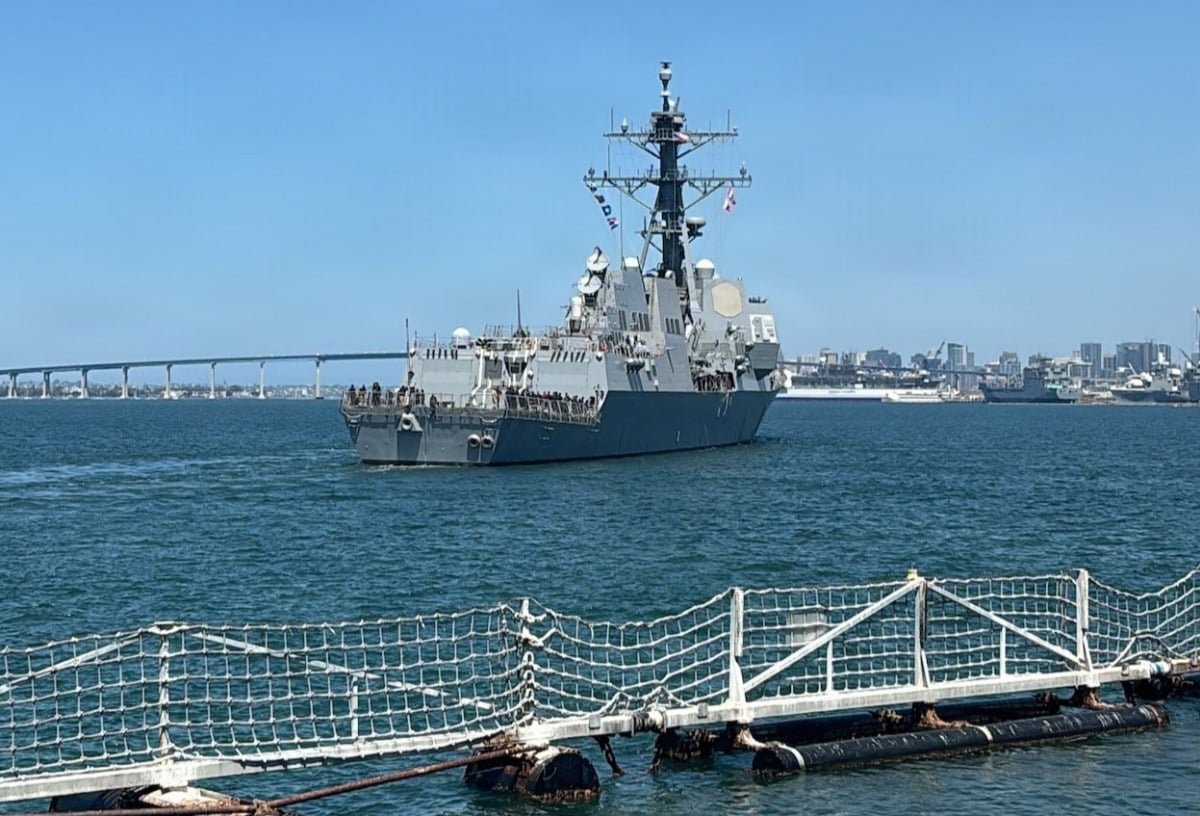
The U.S. Navy just quietly took delivery of two modernized Arleigh Burke-class guided-missile destroyers, USS Chung-Hoon and USS James E. Williams. Both vessels emerged from their Depot Modernization Periods ahead of schedule, sporting massive, blocky structural alterations on their superstructures. Those new sponsons house the AN/SLQ-32(V)7 electronic warfare suite, better known as the Surface Electronic Warfare Improvement Program (SEWIP) Block 3.
This isn't a minor hardware refresh. It marks a fundamental shift in how the surface fleet survives high-end conflict. By moving from passive listening to aggressive, non-kinetic destruction, these upgrades change the financial and tactical equation of naval defense.
The Problem with Traditional Missile Defense
For decades, shipboard electronic warfare was mostly about hiding. The legacy "Slick-32" systems deployed during the Cold War were designed to detect enemy radar emissions and fire off chaff or flares to confuse incoming seekers. They were passive shields. If a ship did jam an enemy signal, it was a blunt, localized effort.
When the threat environment evolved into supersonic sea-skimmers and coordinated drone swarms, the Navy relied heavily on its Aegis Combat System and a multi-layered wall of missiles like the SM-2, SM-6, and the Evolved SeaSparrow Missile.
That approach has two massive flaws.
First, magazine capacity is finite. An Arleigh Burke-class destroyer has 90 or 96 Vertical Launching System cells. Once those cells are empty, the ship is highly vulnerable and must retreat to a specialized port to reload. You cannot pack more missiles into a hull than the physical dimensions allow.
Second, the cost curve is completely upside down. Firing a pair of interceptors costing several million dollars each to neutralize a drone assembled for a few thousand dollars is financially unsustainable. The red sea engagements of the past few years proved that non-state actors can stress naval logistics simply by forcing ships to expend ammunition. SEWIP Block 3 fixes this by providing an unlimited magazine. As long as the ship's gas turbine generators are burning fuel and creating electricity, the weapon can keep firing.
What Makes SEWIP Block 3 Different
Previous iterations of the SEWIP program focused heavily on the defensive, passive side of the spectrum. SEWIP Block 2, or the AN/SLQ-32(V)6, upgraded the ship's eyes and ears. It gave crews an incredibly sensitive tool to identify and track complex signals from miles away, but it lacked the teeth to strike back electronically.
Block 3 changes that by integrating an advanced electronic attack subsystem directly into the existing architecture.
[Legacy SLQ-32] -> Passive detection, basic analog jamming
[SEWIP Block 2]  -> High-sensitivity digital receiver, precise tracking
[SEWIP Block 3]  -> Active Electronically Scanned Arrays (AESA), infinite digital jamming
Instead of the older, directional jamming antennas that could be overwhelmed by multiple threats from different angles, Block 3 utilizes Gallium Nitride based Active Electronically Scanned Arrays. These are essentially the same underlying technology found in modern fighter jet radars and the Navy's new SPY-6 air defense radars.
Because these arrays are software-defined, they don't just blast generic noise across a radio frequency. They can generate multiple, highly focused, high-energy beams simultaneously. Each beam can be customized on the fly to match the exact frequency, waveform, and pulse repetition of an individual incoming threat.
The system acts like an invisible, high-powered laser rifle for the digital spectrum. It tricks an incoming missile's seeker into seeing false targets, blinds its radar entirely, or corrupts its guidance data so badly that the missile tumbles harmlessly into the ocean miles away from the ship. It can jam drone control links, disrupt aircraft communications, and degrade the targeting systems of enemy surface vessels before they can even launch their weapons.
Fixing the Modernization Bottleneck
The delivery of USS Chung-Hoon and USS James E. Williams represents a rare win for naval acquisition timelines. Historically, major mid-life overhauls for complex surface combatants have run over budget and past deadlines. The Ticonderoga-class cruiser modernization effort, for instance, became a cautionary tale of structural cracking, delayed schedules, and ballooning costs.
To prevent a repeat with the destroyers, the Navy established the Portfolio Acquisition Executive Maritime office. This structure consolidated authority to cut through administrative red tape and accelerate structural modifications.
The modernization of these Flight IIA destroyers follows a distinct two-step pipeline under the DDG Modernization 2.0 blueprint.
- Install the SEWIP Block 3 "Hemisphere" configuration, along with massive new cooling plants and electrical infrastructure required to feed the power-hungry jamming arrays.
- Retrofit the older AN/SPY-1D passive radars with Raytheon's newer, far more capable AN/SPY-6(V)4 active arrays.
By breaking the overhaul into distinct phases and leveraging lessons learned from the very first installation on USS Pinckney, regional maintenance centers in San Diego and Norfolk managed to deliver the Chung-Hoon and James E. Williams ahead of schedule.
The scalability of this technology is already expanding beyond destroyers. Northrop Grumman is currently under contract to deliver up to 24 of these systems. This includes a modified "Quadrant" configuration designed to be distributed around the massive hulls of Nimitz and Ford-class nuclear-powered aircraft carriers, with the USS Harry S. Truman slated as an early candidate.
The Operational Reality
While the hardware is impressive, the real challenge lies in spectrum management. A modern strike group is an incredibly noisy environment. Between cooperative engagement capabilities, air search radars, satellite communications, and tactical data links, the airwaves are packed.
If you activate a high-powered jammer without precise coordination, you risk blinding your own sensors or disrupting friendly communications.
To solve this, the SEWIP Block 3 architecture relies on a government-developed software package known as the soft-kill coordinator. This system integrates directly into the ship's Aegis combat system. It automatically calculates how to execute electronic attacks without interfering with friendly frequencies, seamlessly balancing hard-kill options like standard missiles with soft-kill electronic countermeasures.
For ships deploying into contested environments, this capability is no longer optional. The first upgraded destroyer, USS Pinckney, is already operating under this doctrine. The addition of two more operational hulls means the surface fleet is finally building the capacity needed to face sophisticated electronic environments.
The next tactical step for naval planners involves scaling this capability down. Ships like Littoral Combat Ships or smaller amphibious vessels cannot handle the immense weight, space, and power requirements of the full SEWIP Block 3 installation. Because of this restriction, development is already underway on a Scaled Onboard Electronic Attack variant. This smaller version uses the same core Gallium Nitride technology but downshifts the physical footprint, ensuring that even isolated components of a distributed maritime force can defend themselves without relying on a protective umbrella from a nearby destroyer.