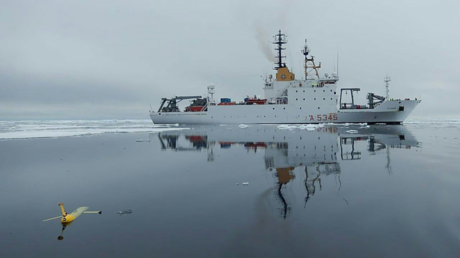
The defense establishment is swooning over NATO’s shiny new toy. Brussels announces a new Arctic drone task force, and the defense tech echo chamber nods in unison. They see a masterpiece of modern deterrence. They see high-altitude endurance assets mapping every fracture in the Greenland ice sheet and tracking Russian submarine signatures in the GIUK gap.
They are looking at a graveyard of expensive carbon fiber.
The consensus view is dangerously naive. It assumes that because autonomous systems won't bleed, they are perfectly suited for the most hostile aviation environment on earth. This is a classic peacetime procurement delusion. I have spent years analyzing Nordic defense logistics and cold-weather surveillance architectures. The reality on the tundra doesn't care about a contractor’s glossy PowerPoint slide.
NATO isn't securing the high north with this initiative. It is building a fleet of incredibly expensive, easily jammed flying ice pops.
The Icing Reality the Pentagon Ignores
Let's look at the basic physics. The Arctic is not just cold; it is an aerodynamic nightmare.
Uncrewed aerial vehicles (UAVs) thrive in predictable environments. They like the dry heat of the Nevada desert or the stable air of the Persian Gulf. The Arctic offers atmospheric icing that can deform a laminar wing profile in minutes.
Commercial airliners handle this with massive engine bleed air systems or heavy pneumatic de-icing boots. Light, long-endurance surveillance drones cannot afford that weight penalty. Every ounce of power diverted to melting ice is an hour stripped away from loiter time.
Imagine a scenario where a $30 million platform hits a layer of supercooled liquid droplets over the Barents Sea. The automated flight control system senses a sudden drop in lift and an increase in drag. It compensates by throttling up, burning through fuel reserves at three times the projected rate. Within twenty minutes, the satellite communication dish is coated in an inch of rime ice, severing the command link. The drone doesn't get shot down. It simply grows too heavy to fly and slips quietly into the ocean.
This isn't a theoretical edge case. The US military has already crashed multimillion-dollar platforms in temperate zones due to unexpected weather anomalies. Believing we can scale these operations across the Arctic Circle without a massive, unbudgeted overhaul of materials science is pure fantasy.
The Electronic Warfare Blindspot
The defense press loves to talk about Russian aggression, but they ignore Murmansk’s real weapon: electronic warfare (EW).
The Kola Peninsula is home to some of the most sophisticated jamming infrastructure on earth. Systems like the Krasukha-4 and the Murmansk-BN don't just scramble local GPS signals; they can disrupt high-frequency communications across thousands of kilometers.
An uncrewed task force relies entirely on a continuous data tether. Whether it’s low-earth orbit satellite constellations or line-of-sight data links, that signal is vulnerable. When the Kremlin decides to light up its EW arrays, these drones will be blinded and cut off.
A human pilot in a P-8 Poseidon can look out the window. A human pilot can fly a manual magnetic heading when GPS drops offline. A human pilot possesses spatial awareness and tactical intuition. A drone executing a lost-link protocol will merely turn around and fly a predictable, automated route back to base—assuming its compass hasn't been spoofed.
By relying on automated regional surveillance, NATO is handing its adversaries a soft-kill monopoly. Russia won't need to fire a single surface-to-air missile to deny NATO its northern eyes. They just have to flip a switch and watch the screens go blank.
The Real Arctic Chokepoint Is Underwater
Why are we spending billions on the sky when the threat is entirely beneath the waves?
The Arctic power struggle is a submarine game. Russia’s Yasen-M class guided-missile submarines don't care about a drone flying at 60,000 feet. They operate under the pack ice, utilizing the complex thermal layers and high ambient noise of calving glaciers to disappear.
Airborne radar cannot see through water. Even synthetic aperture radar, which can map surface topography with millimeter precision, stops dead at the ocean's surface.
To track a submarine, you need sonobuoys. You need magnetic anomaly detectors. You need maritime patrol aircraft that can drop payloads and process acoustic data in real time. Drones can carry some of these sensors, but their payload capacity is a fraction of a manned crewed platform. A single P-8 can carry over a hundred sonobuoys; a standard medium-altitude drone is lucky if it can manage a dozen without compromising its flight envelope.
Focusing on an Arctic drone task force is a textbook bureaucratic pivot. It allows politicians to look tech-forward and proactive while avoiding the brutal, unglamorous truth: we are desperately short on icebreakers, attack submarines, and hardened deep-water ports.
The Logistics Nightmare of Cold Weather Maintenance
Every piece of equipment deployed to the Arctic requires a massive logistical tail.
Drones are marketed as low-footprint assets. "Just a ground control station and a runway," the sales pitch goes. Talk to any crew chief who has worked an exercise in Tromsø or Keflavík, and they will tell you a different story.
Lithium-ion batteries lose up to 50% of their capacity in sub-zero temperatures. Hydraulic fluids thicken, causing seals to brittle and crack. Carbon fiber fuselages expand and contract at different rates than the metal fasteners holding them together, leading to structural fatigue.
To maintain a high-tempo drone operation in the high north, you need heated hangars, specialized ground support equipment, and a massive supply chain of sensitive electronics that must be kept climate-controlled from the factory to the flight line. If a critical sensor fails at an austere northern airfield, you can't just fly a replacement in on a commercial flight. You are waiting days for a military transport aircraft to clear the weather.
The operational availability of these drone fleets will be abysmal. We will spend 90% of our budget keeping 10% of the fleet in the air.
The Fragile Illusion of Deterrence
Deterrence requires two things: capability and credibility.
If an adversary knows your surveillance platform will crash the moment the temperature drops below -30°C, your capability is zero. If they know they can jam your platform without triggering a kinetic escalation, your credibility is zero.
When an international border is violated by a manned aircraft, it is a major geopolitical crisis. When a drone is harassed, intercepted, or forced into the sea, it’s a footnote. We saw this in the Black Sea when a Russian Su-27 clipped a US MQ-9 Reaper. The response was a diplomatic protest and some declassified video footage.
By replacing manned patrols with an automated task force, NATO is signaling to Moscow that the Arctic is a low-stakes theater. We are telling them that we aren't willing to risk blood in the high north, only capital. That isn't deterrence. It’s an invitation.
Buy More Submarines, Not More Plastic
If NATO wants to secure the Arctic, it needs to stop chasing Silicon Valley buzzwords and invest in heavy metal.
We need to build out our under-ice acoustic arrays. We need to fund the construction of polar-class icebreakers that can clear paths for surface combatants. We need to upgrade the human infrastructure at locations like Thule and Bardufoss so our troops can survive and fight in environments that freeze skin in less than sixty seconds.
Drones have a place in modern warfare, but they are tools of convenience for permissive environments. The Arctic is the most unforgiving, non-permissive environment on the planet.
Scrap the drone task force. Take the budget, hand it to the naval shipyards, and start building the rugged, manned platforms that can actually survive the cold. Stop treating the defense of the northern flank like a tech startup pilot project. It’s a sovereign necessity, and right now, we are failing the math.