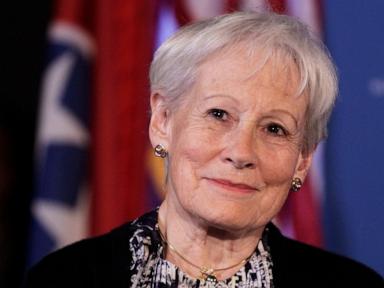
Nancy Kassebaum Baker, the trailblazing former United States Senator from Kansas who died at age 94, occupied a political orbit that now feels entirely theoretical. Elected in 1978 without riding the coattails of a deceased spouse—a rarity for women entering legislative halls in that era—she carved out three decades of influence by refusing to treat partisanship as a religion. Her passing closes the book on a specific brand of Midwestern pragmatism, forcing a hard look at how far American governance has drifted from the principles she quietly embodied.
The Unlikely Ascent From Maize To Washington
When Kassebaum entered the 1978 Senate race, political pundits dismissed her chances. Armed with a modest budget and a political pedigree defined by her father, Alf Landon—the 1936 Republican presidential nominee—she did not fit the archetype of the fiery machine politician. She had served on a local school board in Maize, Kansas, and worked on a Senate staff, but she was fundamentally an outsider to the heavy machinery of congressional campaigns.
Her initial primary victory over a crowded field of eight men proved that voters were hungry for an authentic voice. She spent a fraction of what traditional campaigns required, relying instead on a down-to-earth demeanor that resonated across the Kansas plains. Once in Washington, she did not seek the limelight. She sought results.
The Cost Of Conscience In A Partisan Era
Kassebaum Baker understood that legislative power derived from credibility, not theatrical outrage. As chair of the Senate Labor and Human Resources Committee, she worked alongside fierce ideological opponents like Edward Kennedy to craft enduring policy. This collaboration was not born of weakness; it was born of an analytical recognition that laws built on narrow majorities rarely survive the next election cycle.
That independence came with a price. When she voted to ban assault weapons or broke ranks with conservative orthodoxy on fiscal matters, the backlash from her own party was swift. She absorbed the angry letters without folding into defensive posturing. In her later years, her disillusionment with the direction of the modern Republican Party became a matter of public record, culminating in high-profile endorsements of Democratic candidates when she felt the character of leadership demanded it. She remained a registered Republican, but her loyalty belonged to the institution of democracy rather than a tribal banner.
The Structural Void Left Behind
The current political landscape offers no easy template for politicians cut from her cloth. Modern media incentives reward escalation over compromise, turning legislative chambers into soundstage arenas. Kassebaum Baker belonged to a generation that viewed governance as an administrative duty requiring patience, listening, and an acceptance of half-loaves over ideological purity.
Her career demonstrates that a politician can maintain deep roots in a conservative state while challenging its orthodoxies. Kansans rewarded her with landslide re-election margins because they trusted her motives, even when they disagreed with her votes.
The silence she leaves behind is defined by the absence of that quiet authority. As Washington stumbles from crisis to manufactured crisis, the blueprint she left—grounded in intellectual honesty and a total lack of pretense—remains a standard against which contemporary leaders are measured and found wanting.


