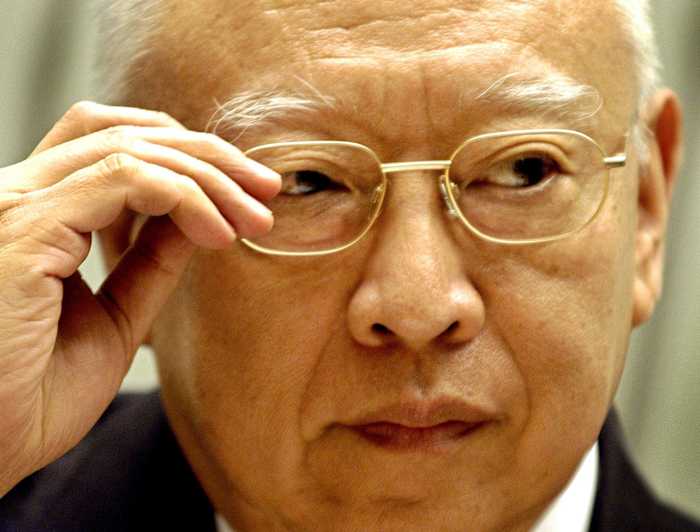
Tung Chee-hwa, who served as Hong Kong’s first chief executive following the 1997 handover from British colonial rule to Beijing, has died at the age of 89. His passing closes a turbulent chapter in modern Asian history, bringing an end to the life of a shipping tycoon thrust into an impossible political transition. While official statements commemorate his upright character and devotion to the nation, his tenure remains a cautionary tale about the friction between corporate autocracy and civil society.
The narrative surrounding Tung has long been packaged as a simple tragedy of a reluctant businessman forced onto a political stage for which he possessed little appetite. That framing misses the structural reality of what his administration represented. Selected by a 400-member pro-Beijing committee in late 1996, Tung was not merely an accidental leader. He was the product of a precise political alignment between mainland ambition and local capitalist survival. Meanwhile, you can explore related developments here: Behind the Closed Doors of the Moscow Backchanneling That Triggered the Trump Putin Phone Call.
To understand Tung is to understand the bailout that preceded his rise. In the mid-1980s, his family’s shipping empire, Orient Overseas Container Line, faced catastrophic collapse under a mountain of debt. A rescue package orchestrated by Beijing-backed entities pulled the company back from the brink. That financial lifeline established a profound debt of loyalty long before a single ballot was cast or a handover flag was raised. When sovereignty transferred on July 1, 1997, Beijing required a figurehead who embodied continuity, commercial pedigree, and absolute reliability. Tung fit that description.
Governance under the "one country, two systems" framework was an unprecedented experiment. No blueprint existed for merging a freewheeling, common-law international financial hub with a centralized socialist party-state. Tung inherited an administrative machine built by British colonial technocrats who answered ultimately to London, yet he was expected to pivot its loyalty northward without destabilizing the local economy. To see the bigger picture, check out the recent report by NPR.
Almost immediately, systemic shocks battered the territory. The Asian financial crisis struck weeks after the handover, puncturing a hyper-inflated property market and plunging the city into deep recession. Shortly thereafter, the world’s first known human outbreak of avian influenza hit the population, followed years later by the devastating SARS epidemic in 2003.
Tung’s administrative instincts were shaped by corporate boardrooms rather than open public debate. He viewed dissent not as a natural component of civic life, but as an operational inefficiency. His management style relied on closed-door consensus among traditional elites, alienating a public that expected accountability. Earnest and relentless—earning the moniker "7-11" for his punishing work hours—he simultaneously earned the derisive nickname "Old Dumb Tung" as his government stumbled through policy rollouts and public relations missteps.
The structural tension of his rule culminated on July 1, 2003. More than half a million citizens poured onto the streets to protest proposed national security legislation under Article 23 of the Basic Law. That massive mobilization shattered the myth that Hong Kong populace would remain politically quiescent as long as asset prices climbed. It demonstrated that civil liberties were not a negotiable luxury for the city's residents.
Tung officially stepped down in March 2005, ostensibly citing declining health. In reality, the central leadership recognized that his continued presence had become a lightning rod for escalating public fury. His departure did not signal a retreat from political engineering by Beijing; rather, it marked the end of the first phase of integration, proving that gentle corporate hands could not permanently suppress underlying ideological friction.
In his post-chief executive years, Tung assumed the role of senior statesman, serving as a vice chairman of the Chinese People’s Political Consultative Conference and establishing think tanks aimed at bridging ties between Beijing and Washington. He remained steadfastly loyal through subsequent political upheavals, including the 2019 protests and the eventual enactment of sweeping national security laws.
The passing of Hong Kong's first post-colonial leader closes an era when the boundaries of "one country, two systems" were still fluid and fiercely contested. History remembers him not merely as a reluctant captain caught in a storm, but as the architect of a transition that laid bare the complex realities of modern governance under the shadow of state power


