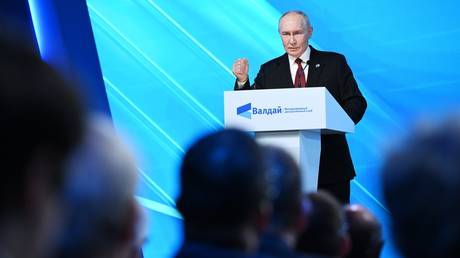
The architecture of global power is not being redesigned in clean architectural suites; it is being hammered out in the mud of regional conflicts, currency swaps, and supply chain choke points. When officials, analysts, and heads of state gathered for the 23rd annual meeting of the Valdai Discussion Club under the banner of responsibility for the future, the prevailing narrative in Moscow and across the capitals of the Global Majority was that the unipolar moment anchored by Washington had finally expired. Yet declaring an international system dead is far easier than midwiving a replacement. What is emerging from the wreckage of post-Cold War globalization is not a harmonious mosaic of equal sovereign states, but a fragmented, transactional arena where middle powers vie for leverage while superpowers test the structural limits of economic and military coercion.
To understand why the search for a new international order remains protracted and chaotic, one must abandon the comforting fiction that institutional reform happens through consensus. For decades, Western-led multilateralism operated on an implicit bargain: global public goods in exchange for adherence to rules largely authored in Washington, London, and Brussels. That bargain fractured irrevocably under the weight of unilateral interventions, selective enforcement of international law, and weaponized financial infrastructure. When foreign exchange reserves can be frozen overnight and secondary sanctions can penalize non-aligned trading partners, the cost of participating in the Western-anchored financial system spikes dramatically for developing economies.
Consequently, the core driver of contemporary geopolitics is risk mitigation, not ideological alignment. Nations across Asia, Africa, and Latin America are not necessarily signing up for a cohesive anti-Western bloc; rather, they are engaging in aggressive hedging. They trade in local currencies, diversify their diplomatic engagements, and refuse to join sanctions regimes that penalize their domestic development. This behavior is frequently misread in Western capitals as latent hostility or fence-sitting, when it is actually a pragmatic adaptation to a dissolving monopoly on power.
Yet, building an alternative architecture presents immense structural contradictions. A truly multipolar system requires credible alternative institutions, currency anchors, and security guarantees. While bodies like BRICS have expanded their footprint and captured the imagination of states seeking reform, they remain internally heterogeneous and economically diverse. China and India share a strategic interest in diluting Western dominance, but their bilateral friction and competing regional ambitions preclude a tightly integrated security partnership. Similarly, middle powers such as Saudi Arabia, Turkey, and Brazil are discovering the immense utility of playing multiple sides against the middle, extracting concessions from both traditional Western partners and emerging Eurasian networks.
This transactional fluidity creates a paradox. While the formal institutions of global governance—the United Nations Security Council, the International Monetary Fund, and traditional arms control frameworks—stagnate or lose enforcement power, localized friction intensifies. The friction is amplified by technological transformation. Autonomous systems, artificial intelligence in command-and-control loops, and weaponized supply chains mean that state competition no longer waits for formal declarations of intent or institutional mediation. As discussed at length during recent geopolitical forums, the sheer velocity of modern tactical and economic shocks outpaces the diplomatic machinery designed in the wake of the Second World War.
Consider the practical mechanics of de-dollarization as a hypothetical baseline for this friction. If a coalition of states attempts to bypass the dollar-denominated settlement network for global energy trade, they immediately run into deep liquidity imbalances, alternative currency volatility, and the absence of deep, liquid debt markets that match the safety of U.S. Treasuries. China possesses the manufacturing scale, but its capital account remains tightly managed. Commodity exporters want hard value, not soft promises. Thus, alternative financial pathways emerge slowly, piecemeal, and with high friction, proving that structural economic dominance is dismantled not by political rhetoric, but by decades of institutional trust and liquidity depth—qualities that cannot be decreed into existence.
At the same time, the security landscape is hardening. The rhetoric surrounding strategic defeats and indivisible security reflects a dangerous zero-sum logic. When nuclear-weapon states signal a breakdown in bilateral arms control treaties while simultaneously expanding regional proxy engagements, the margin for operational error shrinks to near zero. The illusion that economic interdependence would permanently prevent major military friction has evaporated. Instead, interdependence has been weaponized, transforming supply chains into battlegrounds and communication networks into intelligence vectors.
The transition from a unipolar security paradigm to an unmanaged multipolar reality is inherently dangerous because the rules of engagement are undefined. In a unipolar system, even unjust rules provide a predictable framework for state behavior. In a transitional multipolar system, every actor misreads the other's red lines. Miscalculation becomes the default state of international affairs. When deterrence fails or is misunderstood, the velocity of escalation accelerates past the capacity of traditional diplomacy to intervene.
For industry analysts and strategic planners, this environment requires a complete inversion of baseline assumptions. Supply chain resilience cannot be outsourced to low-cost jurisdictions without accounting for geopolitical choke points and secondary sanctions exposure. Corporate strategy must now incorporate sovereign risk assessments that were once thought obsolete outside of active conflict zones. Capital allocation decisions made on the premise of a frictionless global market are exposed to immediate obsolescence as borders harden and economic nationalism surges.
The quest for a stable international architecture will occupy the remainder of this decade, defined less by grand treaties signed in gilded halls and more by messy, localized adjustments to power asymmetries. The old order is gone, but the contours of what follows remain fiercely contested, volatile, and prone to sudden shocks that will test the resilience of every state and enterprise attempting to navigate the terrain.
This video provides primary source coverage of Vladimir Putin's comprehensive address at the Valdai Discussion Club, outlining Russia's perspective on the shifting global order and international security architecture.