The snow in the Neander Valley doesn’t just fall; it entombs. Standing at the edge of a limestone cliff in western Germany, you can feel the bite of the same wind that whistled through the ribs of the world forty thousand years ago. For over a century, we have looked at the bones found here and told ourselves a comforting lie. We called them "brutes." We pictured them as hulking, dim-witted failures who stumbled into the path of a smarter, sleeker version of humanity—us—and simply blinked out of existence because their brains couldn't keep up.
We were wrong.
The narrative of the "stupid Neanderthal" is more than just bad science. It is a reflection of our own ego. We wanted to believe that our survival was earned through a superior biological processor, a divine spark of intellect that they lacked. Recent breakthroughs in archaeology and paleo-genetics are finally shattering that mirror. The truth is far more haunting. It wasn't a lack of wit that killed the Neanderthals. It was a subtle, cruel shift in the math of survival.
The Architect in the Ice
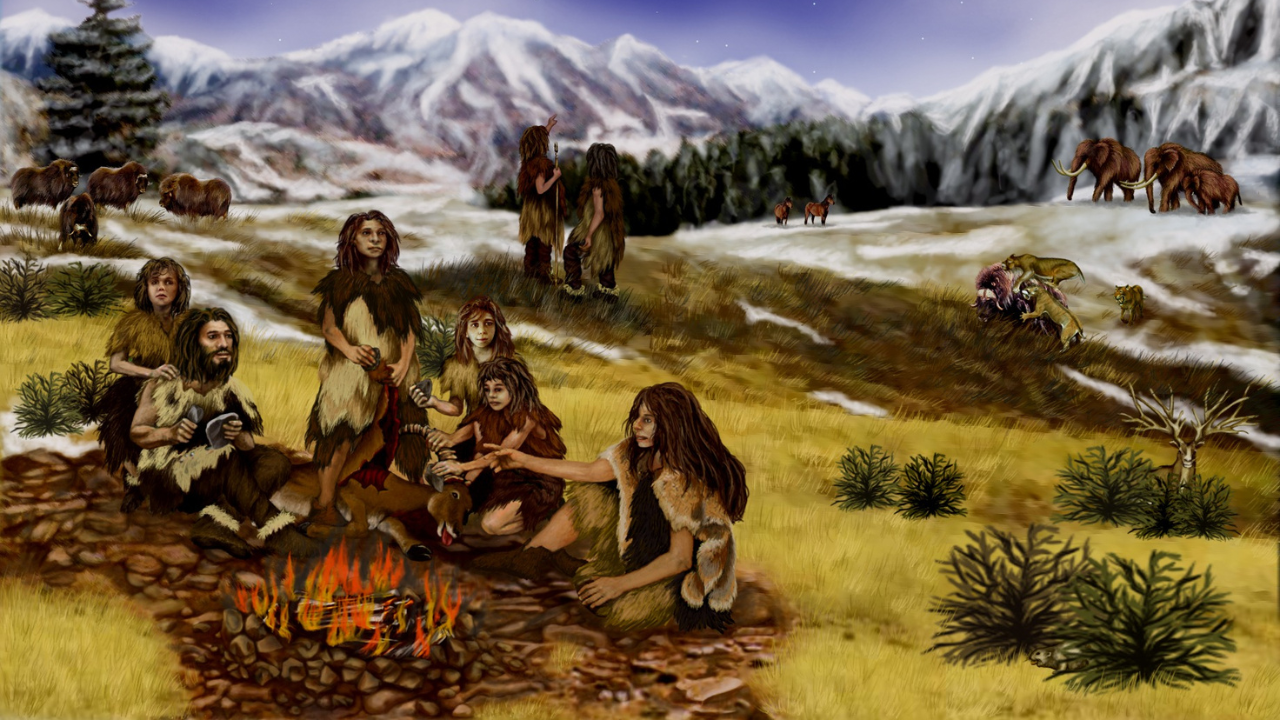
Consider a hypothetical woman named Kira. She lived in what is now southern France during the tail end of the Pleistocene. Kira is a Neanderthal. She is shorter than you, broader, with a barrel chest designed to retain heat and muscles honed by a lifetime of wrestling megafauna. But look at her hands. They are scarred, yes, but they are also precise.
Kira isn't just surviving; she is innovating. She uses birch tar—a complex synthetic adhesive that requires a multi-stage heating process—to bind flint blades to wooden shafts. This isn't the work of a scavenger. This is chemistry. She buries her dead with intentionality, perhaps even with flowers, signaling a mind capable of grasping the abstract weight of grief.
Most importantly, her brain is actually larger than yours.
If we look at the cranial capacity of the average Neanderthal, it often exceeded that of modern Homo sapiens. They possessed a massive visual cortex and a highly developed motor center. They were the ultimate specialists, fine-tuned over 400,000 years to dominate one of the harshest environments the Earth has ever produced.
So, if Kira was strong, capable, and possessed a brain that was, by volume, a powerhouse, why is her lineage a ghost?
The Social Tax
The problem wasn't what was inside Kira’s head. It was the world outside of it.
While Neanderthals were refining the art of the ambush, modern humans were doing something much more dangerous: they were talking to strangers.
Genetic modeling suggests that Neanderthal populations were chronically small and isolated. They lived in tight-knit family bands, rarely numbering more than a dozen or two. In these bubbles, knowledge is fragile. If the master toolmaker in Kira’s group falls into a crevasse, forty years of technical expertise vanishes in an afternoon. There is no backup. There is no cloud storage for the Stone Age.
Modern humans, arriving from Africa with different social hardware, lived in larger, overlapping networks. They traded obsidian across hundreds of miles. They shared stories, styles, and—crucially—innovations.
Imagine two startups. Startup A (the Neanderthals) has the most brilliant engineers on the planet, but they work in total isolation. They never check what the competition is doing. They never outsource. Startup B (the Sapiens) has slightly less capable individuals, but they are hyper-connected. They steal ideas, they collaborate, and they scale.
Startup B wins every time. Not because they are smarter, but because they are more connected.
The Great Thinning
Climate change was the silent executioner. For millennia, the European climate was a pendulum, swinging between "cold" and "unbearable." Neanderthals had survived dozens of these shifts. But the final one was different.
The forests they used for cover—the places where they could use their immense strength to surprise prey—started to fragment. The world became an open, wind-swept steppe. Suddenly, the barrel-chested physique that kept Kira warm became a liability. It required a massive caloric intake just to maintain. She was a high-performance engine in a world where fuel was running out.
Sapiens, with their lanky, energy-efficient bodies, could travel further on less food. They used projectile weapons—spears thrown from a distance—to hunt on the open plains. Neanderthals, built for the close-quarters grapple, had to take massive physical risks for every meal. Every hunt was a potential catastrophe.
We see the evidence in their bones. Almost every adult Neanderthal skeleton found shows signs of healed fractures, similar to the injury patterns seen in modern rodeo riders. They lived lives of constant, bone-crunching trauma.
The extinction wasn't a "war." There were no great battlefields where Sapiens stood on one side and Neanderthals on the other. It was a slow, agonizing dilution. As Neanderthal numbers dwindled, their gene pool became a stagnant pond. Inbreeding became unavoidable. Harmful mutations began to pile up.
The Ghost in the Code
But here is the twist in the story that we only recently learned: Kira didn't entirely disappear.
When Sapiens and Neanderthals met in the Middle East and later in Europe, they didn't just compete. They looked at each other and saw something familiar. They saw humans.
They loved. They raised children.
If you are of non-African descent, about 2% of your DNA is Neanderthal. That DNA isn't just "junk." It’s the reason some of us have certain immune responses or skin types. It is the legacy of a people who were supposed to be "extinct" but instead chose to merge with the newcomers.
We are not the sole survivors because we were the best. We are the survivors because we were the most adaptable, the most social, and perhaps the most opportunistic. We didn't "beat" the Neanderthals in an intellectual arms race. We outlasted them through the power of the group, and then we absorbed what was left of them.
The Lesson of the Valley
Today, we face our own "climate shifts." We face the rise of artificial intelligences that process information in ways we can barely comprehend. We look at the "brutes" of our own era—the systems or people we think are being left behind—and we feel a familiar sense of superiority.
But the Neanderthals teach us that biological hardware isn't destiny. You can have the largest brain in the valley and still find yourself at a dead end if you cannot bridge the gap between yourself and others.
The tragedy of the Neanderthal is that they were almost exactly like us, right up until the moment the world changed too fast for their specific kind of excellence. They were artists, chemists, and mourners. They were masters of their domain.
The wind still howls through the Neander Valley, but it doesn't carry the sound of a "lesser" species. It carries the memory of a cousin who held on as long as they could, until their fire finally merged with ours.
We aren't the peak of the mountain. We are just the ones who stayed in the room when the lights went out.