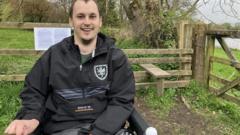
Public spending projects have a strange way of losing sight of their own purpose. When you hear about a £1 million investment into a supposedly "accessible" path, you'd assume someone checked if a wheelchair could actually get through. Instead, we have a high-profile failure that highlights a massive gap between bureaucratic checklists and the reality of life for disabled people.
The project was pitched as a win for inclusivity. It was meant to open up a beautiful stretch of the countryside to everyone. But the reality on the ground is a mess. 15 stone steps. Multiple stiles. These aren't just minor inconveniences. They're hard barriers. They effectively tell anyone with mobility issues that this space isn't actually for them. It’s a waste of taxpayer money and, frankly, an insult to the people it claimed to help.
How a Million Pounds Bought a Dead End
The math doesn't add up for most people. If you spend seven figures on a trail, the very least you should expect is a flat surface. This specific route, designed to connect communities and provide a scenic escape, hits a literal wall of stone steps early on.
Local advocates and disability rights groups have been vocal about this. They point out that a "multi-user" path shouldn't require the agility of a mountain goat. Stiles are a relic of old agricultural boundaries. They're designed to keep livestock in while allowing able-bodied hikers to climb over. They're the antithesis of accessibility.
The problem often starts in the planning phase. Engineers and council planners look at maps. They look at budgets. They might even look at "accessibility guidelines" on a screen. What they don't always do is walk the route with someone who uses a power chair or a walker. If they had, they’d have seen the 15 stone steps and realized the project was doomed from the start.
The Myth of the Almost Accessible Path
There's no such thing as "mostly accessible" when it comes to infrastructure. If 90% of a trail is smooth tarmac but the remaining 10% is a flight of stairs, the entire route is inaccessible. You can't ask a wheelchair user to just "try their best" with a stone staircase.
This isn't an isolated incident. It’s part of a wider trend where "accessibility" becomes a buzzword used to secure funding rather than a genuine design principle. We see it in train stations where the "accessible" entrance is a mile away from the main one. We see it in parks where the paths are wide but the gates are too narrow.
Why Stiles Still Exist in Modern Projects
- Land Ownership Issues: Often, paths cross private land where owners insist on maintaining specific types of boundaries.
- Heritage Preservation: In some areas, stone steps or historic stiles are protected, creating a conflict between conservation and modern access laws.
- Budget Mismanagement: Money gets funneled into the "easy" parts of the path—the long stretches of gravel—while the difficult junctions and elevation changes are left as "existing features."
These excuses don't hold water when the Equality Act is supposed to guarantee reasonable adjustments. A million-pound budget provides plenty of room for creative engineering. You can build ramps. You can install RADAR key-accessible gates. You can reroute around obstacles. Choosing not to do these things isn't a budget constraint; it's a choice.
Design Failures and the Lack of Lived Experience
The most frustrating part of the £1m accessible route failure is how easily it could've been avoided. There’s a mantra in the disability community: "Nothing about us without us."
When projects are designed in a vacuum, mistakes are inevitable. A planner might think a small lip on a curb is fine. To someone in a manual chair, that lip is a jolt that can cause pain or even a tip-over. Fifteen steps aren't just a mistake; they're a total failure of imagination.
True accessibility requires a different mindset. It’s not about ticking a box. It’s about understanding the physics of mobility. It’s about knowing that a gravel path might look nice, but it’s a nightmare for small wheels. It’s about realizing that a stile is a "Keep Out" sign for a significant portion of the population.
Holding Authorities Accountable for Wasted Funds
We need to start asking where the accountability is. When a bridge is built and it collapses, people lose their jobs. When an accessible path is built and it’s unusable, it often just fades into the background as a "learning experience."
Taxpayers should be angry. That £1 million could have gone toward fixing broken elevators at local stations or installing changing places toilets in town centers. Instead, it’s sitting in a field in the form of steps that nobody in a wheelchair can climb.
Local councils and National Trail boards need to face actual consequences for these blunders. This includes:
- Mandatory Audits: Every penny of "accessibility" funding should be contingent on an independent audit by disabled access consultants.
- Clawback Clauses: If a project is marketed as accessible but fails to meet basic standards, the contractors or planners should be held financially responsible for the fixes.
- Public Mapping: Real-time, user-updated maps should be part of every new project, so people don't drive miles to a trail only to find a stile at the entrance.
Fixing the Mess on the Ground
You can't just leave a failed project as it is. The "accessible" label needs to be stripped off until the barriers are removed. If the steps stay, the signs must change to warn people of the obstacles.
But the better path is to fix it. Removing 15 stone steps and replacing them with a graded ramp isn't impossible. It's basic civil engineering. Replacing stiles with kissing gates that are wide enough for mobility scooters is standard practice in many parts of the country.
If you're a local resident or an advocate, don't let this slide. Contact your local council. Ask for the specific accessibility impact assessment that was supposedly done before the million pounds was spent. Demand to see the minutes of the meetings where these stone steps were discussed.
Accessibility isn't a luxury or an "add-on." It's a fundamental right to navigate the world. When a project fails this spectacularly, it’s a sign that the people in charge simply didn't care enough to do it right the first time. We shouldn't have to fight for the bare minimum, especially when the budget was already there to do it properly.
Check the trails in your own area. If you find a "million-pound" gate that's locked or a "new" path that ends in a staircase, document it. Post the photos. Tag the agencies involved. The only way to stop this waste of money is to make the embarrassment of the failure outweigh the convenience of the shortcut.
Stop accepting excuses about "difficult terrain" or "historic features." If the terrain was too difficult, the project shouldn't have been marketed as accessible in the first place. If the heritage was too precious to change, the money should have been spent elsewhere. It's time to build things that actually work for everyone, not just those who can climb over the mistakes of others.