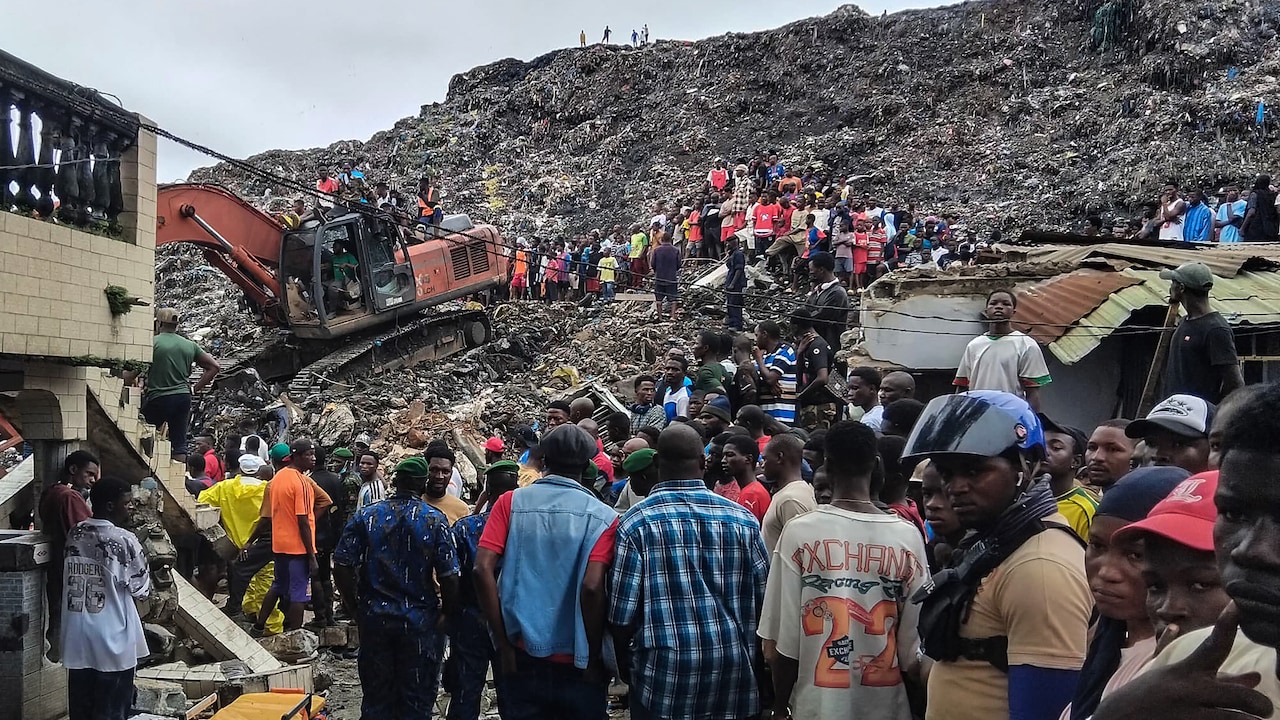
Midnight in the Gbessia commune of Conakry usually carries a heavy, humid stillness. But the early hours of Sunday broke with a terrifying roar.
Rain had been falling for hours, drumming a relentless, deafening rhythm against the corrugated tin roofs of the Dar-es-Salam neighborhood. For the families living in the precarious shacks and makeshift homes clustered tightly at the foot of the city's largest open-air waste dump, sleep was already uneasy. They lived in the shadow of a ticking clock. Years of unmanaged urban refuse had piled skyward, forming an artificial mountain of discarded plastic, organic rot, and compacted earth that scraped against the sky.
At approximately two in the morning, that mountain gave way.
A colossal wave of sodden, shifting garbage broke loose, liquefied by the relentless torrential downpour. It slid down the slope with the speed and weight of an avalanche, swallowing tents, shacks, and concrete structures whole before anyone inside had time to draw a breath.
When the sun finally clawed its way through the gray mist, the human cost was stark and devastating. Government officials confirmed that at least thirty people lost their lives in the sudden landslide. Dozens more suffered injuries, with emergency responders pulling survivors and victims from a suffocating sea of debris. Excavators clawed desperately through the trash while grief-stricken onlookers watched in stunned silence, hoping against hope to find loved ones beneath the wreckage.
Consider the cruel irony hanging over the tragedy: the Dar-es-Salam site was scheduled for permanent closure precisely on that Sunday.
For years, the massive dump had posed an escalating danger to the surrounding community. Authorities had issued eviction notices, attempting to clear the dense pockets of housing that crowded its perimeter. Yet, poverty leaves little room for relocation. Many families, trapped by economic survival, had nowhere else to go. They stayed, gambling their lives against the creeping instability of the garbage heap, hoping they could outlast the deadline. They ran out of time.
This disaster is not merely an isolated tragedy born of bad weather. It is a harsh symptom of a wider, systemic friction between rapid urbanization and critical infrastructure failure. Guinea sits atop some of the richest mineral deposits on earth, holding the world's largest bauxite reserves alongside vast quantities of iron ore. Yet, wealth in the ground does not instantly translate to safety on the streets. Rapid population growth in Conakry has outpaced city planning, leaving vulnerable communities to squeeze into dangerous margins near industrial zones, flood plains, and towering open dumps.
When a society’s infrastructure fails to match its growth, the heaviest burdens always fall on the most defenseless.
Rescue teams, medical personnel, and local volunteers continue to comb through the unstable wreckage. For the families left behind, the grief is compounded by the suddenness of the loss.
The rain has stopped, but the mountain remains—a grim monument to a catastrophe that everyone saw coming, yet nobody could stop in time.