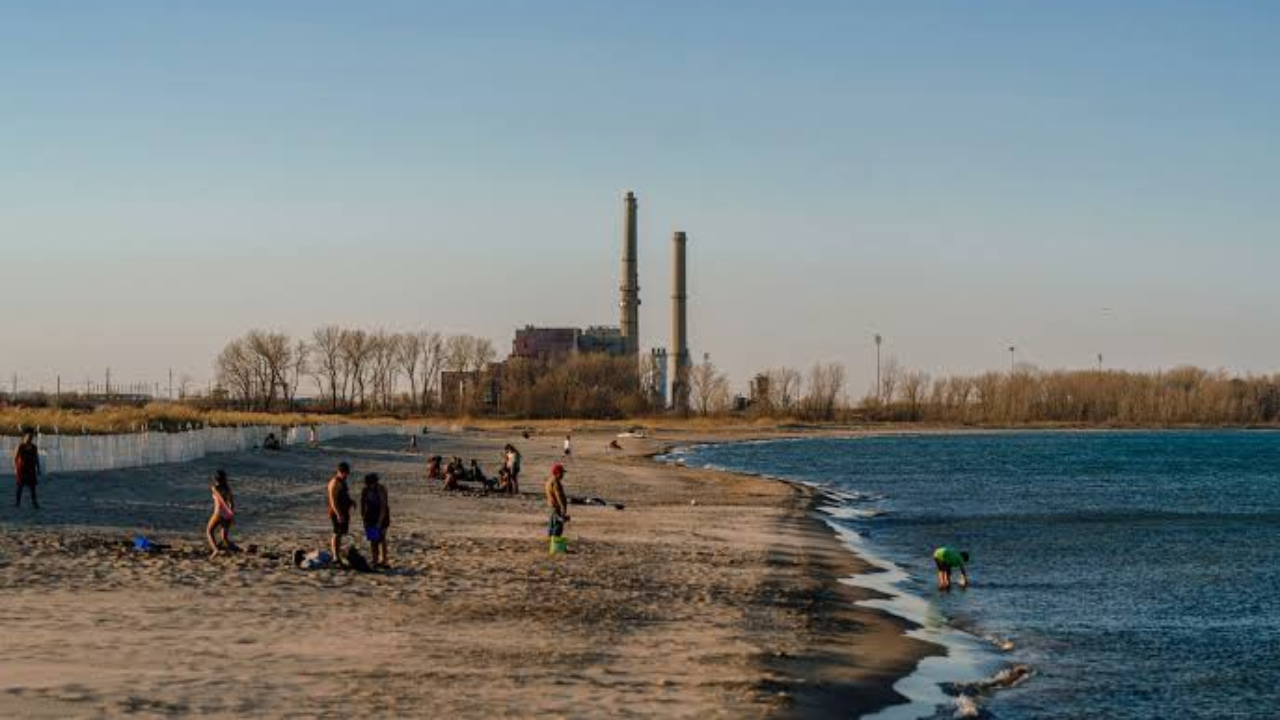
The coffee in the thermos had gone cold hours ago, tasting faintly of chicory and stale rain. Frank wiped a gloved hand across the frost-rimmed windshield of his crane, squinting through the dawn gray at the roaring expanse of the Dan Ryan. Millions of tons of steel and commuter fury hummed above him every single day. But today, the most important part of the highway wasn't the asphalt scraping the sky.
It was what sat quietly beneath the dirt.
Let us step back to the autumn of 1972. Illinois was drowning in a gray snowstorm of its own making.
Downstate, coal-fired power plants screamed day and night, keeping the lights burning in Chicago skyscrapers and suburban split-levels alike. They burned millions of tons of black rock, turning raw power into electricity. But energy always leaves a ghost behind. For every mountain of coal fed into those giant iron furnaces, another mountain of powdery, gray residue was left behind. Coal fly ash. It was worthless. It was a nuisance. It choked the smoke stacks, settled in industrial lungs, and piled up in towering artificial dunes near the rivers, waiting for a gust of wind to turn the landscape into a lunar dust bowl.
Nobody knew what to do with it. Until engineers looked down at the mud beneath the asphalt and realized they had a structural crisis on their hands.
Building a highway across the American Midwest is an exercise in wrestling with mud. The earth here is stubborn, wet, and endlessly shifting under heavy loads. Conventional gravel and crushed stone were expensive, hard to truck in massive quantities through congested urban corridors, and often required tearing up more pristine quarries elsewhere just to feed the ravenous appetite of expanding transit lines.
Enter a radical, desperate gamble.
(Note: The following historical reconstruction is based on verified Department of Transportation records from the era, though I am imagining Frank as a composite archetype of the hard hats who actually turned the valves.)
What if, instead of hauling clean stone, they used the gray ghost? What if they took the very waste choking the power plants and forced it to shoulder the weight of an empire?
Underneath seventy-five hundred feet of expressway, crews pumped, dumped, and compacted two hundred forty-six thousand cubic yards of coal fly ash.
Pause for a second to let that number settle. Two hundred forty-six thousand cubic yards. That is enough volume to bury a small neighborhood under a silent, dense shroud of industrial byproduct. To the average driver speeding past on their way to work, it was invisible. Out of sight, out of mind. To the environmental watchdogs of the era, it was a terrifying roll of the dice. Leaching heavy metals, contaminating groundwater, turning subterranean streams into industrial soup—these were the dark nightmares whispered in regulatory offices.
Yet, the ash did something remarkable. When mixed with the right stabilizers and compacted with brute force, it didn't just sit there. It cured. It locked together. It behaved.
Physics can be a fickle collaborator. When you deal with industrial byproducts, you walk a very thin wire between genius and environmental catastrophe.
To understand why this mattered, you have to understand how engineers think about ground. It is never just dirt. It is a living, breathing sponge. Every drop of rain, every freezing winter night, every semi-truck hauling twenty tons of steel pushes down on that sponge. If the foundation yields, the concrete cracks. If the concrete cracks, the city grinds to a halt.
By utilizing coal fly ash as structural fill beneath the expressway, the state achieved something unprecedented on that scale. They solved a disposal crisis by weaponizing the waste itself. They turned an environmental liability into load-bearing infrastructure.
Critics at the time pointed to the heavy metals—the arsenic, the lead, the mercury trapped within the glassy spheres of the ash. They weren't wrong to worry. Industrial history is littered with the toxic receipts of convenience. But in this specific stretch of 1972 Illinois engineering, the placement was engineered with a meticulous, old-school precision that defied the messy reality of industrial dumping. It was encapsulated. Kept dry. Kept compressed.
Decades have passed since Frank climbed down from his crane. The trucks roaring overhead have grown heavier, faster, more numerous. The power plants that spawned that ash have either evolved or gone dark, replaced by different ghosts of energy generation.
Yet, beneath the concrete arteries of Illinois, those two hundred forty-six thousand cubic yards remain.
We live in a culture obsessed with brand-new solutions, chasing the shiny and the immaculate. We forget that progress is often built by looking at the trash heap, squinting through the frost, and asking what else it can hold up.