The sun had not yet risen over the concrete towers of North York, but inside the unmarked tactical vans, the air was already heavy. It was 5:40 a.m. on a damp June Thursday. Most of Toronto was still asleep, dreaming of summer weekends, completely insulated from the reality that international geopolitics was about to detonate on a fourth-floor apartment door at 15 Martha Eaton Way.
Constable Marc Pinizzotto adjusted his heavy body armor. At 43, he was a veteran. Eighteen years on the force, the last five spent with the elite Emergency Task Force. He knew how these mornings went. The adrenaline spike. The disciplined breathing. The quiet prayers for a smooth entry and a safe return to his 14-year-old twins.
He was a man who used to fly across the ice, having played professional hockey in Europe before trading the jersey for a badge. His first coach on the force remembered him as a "dream recruit"—a guy with real life experience, immense calm under pressure, and a deep-seated desire to protect his city.
But Toronto is no longer just a local municipality. It is a global hub, and as a consequence, its streets are increasingly tied to fractures on the other side of the planet.
When Pinizzotto and his team breached the apartment door, they weren't just executing a local warrant. They were stepping into the crosshairs of a shadow war that had traveled thousands of miles across oceans and borders.
The door gave way. A split second later, muzzle flashes tore through the dim apartment. A 19-year-old man inside opened fire.
Bullets hit Pinizzotto. Another officer fired back, striking the gunman multiple times. Within minutes, the quiet morning broke into a chorus of sirens as tactical paramedics scrambled to save one of their own. The emergency run to Sunnybrook Hospital was a blur of flashing red lights and desperate chest compressions.
By mid-morning, the grim reality settled over the city. Marc Pinizzotto was gone.
Consider what happens next when a localized domestic raid turns out to be the tail end of an international terrorism thread. The standard news reports will tell you that the raid was tied to a string of local shootings, most notably the brazen attack on the United States Consulate on University Avenue back in March. They will list the names of the accused. They will talk about search warrants.
But the real story lies in how easily the wars of the Middle East can manifest in a North York stairwell.
Let's trace the thread backward. In late February, regional conflicts erupted overseas involving the United States, Israel, and Iran. Instantly, the shockwaves traveled across the globe. By early March, the tension spilled onto Canadian soil. Gunfire targeted two Toronto-area synagogues. Days later, a white Honda SUV pulled up to the U.S. Consulate in the dead of night. Two figures stepped out, pulled the triggers of high-powered firearms, and riddles the diplomatic building's facade with bullets before vanishing into the dark.
At the time, federal authorities labeled it a national security incident. They began tracing a complex, global web. South of the border, American prosecutors unsealed a federal complaint linking the consulate shooting to an Iraqi national named Mohammad Baqer Saad Dawood Al-Saadi, alleging ties to a proxy network directed by Iran's Revolutionary Guard.
Think about that trajectory. A command structure in Tehran shifts its geopolitical weight. A proxy network activates. A diplomatic building in downtown Toronto is targeted. And months later, a Canadian father of two, who spent his youth chasing a puck around European ice rinks, pays the ultimate price while trying to secure an apartment building near Black Creek Drive.
This is the hidden gravity of modern policing. The officers putting on their uniforms every morning aren't just dealing with local property crimes or domestic disputes. They are standing on the front lines of global friction points.
Chief Myron Demkiw stood before the microphones at Sunnybrook Hospital, his face etched with a fatigue that no amount of sleep could cure. He didn't speak in the sterile language of police briefs. He spoke of a family shattered, of a task force grieving, and of a city that had lost a piece of its shield.
"No words can capture the impact on Marc’s family, who expected him to come home today," Demkiw said, his voice carrying the weight of a leader who had just delivered the worst news a parent or spouse could ever hear.
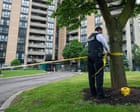
The neighborhood around Martha Eaton Way is no stranger to police tape. It is a community that has seen its share of local tragedies, including the heartbreaking loss of an eight-year-old boy caught in a stray-bullet crossfire just a year prior. But Thursday morning felt different. The yellow tape wrapped around the trees didn't just cordon off a crime scene; it cordoned off a collision site where international terror met domestic vulnerability.
As the province's Special Investigations Unit stepped in to probe the specifics of the gunfire exchange, the hunt intensified for those still in the wind. A 19-year-old suspect named Zara Jabbi remains outstanding, considered armed and dangerous. Chief Demkiw’s public plea to the teenager was stark: "I urge you to turn yourself in."
The city is left to grapple with the aftermath. Mayor Olivia Chow spoke of her personal connection to the tragedy, having known Pinizzotto’s mother for more than two decades. It was a reminder that behind every uniform, behind every tactical vest, and behind every statistic, there is a generational root system in the community.
We often view national security as an abstract concept. We think of satellite feeds, border checkpoints, and intelligence dossiers read in secure, windowless rooms in Ottawa or Washington. We treat it like a game played on a map.
But national security isn't abstract. It has a body. It has a face. It has a family waiting at the breakfast table for a door that will never open again.
The ultimate cost of a fractured world isn't paid by politicians or strategists in distant capitals. It is paid in the pre-dawn darkness of a fourth-floor apartment hallway, by a veteran cop who simply showed up to do his job, keeping the chaos of the world from reaching the doorsteps of the city he loved.