The wind does not care about your designer sunglasses. It howls across the geyser basins of Yellowstone, carrying sulfur, ancient cold, and the quiet ghost of every hurried mistake left behind by millions of passing shoes.
Imagine kneeling in the volcanic dirt. Not a metaphor. Just knees sinking into pine needles and grit, fingers brushing against plastic.
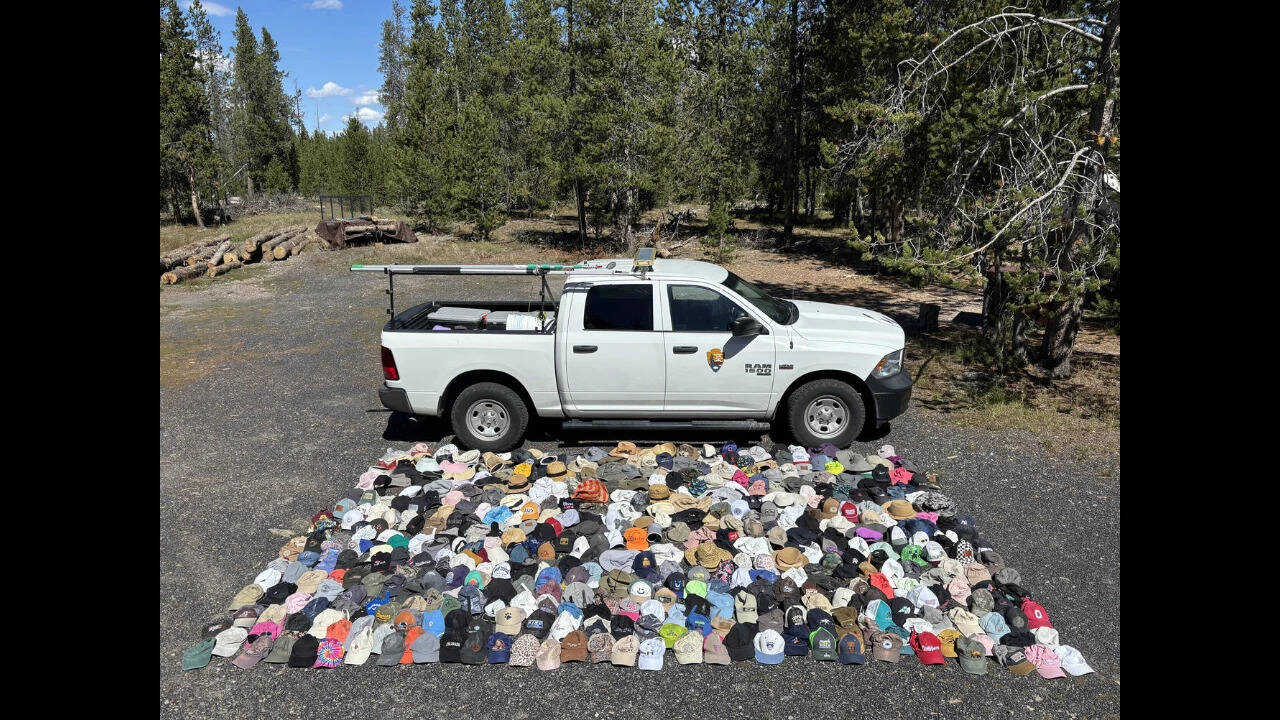
Two hundred and eighty hats. Think about that number for a moment. Two hundred and eighty individual crowns of wool, cotton, and mesh, plucked from the thermal springs, the bison trails, and the steep drops of the Grand Canyon of the Yellowstone. Add to that thirty-six pairs of sunglasses—some scratched, some polarized, some tinted expensive shades of amber meant to shield eyes from high-altitude glare—and you begin to map an invisible geography of human carelessness.
By mid-season, the total haul sits at a staggering twenty thousand pieces of trash.
Trash. It is a clean, sterile word for a dirty reality. We treat the oldest national park in America like an oversized roadside dumpster during a cross-country road trip. We drop things. We forget things. Sometimes, the wind snatches them right off our heads while we gawk at a grizzly bear three hundred yards away, and instead of chasing the rogue baseball cap down a fragile hillside, we shrug and buy another at the gift shop.
The rangers see it all. Ask any field worker who spends twelve hours a day patrolling the backcountry, and they will tell you that the wild does not look like the postcards. It looks like a parking lot after a tailgate party, stretched across two million acres of primeval wilderness.
Consider what happens when a plastic water bottle slips from a backpack pocket near a hot spring. It does not simply biodegrade. It bakes. The mineral-rich, acidic waters dissolve some materials while encrusting others in pale, ghostly layers of silica. It becomes a bizarre artifact of modern civilization, fossilized before its time, sitting next to a steaming vent that has burned uninterrupted for ten thousand years.
There is an eerie dissonance to it. You stand before Grand Prismatic Spring, the water swirling in impossible ribbons of sapphire and marigold, microbes thriving in water hot enough to scald flesh. Then you look down. Right there, half-submerged in the mineral crust, is a crushed aluminum can of generic soda.
How did it get there? Someone walked past a dozen trash receptacles, carried it deep into a fragile thermal area, and either dropped it by accident or dropped it out of a profound, numbing apathy.
We have turned sacred earth into a lost-and-found bin for our worst habits.
Park officials track the numbers with a weariness born of repetition. Every year, the tonnage climbs. Twenty thousand items sounds like a statistic compiled by a bored bureaucrat in an air-conditioned office in Washington, but out here, on the ground, it represents sweat, bent backs, and heavy canvas sacks dragged up steep ravines by maintenance crews who would rather be doing literally anything else.
Let us talk about the hats. Why hats? Because Yellowstone is windy. Because people lean over wooden boardwalks to snap a selfie with a bubbling mud pot, their favorite baseball cap tilting backward, catching the updraft, and sailing over the railing into a restricted zone where human feet cannot tread.
And once it goes over the rail, it stays there. Unless a technician with a long grab-pole and a hazmat mindset goes in to retrieve it, that hat becomes part of the landscape. It becomes a neon-blue tumor on an emerald meadow.
Then there are the sunglasses. Thirty-six pairs in a single sweep of select regions. These are not cheap gas-station readers. These are Ray-Bans and Oakleys, dropped while wiping sweat from a brow during a grueling climb up Mount Washburn. They represent panic, distraction, and the frantic pace of modern tourism. We are in a rush to see everything, to check off landmarks on a frantic itinerary, and in our rush, we shed our possessions like shedding winter skin.
We treat nature as a backdrop for our validation.
When you view a landscape purely through a five-inch smartphone screen, your physical connection to the earth frays. You stop feeling the weight of the pebble in your shoe. You stop smelling the pine sap. You stop noticing the fragile, creeping moss that took half a century to colonize a boulder. When you are detached from the physical reality of the place, dropping a candy wrapper or a plastic water bottle feels weightless. It feels like throwing something away in a city street where a municipal sweeper will make it vanish by dawn.
Except there is no dawn sweeper in the backcountry of Wyoming. There is only a coyote sniffing a discarded protein bar wrapper, or a raven mistaking a bit of crinkled cellophane for a beetle.
The consequences ripple outward in ways we rarely calculate. Animals are resourceful and dangerously curious. A discarded juice pouch smells like sugar to a black bear. A tangled mass of fishing line left by an illegal stream-bank angler becomes a death sentence for an osprey.
We forget that we are visitors in an ancient home.
Walk the boardwalk at West Thumb Geyser Basin just as the sun dips below the Gallatin Range. The steam rises in thick, white plumes against the darkening slate of the lake. It is silent except for the liquid burp of boiling mud and the distant, lonely bugle of an elk. It is the closest most of us will ever get to the dawn of creation.
Now, imagine that silence punctured by the bright, crinkling snap of a fresh plastic wrapper falling onto the fragile, brittle mats of bacterial colonies that line the thermal runoff.
That sound should echo like a gunshot.
The twenty thousand pieces of trash hauled out of Yellowstone this year represent a massive failure of imagination. We cannot imagine the consequences of our small, lazy gestures. We cannot picture the ranger hauling fifty pounds of soggy cardboard out of a backcountry ravine. We cannot see the microplastics slowly leaching into the pristine headwaters of the Snake River.
Change does not begin with another warning sign posted at a trailhead. We ignore signs. We have evolved a remarkable psychological blindness to yellow plastic rectangles with black lettering.
Change begins the moment you feel the grit in your palm, bend your knees, and pick up someone else's forgotten water bottle, cursing softly under your breath.
The park does not belong to us. We are merely renting the view, and our lease is already past due. The hats will keep flying off heads. The sunglasses will keep slipping from pockets. The tide of modern convenience will keep washing up against the ancient shores of Yellowstone Lake.
The real question is how much longer the earth can carry our mess before it stops pretending to forgive us.