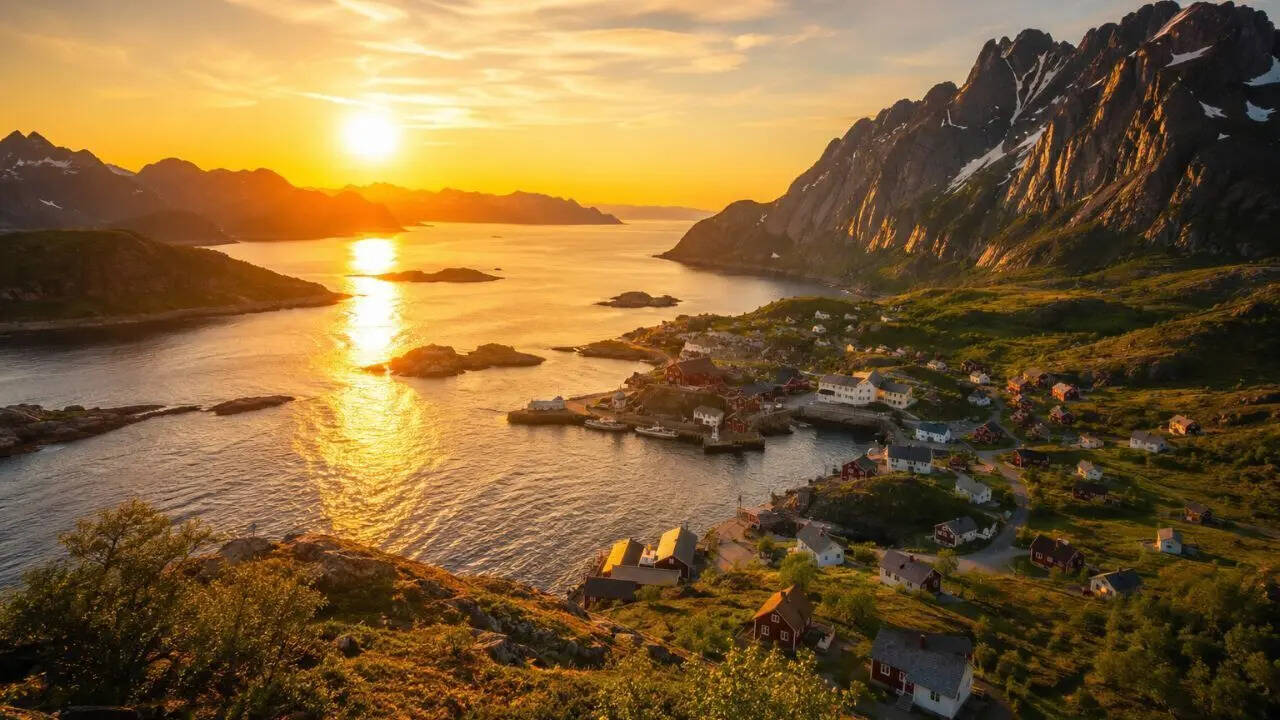
Travel writers love selling you the romantic dream of the midnight sun. They crank out identical, clickbait lists highlighting Iceland, Norway, and Finland as magical worlds where the sun never sets, as if these countries exist in a permanent, golden-hour wonderland for three months straight.
It is a beautifully packaged lie.
If you book a trip to Reykjavik in June expecting to bask in perpetual, midday sunshine while sipping coffee at 2:00 AM, you are going to get an expensive lesson in atmospheric physics. The "lazy consensus" in travel journalism conflates astronomical daytime with actual, usable sunlight. The reality is far more depressing, logistically frustrating, and visually gray than anyone in tourism wants to admit.
The Mathematical Illusion of Constant Daylight
Let us fix the definitions before we go any further. Tourism boards trick you using basic geometry while ignoring weather and biology.
Yes, if you sit above the Arctic Circle (66°33′N) during the summer solstice, the center of the sun does not drop below the horizon for a full 24 hours. That is a geometric fact. But travel blogs routinely include places well below the Arctic Circle—like Reykjavik, Helsinki, or Oslo—in these roundups.
What those southern locations actually experience is not continuous sunshine. It is civil twilight.
[Sun Position relative to Horizon]
Above Horizon --------> Actual Daylight (Intense, direct light)
0° to -6° Below ------> Civil Twilight (Reading outside is possible; sky is bright blue/gray)
-6° to -12° Below ----> Nautical Twilight (Horizon is visible; stars appear; distinct darkness)
In places like southern Iceland or central Finland, the sun absolutely sets. It just dips a few degrees below the horizon, creating a prolonged dusk that bleeds into dawn. You are not getting "never-ending daytime." You are getting an endless, exhausting twilight.
More importantly, these lists completely ignore the single biggest disrupter of the midnight sun: cloud cover.
Data from atmospheric monitoring stations shows that Arctic and sub-Arctic regions suffer from massive cloud density during the summer. Iceland, for instance, averages over 20 overcast days in June. When the sky is choked by thick, low-hanging gray stratus clouds, 24 hours of daylight does not look like a glowing golden paradise. It looks like a fluorescently lit office building where someone broke the light switch. It is a dim, monochrome reality that stays exactly the same shade of depressing gray at 2:00 PM and 2:00 AM.
Why People Also Ask the Wrong Questions
If you look up public forums about northern summers, the questions always follow the same naive pattern. People want to know: "What are the best outdoor activities to do at midnight in Norway?" or "How do I maximize my sightseeing with 24 hours of sun?"
These questions assume your body is a machine that can be hacked by a change in latitude. They fail to account for circadian biology.
Human physiology is governed by the suprachiasmatic nucleus, the internal clock in your brain that relies on the contrast between light and dark to trigger melatonin production. When you eliminate that contrast, your endocrine system goes into chaos.
I have seen seasoned travelers spend thousands on high-end Arctic expeditions only to spend their entire vacation completely miserable, plagued by "Arctic insomnia." You do not get more done; you just get progressively more fatigued, irritable, and disoriented. The local population handles this because they have spent a lifetime adapting, and frankly, they spend a massive portion of their summer indoors behind thick, motorized blackout shutters trying to maintain a normal sleep schedule so they can go to work the next day. The idea that locals are out running marathons and having barbecues at 3:00 AM on a Tuesday is a fantasy invented to sell hotel rooms.
The Secret Downside No Travel Agency Admits
Let us talk about the actual experience of traveling through these regions during peak summer.
Because the sun hovers so close to the horizon for hours on end, the angle of the light is incredibly low. If you are driving north on Norway’s E6 or trying to navigate Iceland’s Ring Road at midnight, you are dealing with a blinding, unrelenting glare that bounces off wet tarmac and windshields. It is a grueling driving hazard that exhausts your eyes within an hour.
Furthermore, the travel industry creates a massive logistical bottleneck by promoting this single phenomenon. Everyone floods into these fragile ecosystems during a tight eight-week window. Prices skyrocket to absurd levels. A mediocre hotel room in Lofoten that costs a reasonable amount in October will drain your bank account in July, all so you can stand in a crowded parking lot at midnight with 400 other tourists, staring at a wall of fog where the sun is supposed to be.
How to Actually Experience the High North (The Counter-Intuitive Approach)
Stop chasing the summer solstice. If you want to experience the true majesty of the northern latitudes without the hype, the crowds, or the biological meltdown, you need to change your calendar.
Book your trip for the "shoulder transitions"—specifically late August through September, or late March through April.
During these windows, you get the best of both worlds: highly dramatic, crisp daylight during the day to actually see the landscape, followed by deep, true darkness at night. This darkness serves two vital purposes: it lets your brain sleep naturally, and it unlocks the actual crown jewel of the north—the Aurora Borealis. You cannot see the northern lights during the midnight sun because the sky is too bright.
If you absolutely must travel in June, stop trying to run a 24-hour sightseeing marathon. Treat the midnight sun not as extra hours to consume activities, but as a structural tool. Sleep during the crowded midday hours when the tour buses are out. Wake up at 10:00 PM, hit the trails when the thermal winds die down and the wildlife comes out, and accept that the view will likely be a serene, moody silver rather than a postcard gold.
Unpack the sleep mask, ignore the listicles, and stop expecting the sun to cure your travel FOMO. Nature does not operate on a tourism board's marketing schedule.