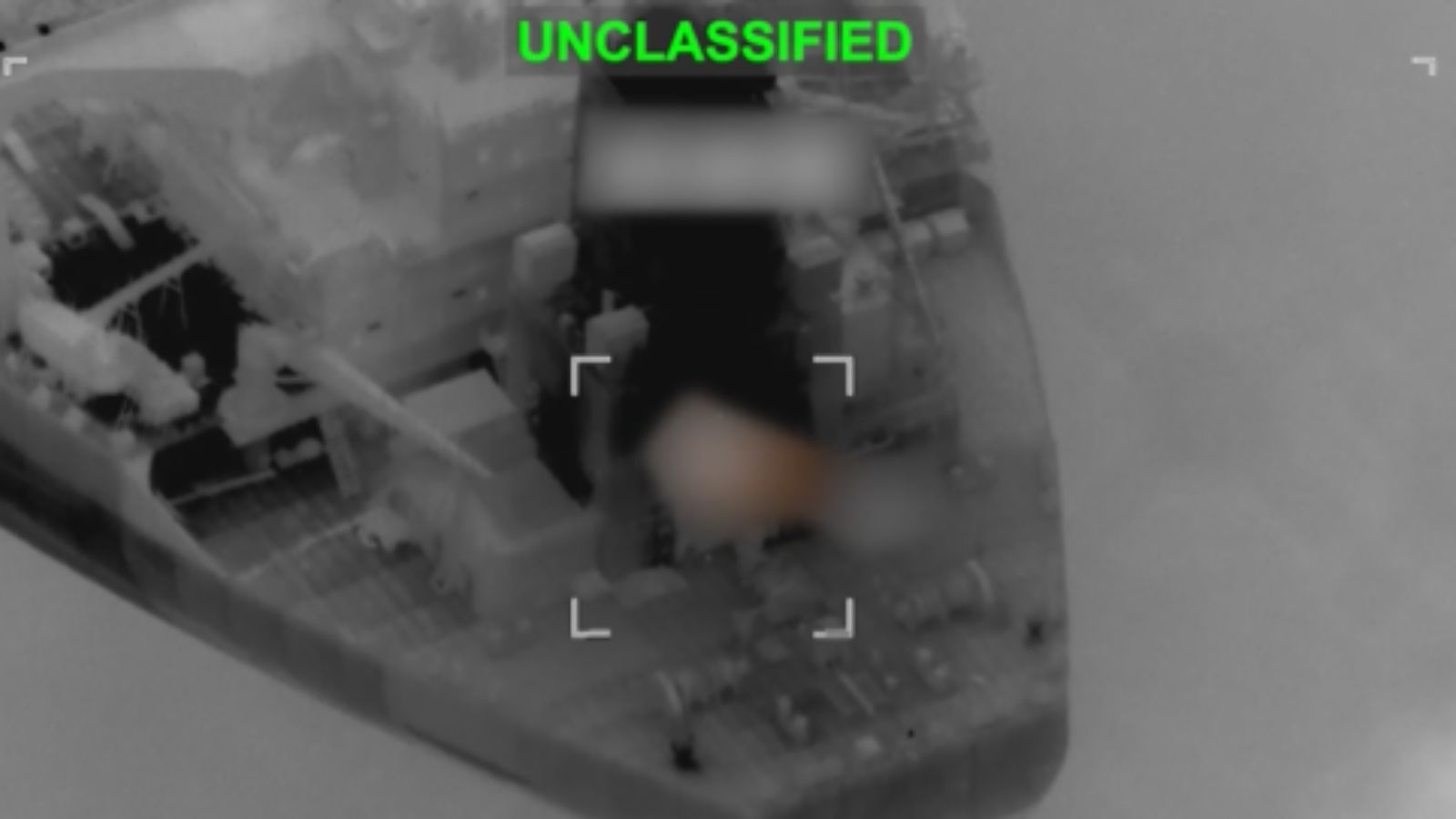
The sea at 3:00 AM does not look like water. It looks like poured obsidian, heavy and slick, moving in slow, muscular swells that shrug against the steel hull of a warship.
Inside the skin of a United States Navy destroyer, the world smells of diesel oil, floor wax, and the dry, metallic tang of recycled air. There is no sunlight here. There is only the low, red glow of battle lanterns and the soft, rhythmic chirping of tactical consoles.
On the radar screens, a single blip moves slowly across the display. It is an unregistered oil tanker, running dark. No lights. No automated identification broadcast. Just eighty thousand tons of steel and crude sliding through the black water of the Gulf of Oman, bound for international markets in direct defiance of a global naval blockade.
To the average observer, a naval blockade is an abstract concept. It is a line drawn on a map in a Washington briefing room, a bullet point in a dry press release, or a sterile headline about "enforcing maritime law."
But treaties do not stop ships. Steel stops ships. People stop ships.
The Cold Physics of the Intercept
To understand how a superpower halts a rogue giant on the high seas, you have to understand the sheer, terrifying scale of the physics involved.
Imagine trying to stop a runaway train on ice using only your bare hands and a few lengths of rope. A fully laden supertanker cannot simply step on the brakes. Once those massive diesel engines push eighty thousand tons of displacement up to fifteen knots, the kinetic energy stored in that hull is colossal. If the crew refuses to stop, you cannot easily force them to do so without risking an environmental catastrophe that would coat hundreds of miles of pristine coastline in toxic sludge.
This is the delicate dance of the Visit, Board, Search, and Seizure (VBSS) teams.
Before the helicopters spin up, before the fast-raiding boats hit the water, a quiet war of nerves plays out over the radio waves.
"Unidentified vessel on course two-seven-zero," the bridge watch officer calls out, his voice flat, drained of emotion by hours of repetition. "This is United States coalition warship. You are operating in violation of international maritime sanctions. Under the authority of the United Nations, you are ordered to alter course immediately and prepare to be boarded."
Silence. Only the static of the VHF radio hiss fills the bridge.
On the bridge of the dark tanker, the captain faces a choice. To his left is the satellite phone linking him to handlers in Tehran or obscure shell companies registered in Panama, urging him to push through, promising bonuses, reminding him of the millions of dollars riding on this single cargo of black gold. To his right is the radar signature of a guided-missile destroyer closing the distance at thirty knots.
The static pops.
"We are a commercial vessel," a heavily accented voice replies. "We are in international waters. You have no authority."
It is a lie, of course. But on the water, lies are currency until they are cashed in for cold reality.
The Drop into the Dark
When the order comes, the transition from tense waiting to explosive action is instantaneous.
Members of the boarding team do not look like the sailors you see in recruiting commercials. They are weighed down by eighty pounds of gear: ballistic plates, waterproof radios, zip-ties, breaching tools, and short-barreled carbines. Their faces are covered in flame-resistant balaclavas.
They pile into the rigid-hull inflatable boats (RHIBs)—essentially high-powered, armored rafts that bounce violently off the waves at forty miles per hour. The salt spray hits their goggles like gravel.
Up ahead, the tanker looms like a black cliff face. Standing on the deck of a RHIB looking up at the towering hull of a supertanker is a humbling experience. The sheer mass of the vessel makes you feel microscopic. One misstep, one slip of the aluminum boarding ladder, and you are sucked beneath the giant hull into the massive, churning bronze screws of the ship's propeller.
The ladder goes up, hooking over the tanker’s gunwale.
The first man climbs. He does not look up. He focuses only on his hands, his feet, and the rhythmic rise and fall of the ocean trying to rip the ladder away from the hull.
As his boots hit the rusted steel deck, his world shrinks to the beam of his weapon’s flashlight. The tanker's crew is nowhere to be seen. They have retreated to the superstructure, locking themselves behind heavy steel doors in the superstructure—a tactic known as taking refuge in the "citadel."
The boarding team moves in a tight, synchronized wedge. They bypass the massive pipes and valves of the cargo deck, navigating the maze of dark corridors, their boots clinking against the steel grate stairs.
The Human Ledger of the Shadow Economy
It is easy to paint the crew of these black-market tankers as villains or smugglers. The truth is far more tragic, far more human.
Most of the men working these ships are not geopolitical masterminds. They are merchant mariners from developing nations—families to feed in Manila, Mumbai, or Odessa. They took a job on a ship with a suspicious name and a flag of convenience because the pay was slightly better, or because it was the only contract available.
When the boarding team breaches the bridge, they do not find hardened commandos. They find tired, frightened men in grease-stained coveralls, squinting against the sudden flashlights.
The tanker’s captain sits in his high chair, his hands resting on his knees. He knows the game is up. He does not resist.
"Where is your manifest?" the boarding team leader asks, his voice muffled by his mask.
The captain points to a clipboard on the chart table. It is a work of fiction. It claims the ship is carrying molasses, or industrial wastewater, or oil sourced from a completely legitimate, non-sanctioned port thousands of miles away.
But the chemical sniffers do not lie. The draft of the ship—how low it sits in the water—does not lie. The hundreds of millions of dollars of raw, unrefined Iranian crude oil sitting beneath their feet is real, and it is not going anywhere.
The Cost of the Invisible Blockade
By the time the sun begins to crack the eastern horizon, painting the sky in bruised shades of purple and orange, the situation is resolved.
The tanker's engines are shut down. A skeleton prize crew from the destroyer has taken control of the helm. The rogue vessel will be escorted to a neutral port, its cargo seized, its crew processed, and its owners fined millions of dollars they will likely write off as the cost of doing business.
In the grand scheme of global politics, this intercept is a minor event. It will merit perhaps three paragraphs on page twelve of the financial news, framed as a routine enforcement action.
But there is nothing routine about it.
Every gallon of oil intercepted is money denied to regimes that fund proxy wars, build drone arsenals, and destabilize entire regions. The blockade is not just a legal construct; it is a giant, silent filter installed at the choke points of the world's oceans, straining out the lifeblood of conflict before it can reach the global market.
On the deck of the destroyer, the boarding team climbs back aboard. They peel off their heavy gear, their skin pale and wrinkled from sweat and salt water. Their hands shake slightly as the adrenaline finally drains from their systems.
One of them lights a cigarette, looking out over the water at the captured tanker, now sitting still and silent in the morning light.
The ocean remains indifferent. It has witnessed empires rise and fall, ships sink, and fortunes vanish into its depths. Tonight, another ship will try to slip through the dark. And tonight, the boats will launch again.