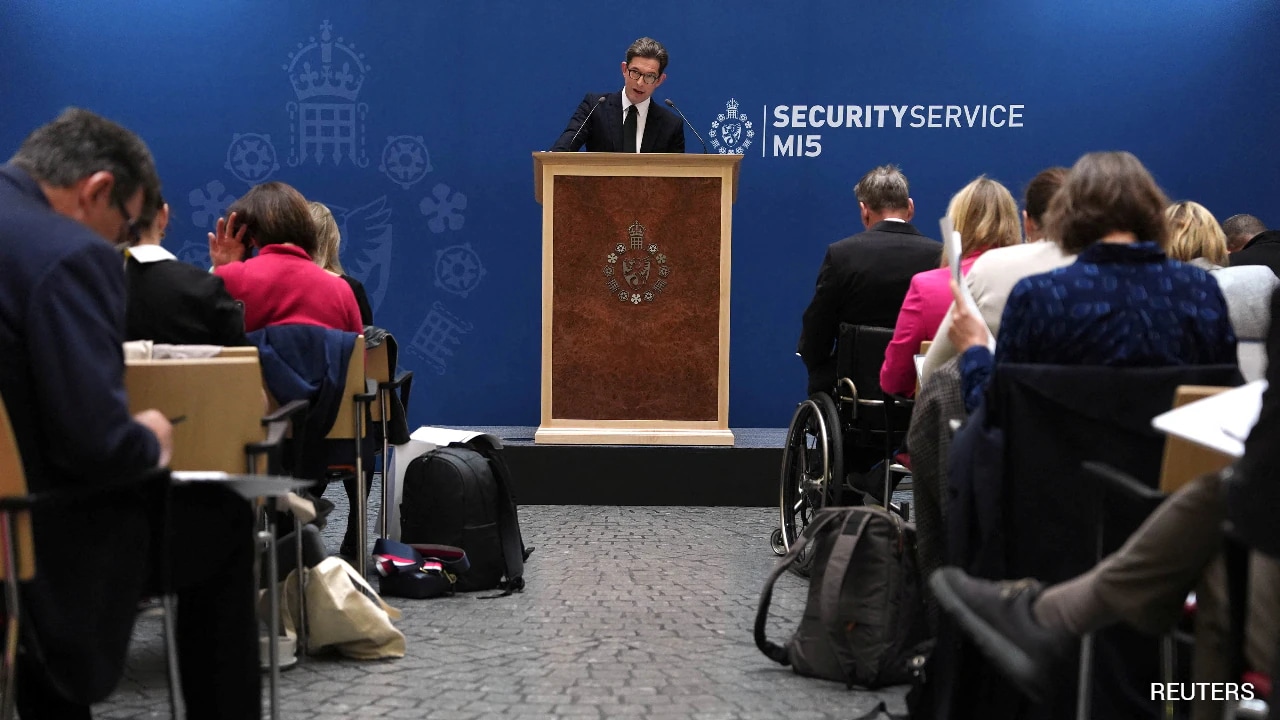
Every year, an intelligence chief steps up to a lectern in London. Every year, the headline writes itself. Iran. Russia. AI. Terrorists. Same four horsemen. Same breathless warnings. Same predictable outrage in the morning papers.
It is theater. High-stakes theater, sure. Well-funded theater, certainly. Yet watching security commentary treat an intelligence chief's annual address like a final exam rather than a budget pitch misses almost everything that matters. Meanwhile, you can find similar developments here: Inside the NEET Crisis Nobody Is Solving With Benefit Cuts.
When a threat briefing bundles state-backed espionage, Russian hybrid warfare, artificial intelligence, and violent extremism into a single neat bucket, it sounds decisive. It is actually lazy. Those four threats do not operate on the same timeline, share the same incentives, or respond to the same defenses. Lumping them together makes for a great news ticker. It makes for terrible strategic clarity.
I have watched organizations spend millions chasing the flashiest name on that list while leaving the doors wide open to far duller, far deadlier failures. Boards buy shiny detection tools because someone said "AI." Executives panic about foreign sabotage because they read a headline about Tehran or Moscow. Meanwhile, basic identity hygiene, patching, vendor vetting, and human resilience sit neglected in the corner. To explore the full picture, check out the detailed article by Associated Press.
The Four-Horseman Fallacy
Security headlines love symmetry. Four words fit nicely on a placard. They give readers the comforting illusion that the chaotic world of espionage, sabotage, and extremism has been neatly cataloged.
It has not.
Start with state-backed espionage and hybrid warfare. States act out of power politics, leverage, deniability, and strategic patience. When Russian actors run disinformation, sabotage supply chains, or probe critical infrastructure, they are testing boundaries and imposing costs without crossing into open conventional war. When Iranian networks operate abroad, they blend intelligence collection, regional influence operations, transnational intimidation, and opportunistic cyber activity.
Now look at terrorists and violent extremists. Their incentives look very different. Small cells or lone actors rarely care about decade-long geopolitical leverage. They care about propaganda reach, operational simplicity, access to targets, and exploiting moments of social strain.
Then drop artificial intelligence into the middle of that mix as if it were a rival nation or a militant group. It is neither. AI is a force multiplier, a tooling layer, and an automation engine. Calling AI a threat alongside Iran and Russia is a bit like listing "electricity" right next to "smugglers" and "armored divisions." Electricity powers both factories and traps; treating the power grid itself as the adversary confuses the medium with the motive.
When commentators treat all four as a single monolithic danger, they flatten real differences in tradecraft and intent. A defender who prepares for a noisy, automated phishing wave is not automatically ready for a patient, human-enabled insider operation inside a cleared supply chain.
What People Actually Ask When They Read These Headlines
Whenever a major security warning hits the news, search bars fill up with the same anxious questions. Most of them start from a shaky premise.
"Are foreign states about to knock out UK infrastructure overnight?"
Unlikely in a single cinematic blackout. Sustained, kinetic disruption of major national infrastructure carries massive escalation risks for any state actor. What happens far more often is quieter, messier, and harder to attribute: probing, supply-chain compromise, pre-positioning, disruption of smaller contractors, and psychological pressure designed to make institutions look brittle.
The real danger is rarely one giant explosion. It is slow erosion of trust and resilience across dozens of unglamorous links.
"Will AI make terrorist attacks and cyber espionage ten times more sophisticated?"
AI makes scale and speed cheaper. It helps bad actors draft convincing lures faster, translate material, sift through leaked data, and automate repetitive reconnaissance. That matters. Volume creates noise, and noise exhausts defenders.
What AI does not automatically hand out is zero-day mastery over hardened systems or flawless physical execution in the real world. Most high-impact breaches and attacks still rely on human error, weak access controls, unpatched vulnerabilities, or social pressure rather than sci-fi super-intelligence. If an organization cannot stop basic credential theft today, worrying about hypothetical future AI super-weapons is a distraction.
"How can ordinary businesses and citizens tell real danger apart from political noise?"
You separate incentive from spectacle. Political speeches and intelligence briefings serve real institutional purposes, including deterring adversaries, rallying allies, and justifying resources. None of those purposes are illegitimate on their face. Still, a warning is not a complete risk assessment for your specific company or household.
Ask two blunt questions whenever a sweeping threat roundup lands:
- Why would an adversary care about my data, access, or operations?
- Which single weakness of mine is easiest to exploit right now?
If your answer to question two is "weak multi-factor authentication" or "an unmonitored third-party vendor," you do not need a geopolitical treatise. You need execution.
Where the Conventional Wisdom Breaks Down
To be fair to intelligence professionals, public briefings have constraints. Operational security prevents officials from laying out sensitive sources, ongoing operations, or exact technical attribution in full view. A public speech is inherently broad.
The mistake is treating a broad public warning as a finished analysis.
Consider how hybrid warfare works in practice. Adversaries rarely rely on one channel alone. Cyber intrusions pair with influence campaigns, front companies, financial proxies, or physical disruption. Analysts who view cyber as purely a technical IT problem miss the political and human levers attached to it. Conversely, commentators who treat everything as grand geopolitical chess ignore mundane operational slip-ups that get attackers caught or stopped.
I have seen security teams get hypnotized by attribution—spending weeks debating whether a set of indicators points to Moscow, Tehran, or a criminal syndicate—while active lateral movement sits right inside their network. Attribution matters for diplomacy, deterrence, and law enforcement. During an active intrusion, containment and eradication matter first.
Think about a simple scenario. Imagine a mid-sized engineering firm supplying components to public works. Its leadership reads a dramatic warning about state-backed sabotage and AI-enabled threats. The board asks for an "AI threat briefing" and buys an expensive monitoring tool. Six months later, an attacker walks in through a contractor's compromised VPN using a reused password. No exotic AI trick. No movie-plot espionage. Just basic hygiene failure.
That is not a failure of imagination. It is a failure of priorities.
What Heavy Hitters Get Right—and Where Even Experts Stumble
Serious thinkers in national security, intelligence studies, and cybersecurity—figures like Thomas Rid on cyber conflict, Bruce Schneier on security trade-offs and systems thinking, and veteran intelligence practitioners who write candidly about tradecraft—converge on a sobering truth: complexity is the enemy of defense, and hype is the enemy of prioritization.
Rid's work on how cyber conflict behaves less like classic warfare and more like espionage, subversion, and political contestation cuts straight through apocalyptic exaggeration. Schneier's emphasis on incentives, risk trade-offs, and brittle systems reminds us that adding flashy layers without fixing underlying design flaws just creates new failure modes.
Even seasoned experts can stumble when they over-index on novelty. A new technique gets a catchy name, and suddenly every incident gets squeezed into that frame. Yesterday it was advanced persistent threats; today it is AI agents; tomorrow it will be whatever buzzword sells conferences. The fundamentals—identity, least privilege, segmentation, patching, logging, backups, and calm incident response—never stop mattering, yet they rarely get applause.
The Downside of Taking a Contrarian View
Calling out threat hype carries its own traps. A contrarian posture can easily drift into smugness or under-reaction.
Here is the honest catch with pushing back against alarmist briefings: low-probability, high-impact events still happen, and complacency punishes the overconfident. States do occasionally cross lines they usually avoid. Terrorist plots do occasionally slip past defenses despite overwhelming odds. New technologies do occasionally unlock capabilities faster than defenders expect.
If you dismiss every broad warning as "just politics," you can blind yourself to genuine shifts in adversary behavior. Skepticism is useful only when paired with discipline. Cynicism is just another form of laziness.
The right stance is not indifference. It is cold-eyed triage. Treat dramatic headlines as prompts to check your assumptions, not substitutes for measuring your actual exposure.
How to Actually Defend Against What Is Coming
Forget trying to out-predict every capital and every extremist group on earth. Focus on raising the cost of attacking you while shrinking your own blast radius.
Fix the Unsexy Fundamentals First
- Lock down identity and access: Enforce phishing-resistant multi-factor authentication, retire standing privileged access where possible, and audit third-party accounts ruthlessly.
- Segment and back up: Assume breaches will happen. Isolate critical systems and keep immutable, tested offline backups so disruption stays contained instead of cascading.
- Patch and shrink: Fewer exposed services and faster remediation cut off the low-hanging fruit that automated campaigns and opportunistic actors harvest first.
Map Real Adversary Paths, Not Buzzwords
Instead of asking "How do we stop AI?" or "How do we stop nation-states?", map concrete attack paths against your crown jewels. How could someone reach your sensitive data, operational controls, or reputation? Usually through a vendor, a compromised account, a misconfigured cloud asset, or a trusted insider. Close those paths in order of likelihood and impact.
Build Institutional Calm Under Pressure
Crises thrive on panic and ambiguity. Run tabletop exercises that test decision-making when information is incomplete and noisy. Make sure leaders know who has authority to pull the plug, communicate clearly, and keep core operations running without waiting for 100% certainty.
Warnings about Iran, Russia, AI, and terrorism will keep coming every year, and some of them will point to very real dangers. Do not let the loudest words in the room dictate where you spend your time or money. Fix the weak links you can actually control today.