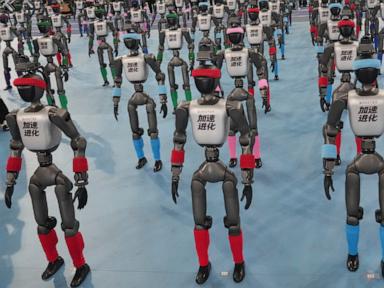
The stadium air smelled of ozone, warm rubber, and quiet tension. High above the floor of the National Speed Skating Oval in Beijing, the scoreboard lights cast a cold, amber glow over thousands of empty seats and rows of engineers clutching thermal mugs. They were waiting for a starting gun that would not sound for a runner with lungs, blood, or heartbeat.
Consider a hypothetical spectator named Chen, sitting midway up the steel stands. Chen remembers watching Usain Bolt cross the finish line in Berlin back in 2009, arms outstretched, defying every biological ceiling humanity had ever known with a time of 9.58 seconds. That number felt sacred. It felt like an absolute boundary drawn by evolution, muscle fiber, and bone.
Until today.
The machine crouched at the starting blocks did not breathe. Its actuators hissed softly, equalizing pressure within synthetic limbs engineered by Beijing-based X-Humanoid. When the electronic tone pierced the air, there was no hesitation, no buildup of lactic acid, no dramatic torso lean at the tape. There was only an instantaneous, violent acceleration of titanium and carbon fiber.
Stop. Look at the clock.
Nine point three nine seconds.
The record is gone. Smashed into pieces by an autonomous runner that treats Bolt's golden standard as a warm-up drill. During earlier trials, another creation from smartphone maker Honor tore down the same straightaway in 9.32 seconds, hitting peak velocities that would leave world-class sprinters staring at dust.
We built these bodies to mimic our own, assuming vanity was our only motive. We wanted mechanical servants that looked like us so they could hold our coffee or fold our laundry without alarming us. But the World Humanoid Robot Games stripped away that domestic pretense. This is not about chores. This is about physical supremacy, measured in millimeters and milliseconds, playing out on a global stage where more than two thousand machines have converged to rewrite physics.
Look across the infield to the high jump pit.
For decades, Javier Sotomayor’s 1993 record of 2.45 meters stood like a monument to human vertical potential. It required a masterclass of kinetic energy transfer, a precise curved approach, and an agonizingly tight arch of the spine to clear the bar by a whisper.
The X-Humanoid machine parked before the uprights did not arch its back. It simply calculated the load, compressed its hydraulic springs, and launched upward with terrifying mathematical indifference. It cleared 2.88 meters. That height is not an athletic achievement in the traditional sense; it is a demonstration of pure, unfeeling material translation. The machine did not feel the triumph of flight. It only executed code.
Yet down on the sidelines, the humans felt plenty.
Li Yanfeng, an education worker who came to the stadium with a deep-seated resistance to artificial intelligence, watched the mechanical athletes march onto the field in synchronized formations. She had spent months harboring the quiet, universal fear that automation would render human effort obsolete, erasing the value of our struggle. But standing in the roar of the arena, watching metal limbs achieve what generations of human athletes bled to approach, her resistance shifted into a dizzying sense of awe.
We are watching the end of biological exclusivity.
For all our history, motion was our domain. To run was to be alive. To jump was to escape gravity, if only for a second, through sheer willpower and biological grit. Now, algorithms own the stopwatch.
Geopolitical currents swirl outside these stadium walls like an incoming storm. Trade restrictions tighten. Regulatory walls rise across continents. Governments scramble to classify and contain the very entities performing calisthenics on an Olympic track. But inside the oval, stripped of politics and trade tariffs, the reality is far simpler and far more haunting.
The boundary lines have moved.
The machines are no longer learning how to walk among us. They are learning how to leave us behind on the track, one shattered second at a time.


