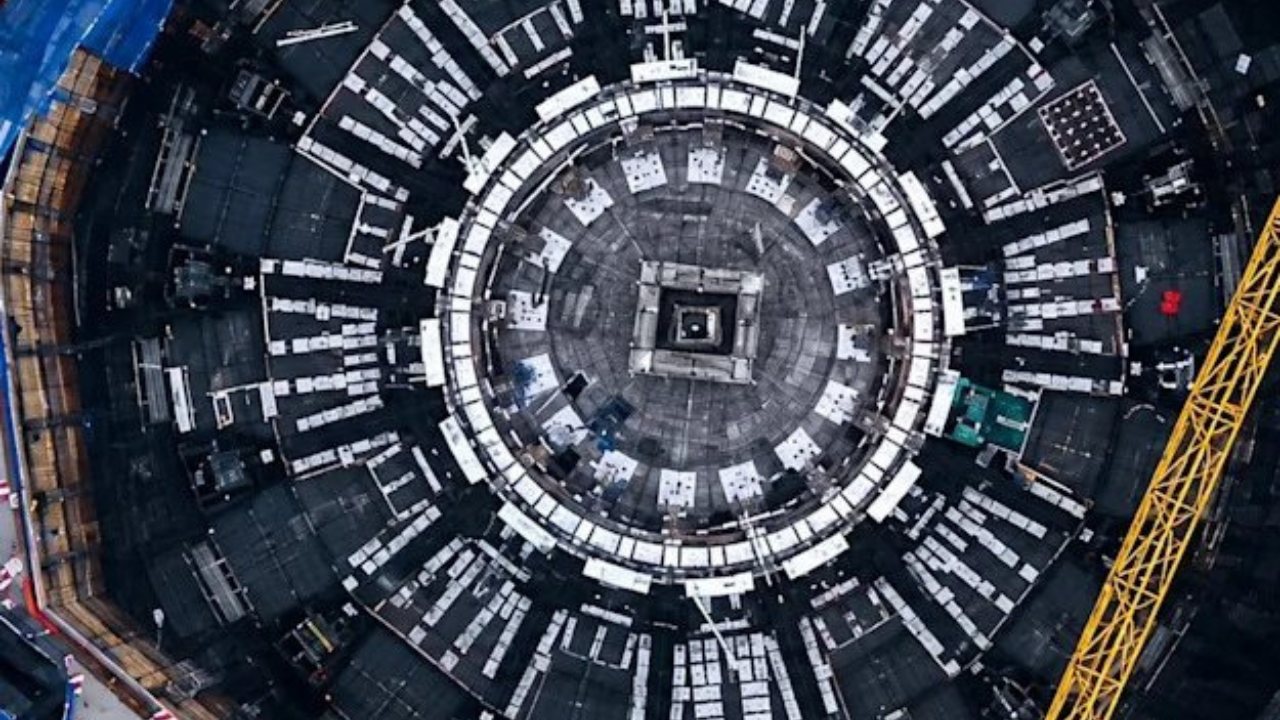
Dr. Aris Thorne does not sleep well. He lives in a small apartment in Hefei, where the air is often thick with the humidity of the Yangtze River valley. Late at night, when the rest of the world goes quiet, he stares at his hands. They are calloused, stained with the faint, persistent ghost of graphite lubricant and high-grade coolant. He isn’t a god. He is a shepherd for a fire that should not exist on this planet.
He spends his days, and many of his nights, thinking about a 582-ton ring of superconducting metal.
It is a magnet. To call it merely a magnet, however, is to call the Mona Lisa a scrap of canvas with some pigment smeared on it. This object, housed within the bowels of the experimental reactor known as the "Artificial Sun," is the only thing standing between the civilized world and the absolute chaos of the stars.
Inside that chamber, they create conditions that have no business occurring on Earth. We are talking about plasma heated to over 100 million degrees Celsius. For context, the core of the Sun burns at a mere 15 million degrees. They are bottling a supernova in a room smaller than a lecture hall.
The physics of this endeavor is a brutal, unforgiving dance. At those temperatures, atoms lose their electrons. They become a frantic, charged soup of ions, desperate to expand, to tear through the walls of the chamber, to melt everything they touch. If the plasma so much as kisses the inner wall of the machine, the entire system crashes. The fire dies. Years of work evaporate in a millisecond.
This is why Dr. Thorne’s magnet matters.
Imagine trying to hold back a stampede of bulls with nothing but a magnetic field. That is the engineering challenge. The magnet doesn't just sit there; it exerts an invisible, crushing pressure. It creates a bottle out of force lines, a cage woven from electricity and super-cooled metal. The 582-ton structure acts as the ribs of this cage, holding the intense, roiling fury of the plasma in a state of suspended animation.
It is a masterpiece of materials science. Most metals would become brittle, useless shrapnel at the temperatures required to keep these coils superconducting. They have to be cooled down to within a breath of absolute zero. There is something deeply poetic, and frankly terrifying, about the fact that to keep a star-hot fire alive, you must surround it with the coldest environment human hands have ever constructed.
We have spent decades chasing the promise of nuclear fusion. It is the holy grail. It is the clean, infinite battery that would render our dependency on burning ancient carbon completely obsolete. But for the longest time, it felt like a ghost story. Always thirty years away. A perpetual carrot dangled in front of desperate scientists.
But then, the weight changed.
When you see the numbers on the screen—582 tons—you have to think about the logistics. The mining, the smelting, the precise winding of miles of superconducting wire. Every single centimeter of that wire represents a potential failure point. If one connection slips, the whole thing warms up, and the magnetic field collapses.
I remember watching the first test run of a smaller coil years ago. The room was deathly quiet. People were holding their breath, not because of the danger of an explosion—the math is too good for that—but because of the fear of failure. We have learned to live with the fear of failure. It is our constant companion. We aren't building a bridge that holds cars; we are building a reality that holds the energy of creation.
The public perception of this technology remains stuck in the 1970s. People imagine clunky, unsafe reactors prone to meltdowns. They confuse fusion with fission. They hear "nuclear" and they instinctively recoil. But this is the opposite. Fission splits atoms, leaving behind long-lived, toxic waste. Fusion joins them. It produces helium—an inert gas—and energy. The fuel is derived from seawater.
The real tragedy is that we lack the vocabulary to describe what this means for the human condition. We speak in megawatts and degrees Celsius, but we should be speaking in terms of liberation.
If we stabilize the plasma, if we master the magnetic bottle, we unlock a future where energy is as abundant as the light of the Sun itself. Think about that. No more resource wars fought over dwindling oil reserves. No more smog-choked cities. The environmental cost of our modern existence could be erased, replaced by a source of power that operates on the same principle that lights the heavens.
But there is a loneliness to the work. When you are the one standing at the console, you realize that history is not a straight line. It is a series of fits and starts, driven by people who are willing to devote their lives to objects that weigh hundreds of tons but exist primarily as pure, abstract force.
The magnet in Hefei is just the latest chapter. It is more sophisticated, more massive, and more capable than anything that came before it. It represents a subtle, but profound, shifting of the tides. We are moving from the era of "can we do this" to "how do we scale this."
Consider the materials needed for this structure. They aren't off-the-shelf components. They were forged in a crucible of necessity. Each section was checked, re-checked, and checked again by people who will never be famous, who will never stand on a podium to accept an award. They are the ones who worry about the microscopic fractures in the insulation. They are the ones who know that the physics of the stars is unforgiving of vanity.
Sometimes, in the dead of the night, Dr. Thorne walks out to the reactor floor. The machine is dark. It is dormant. It looks like a sleeping giant, a tomb of stainless steel and complex geometry. He touches the cold metal of the cryostat, feeling the faint, residual vibration of the hum that occurred earlier that day.
He knows that tomorrow, they will ramp up the current again. They will pump the liquid helium through the cooling channels. They will initiate the pulse. For a few brief, glorious moments, they will create a star in the middle of a laboratory. And then, the magnets will pull, the plasma will dance, and for a fleeting instant, the energy of the cosmos will be contained within a ring of metal.
It is a beautiful, fragile, and absolutely necessary defiance of the darkness.
There is a point where the math stops being numbers and starts being architecture. When you look at the 582-ton magnet, you are seeing the manifestation of a thousand failed experiments, a million lines of code, and the collective willpower of a society that has decided, despite all evidence to the contrary, that we are capable of bending the fundamental forces of the universe to our will.
We are not merely building an artificial sun. We are building the threshold of a new epoch. And while the magnets are cold, and the plasma is unimaginably hot, the heart of the project is entirely, desperately human.
It is the hum of a wire that defies the laws of resistance. It is the silence of a control room watching a graph spike toward the impossible. It is the realization that, eventually, we might just be able to stop burning the world to light it.
The light is coming. It is trapped in a bottle, waiting for us to find the key.