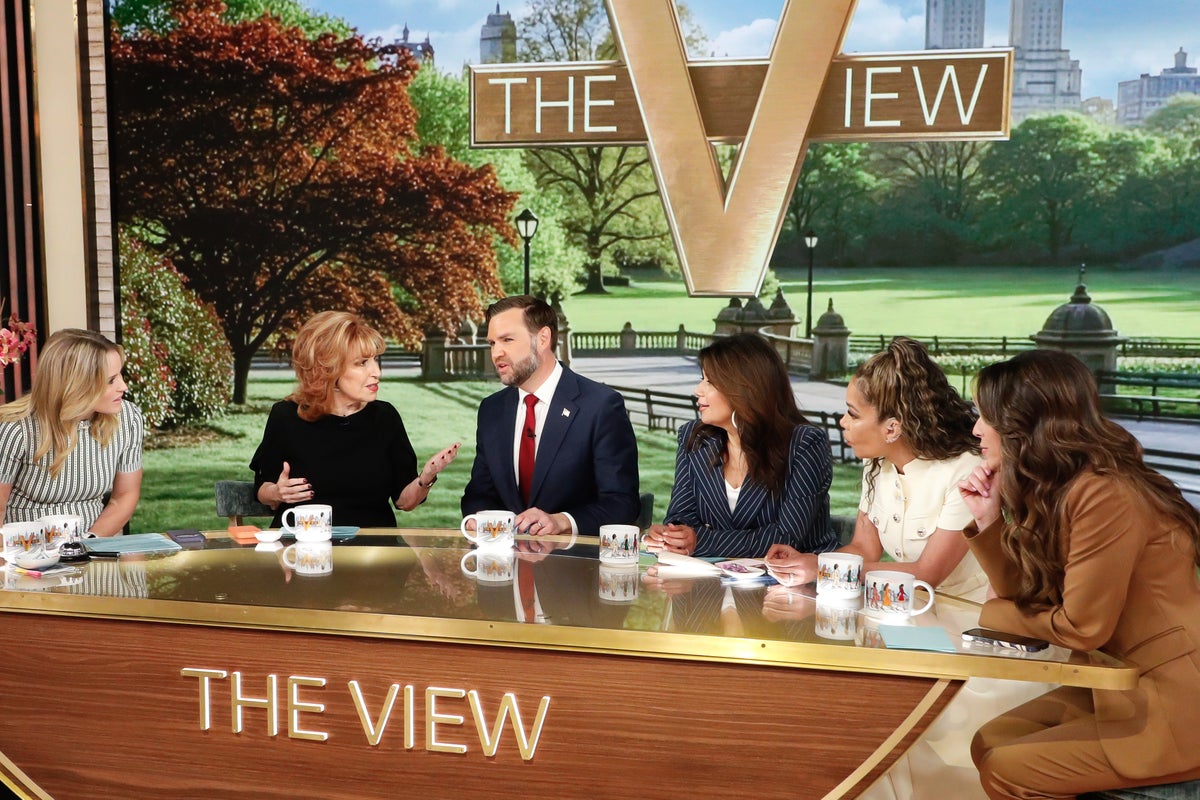
The modern political commentary machine loves nothing more than a manufactured backstage whisper. When a daytime talk show host leaks a private commercial-break exchange with a polarizing political figure like JD Vance, the media treats it like a profound moment of truth-telling. They dissect the body language. They parse the off-camera dialogue. They pretend a twenty-second interaction during a makeup touch-up is a masterclass in political resistance.
It is a total illusion.
The lazy consensus among media critics is that these greenroom confrontations matter. The assumption is that catching a politician with their guard down reveals their "true" nature or shifts the cultural needle. It does neither. In reality, these highly publicized backstage interactions are mutually beneficial transactions disguised as authentic friction. Both sides get exactly what they want, while the audience walks away with a fundamentally warped understanding of how political media actually functions.
The Myth of the Off-Camera Epiphany
Every daytime television producer knows the secret to viral longevity: manufacture a sense of high-stakes intimacy. When a host recounts what they supposedly told a candidate while the cameras were dark, they are not breaking the fourth wall. They are extending the stage.
Politicians of all stripes do not stumble into hostile studio environments by accident. They enter them with a calculated risk-reward matrix. For a conservative figure like Vance, appearing on a traditionally progressive platform is not about convincing the hosts or winning over the live studio audience. It is an exercise in base mobilization. Every hostile question is a gift. Every tense commercial break is raw material for a fundraising email or a post-show grievance loop.
When the host brags about "setting the record straight" during a commercial block, they are feeding their own audience’s desire for validation. The host looks tough; the candidate looks embattled. It is a perfect, closed-loop ecosystem of confirmation bias.
The Reality Check: Political television is an industry built on conflict generation, not conflict resolution. No mind has ever been changed by an off-camera lecture between segments.
The Audience Is the One Being Manipulated
Consider the sheer mechanics of a television production. A commercial break lasts roughly two to four minutes. Within that window, hosts are briefed by executive producers, microphones are adjusted, water glasses are refilled, and stage managers shout countdowns.
The idea that any substantive, nuanced political debate occurs in this chaotic interval is absurd. Yet, the public is told to view these snippets as raw, unvarnished truth.
I have spent years watching the gears turn behind the scenes of major network broadcasts. I have watched hosts nod politely to guests during the break, only to savage them the moment the red light turns back on. I have watched candidates play the villain on air, only to swap golf stories with their interviewers the second the show cuts to a local car dealership ad.
The mistake the public makes is believing that the television industry operates on the same emotional plane as the viewer. It does not. It operates on ratings, retention, and shareable digital video clips.
Dismantling the Greenroom Industrial Complex
Let us address the fundamental questions that media consumers constantly get wrong:
Does confronting a politician on a talk show actually change voter perception?
No. Decades of political science data, from the early Nixon-Kennedy debates to modern polarization metrics tracked by organizations like the Pew Research Center, confirm that audiences process political media through a lens of deep partisan motivated reasoning. A liberal viewer watches a host confront a conservative candidate and sees a heroic defense of truth. A conservative viewer watches the exact same exchange and sees an elite media ambush. The confrontation merely hardens existing biases.
Why do politicians agree to interviews on hostile networks?
Because validation is cheap, but friction is priceless. In a fragmented media environment, a politician gains far more utility from fighting a perceived enemy than from preaching to the choir. Appearing on a hostile program allows a candidate to demonstrate courage to their base. If the interview goes well, they win. If the interview is a disaster, they claim media bias and win bigger.
What happens behind the scenes during commercial breaks?
Logistics, choreography, and professional courtesy. The most jarring aspect of television production for an outsider is how quickly the hostility vanishes when the cameras stop rolling. Television is a workplace. The hosts, the politicians, the producers, and the publicists are all professionals operating within a specific theater. The anger is almost always performative.
The Dangerous Con of "Authentic" Backstage Access
The real damage of this phenomenon is that it cheapens actual journalism. When the focus of political reporting shifts from policy analysis, legislative records, and verifiable facts to greenroom gossip, the public loses.
We are trained to look for the "gotcha" moment—the split second where the mask slips. But the mask never slips. The backstage persona is just as curated, if not more so, than the on-air brand. A candidate who knows that every word spoken in a greenroom might be leaked to a supermarket tabloid or a morning podcast behaves with a calculated level of engineered candor.
- The Setup: The candidate acts slightly more vulnerable or slightly more aggressive off-camera.
- The Hook: The host internalizes this as a "real" moment.
- The Payoff: The host recounts the story later, boosting their own credentials while keeping the candidate at the center of the cultural conversation.
This is not journalism. It is a sophisticated form of reality television where the stakes happen to be the governance of the country.
Stop Looking for Truth in the Greenroom
If you want to understand the trajectory of a political movement or the true intent of a candidate, turn off the post-show commentary. Stop reading the articles detailing what happened when the microphones were allegedly muted.
The obsession with backstage drama is a distraction from the dull, critical work of analyzing governance. It turns serious political discourse into a soap opera, where the viewers argue over plot points and character arcs instead of actual outcomes.
The hosts who boast about what they said during the break are not saving democracy. They are selling commercial time. The politicians who endure it are not being defeated; they are being amplified. The next time a network promos an exclusive look at what happened behind the scenes, realize that the cameras don't need to be rolling for the performance to continue.
The show never stops. You are just paying for the tickets.