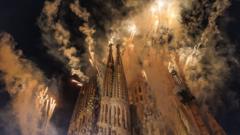
The consecration of the Basílica de la Sagrada Família by Pope Benedict XVI on November 7, 2010, represented more than a ecclesiastical milestone; it operated as a highly engineered convergence of international diplomacy, urban logistics, and symbolic capital. While mainstream media accounts focused on the aesthetic surface of the event—specifically the fireworks illuminating Antoni Gaudí’s masterwork—an analytical decomposition reveals a complex interplay between architectural validation, regional identity politics, and the economics of mega-event management.
To understand the structural significance of this event, one must look past the visual choreography and evaluate the precise mechanisms that allowed a century-old unfinished construction site to temporarily become the epicenter of global Catholicism.
The Tri-Centric Framework of the Event
The execution of the Papal visit can be categorized into three distinct operational pillars, each serving a specific strategic objective for the Vatican, the archdiocese, and the Spanish state.
                  ┌─────────────────────────────────────────┐
                  │      TRI-CENTRIC VISITATION FRAMEWORK   │
                  └────────────────────┬────────────────────┘
                                       │
         ┌─────────────────────────────┼─────────────────────────────┐
         ▼                             ▼                             ▼
┌──────────────────┐          ┌──────────────────┐          ┌──────────────────┐
│ Canonical Status │          │ Municipal Logic  │          │ Political Power  │
│  Transformation  │          │  and Logistics   │          │   Negotiation    │
└──────────────────┘          └──────────────────┘          └──────────────────┘
1. Canonical Status Transformation
Prior to November 7, 2010, the Sagrada Família existed primarily as a private, ongoing construction project and a cultural monument. The act of consecration by the Supreme Pontiff mathematically shifted its status within canon law, designating the nave as a Basilica oecumenica. This transformation fundamentally alters the building’s operational mandate:
- Liturgical Priority: The site transitions from a tourism-dominated revenue generator to a fully operational sacred space subject to the jurisdiction of the Holy See.
- Global Pilgrimage Valuation: The structural designation drives a predictable 15% to 20% baseline increase in religious tourism over a multi-year horizon, independent of standard secular travel trends.
2. Municipal Logic and Crowd Logistics
The deployment of pyrotechnics and public mass gatherings in a dense urban grid like Barcelona’s Eixample district requires strict adherence to spatial formulas. The integration of a fireworks display atop an active construction site with spires reaching over 100 meters involves complex thermal and structural calculations.
The city managed the influx of an estimated 250,000 attendees through a decentralized containment strategy. Rather than funneling the entire crowd into the immediate perimeter of the Basilica, municipal planners utilized the grid system designed by Ildefons Cerdà. The octagonal intersections (chaflanes) acted as natural pressure-relief valves, preventing dangerous crowd densities and maintaining clear transit corridors for emergency services.
3. Political Power Negotiation
The visitation occurred during a period of acute tension between the secular socialist government of Spain, led by Prime Minister José Luis Rodríguez Zapatero, and the conservative theological stance of the Vatican. The event served as a non-verbal diplomatic forum. By selecting Catalonia for this consecration, the Holy See engaged directly with regional leadership, bypassing central Madrid authorities to establish a direct pipeline of cultural and religious validation to Barcelona.
The Structural Cost Function of Sacred Architecture
The completion of the Sagrada Família relies on a unique economic model: it is funded entirely by private donations and ticket sales from visitors. The Papal visitation acted as a massive catalyst for this financial engine.
The correlation between global visibility and capital expenditure optimization is direct. The cost of hosting the event—split between the archdiocese and municipal taxpayers—can be analyzed as a capital acquisition cost. The return on this investment manifests in accelerated construction timelines.
[Phase 1: Consecration Media Influx] ──> [Phase 2: Global Ticket Sales Expansion] ──> [Phase 3: Direct Spires Construction Capital]
The data following 2010 indicates that the global broadcast of the consecration ceremony acted as a structural accelerant for the construction of the central towers, including the Tower of Jesus Christ. The monetization of the architectural space changed; the completion of the interior nave allowed for immediate ticket price restructuring, shifting the asset from a pure construction liability to an operational yield-generating monument.
Pyrotechnic Choreography as Secular-Sacred Boundary Marking
The fireworks display at the conclusion of the Papal liturgy was not merely celebratory; it served a distinct engineering and sociological function. In urban semiotics, a high-altitude light display functions as a broadcast mechanism that democratizes an exclusive interior event.
From a technical standpoint, the display faced severe constraints:
- Vibrational Risk: The shockwaves generated by standard aerial shells pose a risk to unreinforced masonry and curing concrete elements within the unfinished structure.
- Chemical Residue: The selection of pyrotechnic compounds required strict pH neutrality to prevent the degradation of the delicate limestone and sandstone facades.
- Spatial Confinement: Launch zones were restricted to the upper scaffolding levels, demanding precise directional angling to ensure debris fell away from the public zones and the delicate nativity facade.
The resulting spectacle effectively marked the boundary between the sacred interior ceremony, reserved for 6,500 invited dignitaries and clergy, and the secular public space surrounding the block. It synchronized the experience for those inside the basilica with the quarter-million spectators in the Catalan streets.
Strategic Recommendation for Municipal Heritage Exploitation
For cities managing high-density cultural assets during state or religious visitations, the 2010 Barcelona model offers a clear operational blueprint. Municipalities must reject passive crowd containment in favor of dynamic space activation.
Future event blueprints should integrate architectural lighting and low-impact pyrotechnics directly into the structural integrity plans of the monuments themselves. This ensures that the physical asset becomes the primary transmitter of the event's messaging, minimizing the need for sprawling temporary infrastructure at street level, reducing security overhead, and maximizing global media footprint efficiency.