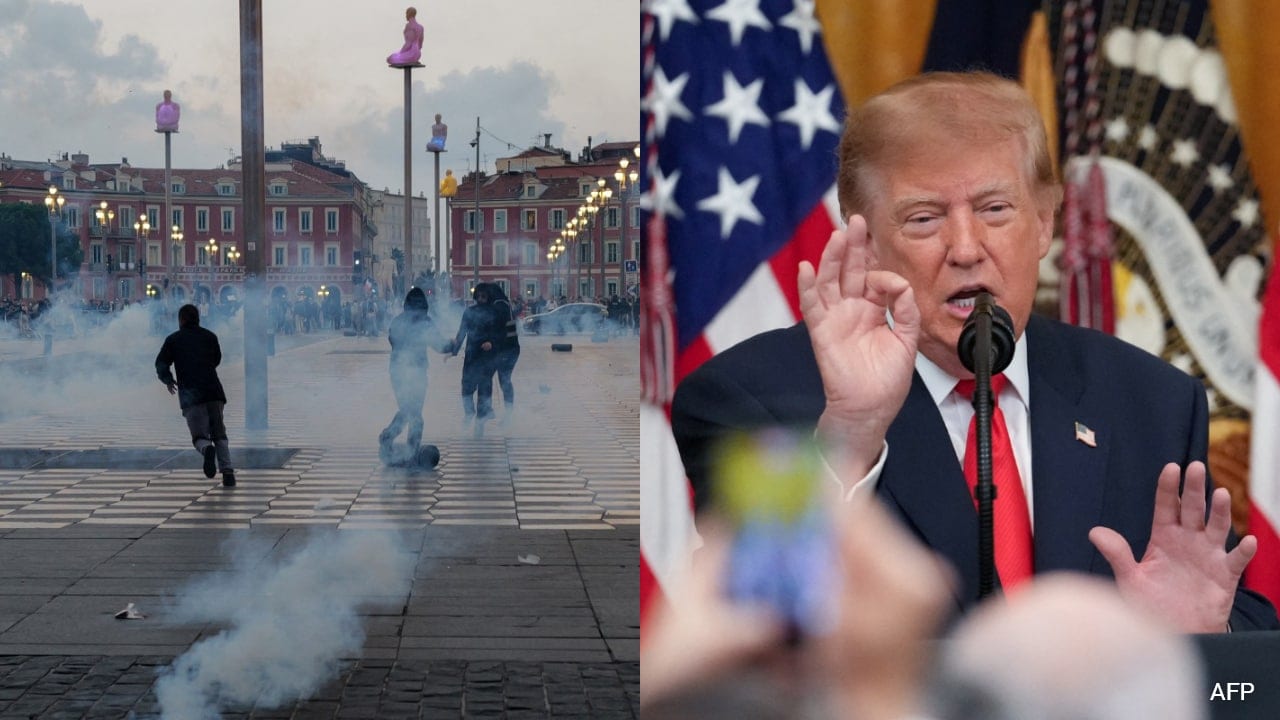
When a head of state mocks civil unrest in an allied democracy, the remarks rarely serve as diplomatic commentary. Instead, they operate as domestic political signaling that converts distant street disorder into a familiar domestic wedge issue.
Standard coverage of U.S. President Donald Trump's sarcastic remarks about French protests—joking about taking a proposed $5,000 payment to France to "join the revolution" amid widespread demonstrations, arson, and looting—typically treats the exchange as a sequence of soundbites and insults. That surface reading misses how foreign unrest is reframed for domestic audiences, how protesters and opportunistic actors interact on the ground, and why rival leaders contest the causal narrative so fiercely.
A rigorous examination separates known facts from educated hypotheses across four layers: the competitor's reporting logic, the anatomy of the protests themselves, the mechanics of cross-border political framing, and the operational limits of any strategic response.
Deconstructing Competitor Reporting Logic
Typical headline-driven coverage of the episode relies on a three-part narrative sequence. First, it highlights the provocative quote—such as mocking France as a "lovely place" with "no riots, no revolutions" before sarcastically urging listeners to join the revolution. Second, it pairs the quote with dramatic visual markers of disorder, including clashes, looting of commercial storefronts, and the fire that damaged the historic 1883 town hall in Limoges. Third, it links the remarks to broader partisan sparring involving Vice President JD Vance, French officials, and domestic U.S. political opponents.
This approach captures immediate attention, yet it leaves three analytical gaps:
- Conflation of distinct actor groups: Treating an entire nationwide protest movement as synonymous with arsonists or looters obscures how peaceful marchers, student demonstrators, black bloc actors, and opportunistic thieves operate within the same urban space.
- Missing causal chains: Reporting the insult alongside the unrest implies a direct explanation without testing whether economic grievances, institutional friction, or external political agendas drove the escalation.
- Unexamined audience targeting: Treating foreign commentary as a critique aimed primarily at France overlooks how domestic leaders use foreign crises as cautionary mirrors for voters at home.
The Anatomy of Unrest and Escalation
Understanding what happens during large-scale demonstrations in France requires separating structural grievances from tactical escalation. Available reporting indicates that the October 2026 mobilizations drew hundreds of thousands of participants across major cities—with estimates ranging from roughly 550,000 according to interior ministry figures to 800,000 cited by the CGT union, alongside more than 1,200 arrests—driven by cost-of-living pressures, economic strain, and student grievances ahead of France's next presidential election cycle.
Rather than a single homogeneous crowd, large protests in dense urban centers typically consist of overlapping layers with different incentives:
- Grievance-driven demonstrators and students: Participants mobilizing over household purchasing power, public policy, or educational issues, who often seek visibility and leverage rather than property destruction.
- Confrontational agitators: Smaller, organized groups—such as black bloc elements—that use crowd cover to clash with security forces or target symbolic and commercial sites.
- Opportunistic looters: Actors who exploit security strain and crowd dispersion to break into retail stores—including high-profile outlets in cities such as Paris and Bordeaux—or vandalize municipal property.
Known facts vs. educated hypotheses: It is a documented fact that large demonstrations occurred across multiple French cities, that violent incidents included fires, clashes, and commercial looting, and that French authorities do not compile official arrest statistics by ethnicity or race under constitutional equality rules. By contrast, attributing the majority of violence to any specific demographic or claiming a single hidden orchestrator behind every act of vandalism remains an educated hypothesis or political claim unless supported by verified evidentiary attribution.
Consider a practical urban policing example. When hundreds of thousands of marchers fill central boulevards while high school students gather near landmarks and smaller groups move into commercial streets, police commanders face a resource allocation trade-off. Concentrating riot units solely around one landmark or march route can leave secondary shopping corridors or municipal buildings exposed, allowing small mobile groups to create high-impact visual incidents even when peaceful marchers represent the bulk of the crowd.
Cross-Border Framing and Narrative Contestation
When political figures outside a country comment on its domestic turmoil, they rarely optimize for nuance. They optimize for narrative portability—the ability to map a foreign event onto an existing domestic debate with minimal explanation.
In the U.S. context, Trump's mockery and allied commentary from figures like Vance framed French disorder around immigration, cultural integration, and warnings aimed at American voters and congressional Democrats ahead of election contests. In France, government officials and commentators pushed back against external attribution, arguing that foreign leaders were misreading domestic dynamics or projecting their own political arguments onto French streets.
This dynamic follows a clear cause-and-effect mechanism:
- Visual anchor selection: A dramatic image—such as a burning historic building or a ransacked storefront—acts as a high-salience shorthand for systemic breakdown.
- Single-factor attribution: Complex multi-cause events (cost-of-living strain, labor and student mobilization, policing friction, opportunism) are compressed into a single preferred cause, such as migration policy or rival partisan governance.
- Domestic transfer: The compressed story is attached to a domestic political opponent or policy choice, turning an external crisis into an internal warning.
The second limitation of this framing is its analytical blind spot. When a speaker treats complex civil unrest as proof of a single pet theory, they ignore variables that could produce similar street friction even under very different demographics or border policies—such as acute inflation, stagnant real wages, or long-running institutional distrust.
Operational Framework for Analysts and Communicators
For analysts, strategists, and communicators evaluating coverage of foreign protests and political reactions, disciplined verification prevents reactive misinterpretation. A practical four-step workflow clarifies what is actually happening:
- Separate scale from intensity: Compare overall crowd size and geographic spread against specific incidents of arson, looting, or clashes to judge whether disorder reflects universal crowd behavior or localized escalation.
- Map stated grievances to timing: Check economic indicators, legislative flashpoints, and electoral calendars to see why mobilization peaked when it did.
- Audit attribution against evidence: Distinguish between verified official findings, eyewitness reporting, and partisan claims that assign blame before investigations conclude.
- Identify the speaker's primary audience: Ask whether a remark is meant to persuade the foreign government in question or to mobilize domestic voters at home.
Limitations and boundary conditions: No analytical checklist eliminates uncertainty during fast-moving street events. Real-time crowd counts vary between organizers and authorities, rumors spread rapidly on social media during curfews and communications disruptions, and political actors routinely compete to define the meaning of events before complete facts emerge. Rigor requires updating assessments as verified data arrives rather than locking onto the first compelling explanation.
Strategic Action for Media and Policy Teams
Editors, researchers, and policy teams covering cross-border political reactions to civil unrest should build a standing Attribution and Incentive Matrix into their editorial and briefing workflow before the next crisis hits. For every major foreign protest story that draws high-profile external commentary, require teams to log three items side by side: documented economic or policy triggers on the ground, verified incident types versus total protest scale, and the domestic political incentive of each external commentator. Doing so strips away performative noise, exposes where causal claims outrun evidence, and gives decision-makers a clearer view of both the street reality and the political theater built around it.


