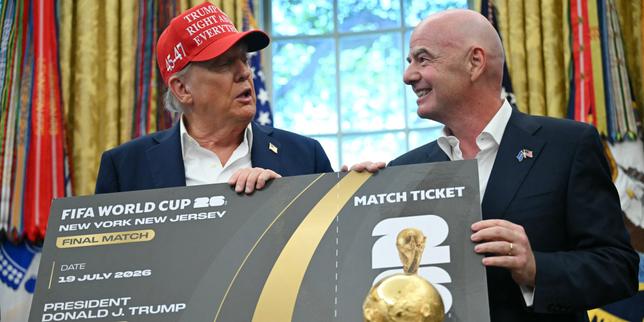
The governance of global football operates under a structural monopoly where the governing body controls both the regulatory framework and the primary commercial engines. When FIFA President Gianni Infantino issues public pleas for patience amid widespread systemic backlash, the standard media narrative frames the conflict as a simple clash of personalities or short-term scheduling grievances. This view misdiagnoses the structural reality. The friction surrounding the expanded Club World Cup and the compounding international match calendar is an inevitable consequence of a centralized sports monopoly attempting to maximize revenue extraction without a corresponding evolution in its risk-sharing architecture.
To evaluate the current institutional deadlock objectively, the problem must be decoupled from PR rhetoric and analyzed through three distinct operational vectors: the economic asymmetry of international expansion, the physical depreciation of human capital, and the breakdown of multilateral stakeholder consensus.
The Economic Asymmetry of Centralized Scale
The expansion of the FIFA Club World Cup represents a fundamental pivot in the organization's commercial strategy, moving from a model reliant almost exclusively on national team properties to one that directly competes for the daily attention and capital of the club football ecosystem. This expansion creates a structural imbalance between the entity capturing the upside and the entities bearing the operational risk.
+-------------------------------------------------------------+
|                        FIFA                                 |
|  Captures: Global Media Rights, Sponsorships, Tournament IP |
|  Operational Risk Exposure: Low                             |
+-------------------------------------------------------------+
                             |
                             v  [Extracts Value / Imposes Schedule]
                             |
+-------------------------------------------------------------+
|                  Domestic Clubs & Leagues                   |
|  Bears: Player Salaries, Local Matchday Execution, Medical  |
|  Operational Risk Exposure: High                            |
+-------------------------------------------------------------+
This structural dynamic reveals a critical flaw in FIFA's capital allocation model.
- Revenue Centralization vs. Cost Externalization: FIFA operates as a asset-light tournament organizer. It does not pay player salaries, maintain year-round training facilities, or underwrite medical liabilities. By expanding the tournament structure, FIFA internalizes the incremental broadcasting and sponsorship premiums while externalizing the entire operational and physical cost burden onto domestic clubs and leagues.
- The Dilution of Domestic Enterprise Value: Domestic leagues generate value through scarcity and predictable scheduling. When a global governing body introduces a month-long summer tournament into an already saturated calendar, it directly cannibalizes the pre-season commercial windows of elite clubs and reduces the market capacity for domestic media rights bidding.
- The Funding Gap: The fundamental friction point is not the concept of a global club tournament, but the lack of an equitable capital-distribution mechanism. If the governing body demands that clubs provide their primary capital assets—the players—for extended periods, the compensation framework must shift from a speculative prize-money pool to a guaranteed baseline underwriting model that offsets domestic revenue displacement.
The Physical Depreciation of Human Capital
The plea for patience ignores the biological reality of elite athletic performance. Within professional sports science, elite players are finite physical assets subject to accelerated depreciation curves when workload thresholds are crossed. The expansion of the match calendar creates a compounding deficit in recovery time that directly undermines the quality of the product FIFA seeks to monetize.
To understand why players and union representatives like FIFPRO are pursuing legal remedies, the physical load must be quantified through an operational throughput lens.
The Macrocycle Recovery Deficit
An elite modern footballer requires an off-season transition phase of 4 to 6 weeks to achieve physiological reset and prevent systemic overtraining syndrome. The introduction of expanded international tournaments in consecutive summer windows eliminates this transition phase entirely. The result is a continuous macrocycle where players operate in a state of chronic residual fatigue.
The Compounding Injury Cost Function
The financial risk of player injury is borne entirely by the employer club, not the international governing body. When a high-value player suffers a soft-tissue rupture or an anterior cruciate ligament tear due to fixture congestion, the club faces a triple penalty: the loss of on-pitch performance, the continuation of wage amortization without productivity, and the potential devaluation of the asset in the transfer market.
The relationship between increased match velocity and asset depreciation can be modeled by analyzing the breakdown of mandatory recovery windows. When the interval between high-intensity match exposures drops below 72 hours consistently, the probability of acute neuromuscular failure increases non-linearly. The current calendar structure forces elite squads to operate within this high-risk zone for over 40% of their annual competitive minutes.
The Breakdown of Multilateral Stakeholder Governance
The current institutional backlash is a textbook example of a governance model that has outgrown its consultative framework. FIFA’s historical structure relies on a top-down legislative process where decisions are ratified by a congress of member associations, many of which do not produce elite-level clubs or players. This creates an governance misalignment: the votes that pass calendar expansions do not represent the stakeholders who supply the infrastructure and capital for elite football.
This democratic imbalance creates a profound bottleneck in three distinct ways.
First, it isolates the decision-making apparatus from market realities. The European Leagues and FIFPRO have bypassed traditional internal appeal mechanisms to file formal complaints with antitrust regulators, specifically targeting the European Commission. This shift from internal debate to external litigation demonstrates that the internal regulatory loops are fundamentally broken. When stakeholders believe that internal consultation is merely a performative prelude to unilateral implementation, they naturally seek external legal intervention to break the monopoly.
Second, it undermines the validity of collective bargaining. In standard industrial relations, changes to working conditions or calendar obligations require bilateral negotiation between employers and employees. FIFA's regulatory supremacy allows it to bypass traditional labor frameworks, imposing structural changes without securing explicit consent from the collective bargaining units of the players or the clubs that finance them.
Third, it introduces a systemic compliance risk. When domestic leagues refuse to alter their calendar footprints to accommodate new international fixtures, it forces clubs into an unmanageable trade-off. They must either field depleted squads in domestic competitions—thereby devaluing local broadcasting agreements—or risk institutional sanctions from the global governing body for failing to prioritize international match mandates.
Operational Redesign: The Path to Systemic Stability
Demanding that the industry "relax" is an unviable strategy when billions of dollars in enterprise value and human health are at stake. The optimization of the global football ecosystem requires a structural shift from a power-based monopoly framework to an integrated economic model.
+--------------------------------------------------------------------------+
|                       RESTRUCTURED GOVERNANCE MODEL                       |
+--------------------------------------------------------------------------+
|  1. Unified Calendar Framework (Dynamic Co-Ownership of Schedule)        |
|  2. Risk-Insured Capital Model (Guaranteed Baseline Underwriting)        |
|  3. Independent Regulatory Oversight (Antitrust-Compliant Structure)     |
+--------------------------------------------------------------------------+
To resolve this institutional gridlock, the governing architecture must be systematically overhauled across three core pillars.
1. Dynamic Co-Ownership of the Calendar
The international match calendar must be co-authored, not handed down by decree. This requires the establishment of an independent calendar board featuring equal voting power split between FIFA, the continental confederations, the European Club Association (ECA), the World Leagues Association, and FIFPRO. No fixture expansion can be implemented without a supermajority from this diversified stakeholder group. This structural mechanism ensures that any proposed tournament must demonstrate net-positive value for the entire ecosystem, rather than unilateral revenue generation for a single entity.
2. Implementation of a Universal Workload Cap
To preserve the long-term value of the human capital, the industry must establish hard physical boundaries backed by sports science metrics. These boundaries should include an individual player limit of 55 appearances per season across all club and country competitions, alongside a mandatory 28-day post-season block of complete physical detachment. Furthermore, back-to-back double-match weeks must be capped at a maximum of three consecutive blocks, ensuring that the 72-hour recovery window is structurally protected rather than treated as an optional luxury.
3. A Risk-Insured Capital Distribution Model
The financial framework of any expanded international tournament must move away from a speculative prize-money model. FIFA must establish a centralized, high-cap asset protection fund. If a player is injured while participating in a FIFA-mandated tournament, this fund must cover 100% of the player's club salary for the entire duration of their absence, alongside direct financial compensation to the club for the measurable loss of sporting utility. Additionally, a fixed percentage of gross tournament revenue must be distributed directly to domestic leagues to mitigate the dilution of local broadcasting rights.
The Strategic Trajectory of the Conflict
The current trajectory points toward an escalating legal fragmentation of the sport rather than a peaceful resolution via patience. If FIFA maintains its strategy of unilateral calendar expansion while relying on rhetorical appeals to defuse criticism, the structural tension will inevitably force a systemic rupture.
The immediate bottleneck will manifest in the European courts. By leverage-testing EU antitrust law, domestic leagues and player unions are attempting to replicate the legal precedent set by the European Court of Justice regarding monopoly power in sports governance. If the courts rule that FIFA’s dual role as both regulator and commercial organizer constitutes an abuse of a dominant position, the governing body will lose its ability to unilaterally mandate tournament participation.
This legal shift would fundamentally dismantle the traditional sports model. It would strip the governing body of its regulatory leverage, forcing it to negotiate for player availability on the open market, much like domestic clubs must negotiate with international entities in other commercial entertainment sectors. The future viability of global tournaments relies entirely on the transition from an autocratic governance framework to a collaborative, risk-mitigated partnership model. Continued reliance on defensive PR messaging will only accelerate the legal and operational unraveling of the sport's global architecture.