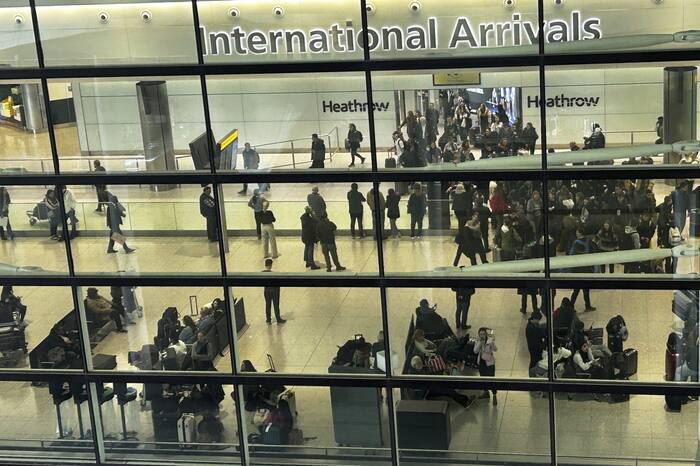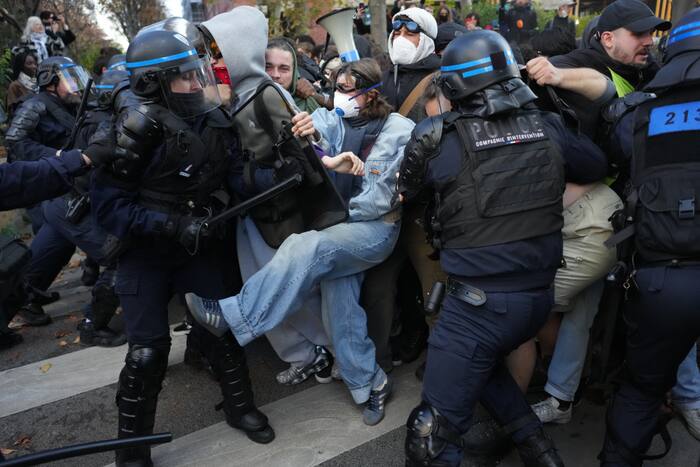
Coordinated nationwide strikes in France represent a predictable game-theoretic equilibrium resulting from structural labor laws, fragmented parliamentary representation, and centralized executive power. When major French trade unions—traditionally divided along ideological and tactical lines—form a unified front (an intersyndicale), the resulting industrial action shifts from a localized wage dispute into a systemic stress test of the Fifth Republic's governing architecture. Understanding the current pressure on President Emmanuel Macron's administration requires stripping away surface-level political commentary and examining the operational mechanics of cross-sector work stoppages, the economic transmission channels of disruption, and the institutional constraints governing executive response.
The Architecture of the Intersyndicale
French labor relations operate under a distinct paradox: the country maintains one of the lowest unionization rates in the Organisation for Economic Co-operation and Development (OECD), hovering near 10 percent of the total workforce, yet its unions wield disproportionate mobilizing power. This discrepancy exists because French labor law extends collective bargaining agreements across entire sectors regardless of individual union membership, and institutional representation within workplace councils (Comités Sociaux et Économiques) grants unions structural chokepoints inside critical infrastructure.
Normally, French labor confederations compete for influence and state funding, split between reformist organizations willing to negotiate incremental compromises—most notably the French Democratic Confederation of Labour (CFDT)—and confrontational syndicates rooted in class-struggle traditions, such as the General Confederation of Labour (CGT) and Workers' Force (FO). A unified strike call occurs only when government policy threatens a baseline consensus shared across both camps.
This coalition creates three distinct operational advantages for labor organizers:
- Legitimacy Aggregation: Reformist unions provide moderate, white-collar, and public-service credibility, preventing the government from framing the unrest as the work of a radical fringe.
- Chokepoint Synchronization: Militant unions control dense operational networks within energy refineries, rail transport (SNCF), aviation control, and maritime ports. Synchronizing walkouts across these nodes maximizes economic friction with minimal total headcount.
- Narrative Consolidation: A unified front eliminates the executive branch's primary divide-and-conquer tactic—offering targeted concessions to moderate unions to isolate hardliners and fracture public support.
The Economic Transmission Mechanism of Nationwide Strikes
A national day of action does not inflict damage evenly across gross domestic product (GDP). Instead, it operates through targeted supply-side bottlenecks and behavioral demand shifts. The immediate macroeconomic impact depends entirely on the duration and sector concentration of the stoppages rather than the raw number of protesters marching in Paris, Lyon, or Marseille.
Primary Logistics and Transit Friction
Public transit and freight rail sit at the center of the French mobilization model. When rail operators and urban transit workers strike simultaneously, labor mobility drops precipitously. In major metropolitan areas, the inability of commuters to reach physical workplaces forces immediate productivity losses in sectors incapable of remote work, including retail, hospitality, manufacturing, and construction. For industries reliant on just-in-time inventory, rail freight interruptions create cascading delays across supply chains within 48 to 72 hours.
Energy and Infrastructure Chokepoints
The escalation from a one-day symbolic strike to a rolling strike (grève reconductible) in the energy sector alters the risk profile entirely. Refinery blockades and power generation throttling restrict fuel distribution and electricity output. Unlike retail or hospitality, where lost consumption can partially rebound once strikes end, industrial output lost to energy rationing or supply chain paralysis often represents permanent economic leakage, particularly when foreign buyers divert orders to competitors in Germany, Spain, or the Benelux region.
Fiscal Drag on the State Balance Sheet
Simultaneous public-sector walkouts—spanning education, municipal services, and civil administration—create a dual fiscal effect. In the short term, the state actually saves marginal payroll expenditure because striking public employees forfeit daily wages under French law. However, extended disruption depresses Value Added Tax (VAT) receipts—the French treasury's largest single revenue source—while forcing municipal and national authorities to absorb auxiliary costs related to policing, emergency logistics, and business relief subsidies.
Executive Constraints Under the Fifth Republic
The pressure on Macron's government is amplified by the constitutional and political configuration of the French legislature. Under the 1958 Constitution of the Fifth Republic, the executive branch possesses formidable institutional tools designed to overcome parliamentary obstruction, most prominently Article 49.3, which allows the Prime Minister to pass legislation without a formal floor vote unless the National Assembly passes a motion of no confidence.
While Article 49.3 solves the problem of legislative deadlock in a hung parliament, it transfers political friction directly from the chamber to the street. When unions and opposition parties view parliamentary debate as bypassed, street mobilization becomes the primary mechanism for contesting policy legitimacy.
The government's strategic room for maneuver is bounded by three hard constraints:
- Sovereign Debt and Deficit Surveillance: France operates under heightened scrutiny from European Union fiscal authorities and sovereign credit rating agencies due to elevated public debt-to-GDP ratios and persistent budget deficits. Broad fiscal concessions—such as reversing austerity measures, halting spending cuts, or expanding public-sector wage indices—risk triggering bond yield spreads widening against German Bunds, increasing national borrowing costs.
- Parliamentary Arithmetic: Without an absolute majority in the National Assembly, the government relies on fragile, ad-hoc coalitions or abstentions from opposition blocs to survive no-confidence votes. A prolonged strike wave erodes the political will of hesitant lawmakers, raising the probability that a coalition of left-wing and right-wing opposition parties votes to topple the cabinet.
- Time Asymmetry: Unions face severe financial attrition during rolling strikes because French syndicates lack the massive, Scandinavian-style strike funds required to compensate workers for weeks of lost wages. Conversely, the executive branch faces reputational and electoral attrition if public services remain paralyzed. Both sides are locked in an endurance contest governed by asymmetrical burn rates: workers burn personal savings, while the government burns political capital.
Historical Precedents and Escalation Thresholds
Evaluating the trajectory of current labor unrest requires benchmarking against established inflection points in modern French political history. Not every unified strike forces an executive retreat; outcomes depend on whether mobilization crosses specific structural thresholds.
In 1995, Prime Minister Alain Juppé attempted to overhaul public-sector pension regimes and social security structures. A unified union front sustained rolling transit strikes for over three weeks, paralyzing Paris during winter. Public opinion remained largely sympathetic to the strikers despite severe personal inconvenience, forcing Juppé to withdraw the core pension reforms. The decisive variable was the combination of sustained chokepoint control in transport and enduring public tolerance for disruption.
In contrast, the 2010 pension reform under Nicolas Sarkozy and the 2023 pension overhaul under Macron saw massive, unified single-day protests—often exceeding one million participants—paired with localized refinery and transit strikes. In both instances, the executive branch absorbed the street pressure and enacted the legislation. The critical difference lay in the inability of unions to sustain indefinite, economy-wide transport paralysis, combined with the government's willingness to accept steep approval rating declines in exchange for legislative completion.
Current mobilization dynamics sit between these two poles. For unions to replicate the 1995 outcome, they must transition from episodic days of action—which allow businesses and commuters to adjust schedules in advance—to unpredictable, multi-day rolling blockades across energy and logistics. For the government to replicate the 2010 or 2023 outcomes, it must maintain strict parliamentary discipline while waiting for individual worker wage losses to fracture union solidarity.
Assessing the Limits of Both Strategies
Neither side holds an unassailable position, and both strategies carry inherent failure modes.
For the unions, over-reliance on hard chokepoints—such as blocking fuel depots or cutting power to industrial zones—carries the risk of alienating the broader public. Public support in France typically tolerates transit delays and peaceful marches, especially when directed against unpopular fiscal or social reforms. However, when disruptions threaten household heating, emergency services, or small-business survival, public sentiment rapidly shifts toward demanding state intervention, enabling the government to deploy legal requisition orders (réquisition) that force striking workers back to critical posts under penalty of fines or imprisonment.
For Macron's administration, relying exclusively on institutional endurance and constitutional mechanisms creates a governance vacuum. Even if a specific reform survives or a budget passes without a successful no-confidence vote, permanent street antagonism degrades state capacity. Administrative implementation slows down, local officials hesitate to enforce contentious directives, and international capital allocators factor chronic civil friction into long-term foreign direct investment decisions.
Strategic Trajectory and Operational Outlook
The resolution of this standoff hinges on watching specific leading indicators rather than crowd size estimates published by the Interior Ministry or union organizers. Observers and market participants should track three concrete metrics over the coming weeks:
- Strike Participation Rates in Rolling Sectors: Monitor daily walkout percentages published by SNCF and electricity operator EDF. A decline below 15 to 20 percent operational participation signals that wage attrition is breaking the momentum of the strike, regardless of weekend protest attendance.
- Fuel Depot Blockade Duration: Track the percentage of service stations experiencing supply shortages nationwide. If shortages remain localized below 10 percent, economic disruption stays contained; if shortages exceed 25 percent nationally, supply-chain paralysis will force the executive branch toward either emergency requisitions or substantive policy concessions.
- Opposition Parliamentary Cohesion: Watch the voting alignment between the far-right National Rally and the left-wing New Popular Front on procedural motions. Any convergence between these blocs transforms street pressure into an immediate institutional threat to the cabinet's survival.
Unless unions successfully convert single-day demonstrations into sustained, multi-week blockades across both rail transport and energy distribution simultaneously, the executive branch retains the structural advantage to outlast the initial wave of mobilization. The government's optimal path involves offering targeted, low-cost regulatory concessions to moderate reformist unions—such as sector-specific working condition adjustments or delayed implementation timelines—to fracture the intersyndicale while holding firm on core macro-fiscal targets.