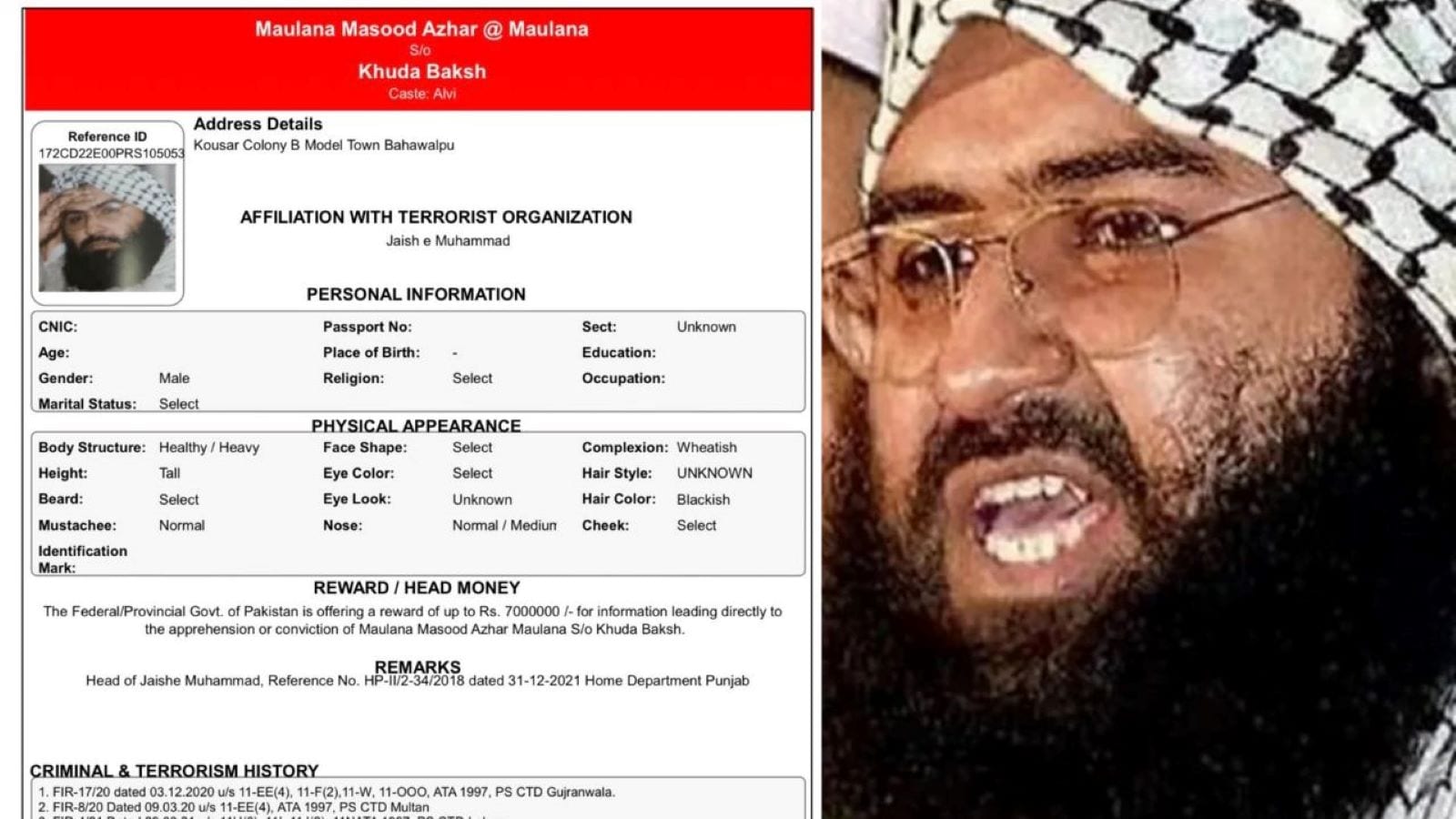
The Financial Action Task Force (FATF) does not function as a geopolitical court, nor does it place jurisdictions onto its grey list based on singular diplomatic grievances. When New Delhi signals an intent to raise the operational status of Jaish-e-Mohammed (JeM) chief Masood Azhar at an FATF plenary, the strategic objective is not an immediate, unilateral blacklisting of Islamabad; it is the deployment of a specific compliance tripwire designed to test Pakistan’s post-2022 anti-money laundering and counter-terrorist financing (AML/CFT) architecture. Understanding whether Pakistan faces renewed grey-list scrutiny requires stripping away diplomatic rhetoric and examining the exact procedural thresholds, evidentiary burdens, and voting mechanics that govern the global financial watchdog.
The Institutional Architecture of FATF Scrutiny
To evaluate the probability of Pakistan returning to the list of "Jurisdictions under Increased Monitoring"—commonly termed the grey list—one must distinguish between political lobbying and technical compliance. The FATF operates through two parallel evaluation tracks: Technical Compliance (assessing whether a country has the necessary laws and institutional frameworks on paper across 40 Recommendations) and Effectiveness (assessing whether those laws actually work in practice across 11 Immediate Outcomes).
Pakistan exited the grey list in October 2022 after completing two concurrent action plans comprising 34 items. That exit did not signify the end of oversight; it transitioned Pakistan into the standard post-exit monitoring phase conducted by its regional body, the Asia/Pacific Group on Money Laundering (APG). Under FATF rules, a jurisdiction cannot be arbitrarily thrown back onto the grey list during a single plenary session simply because a member state raises an objection. Re-listing requires a structured trigger, typically originating from one of three mechanisms:
- A Mutual Evaluation Report (MER) Failure: Every member jurisdiction undergoes a comprehensive peer-review cycle roughly every five to seven years. If a jurisdiction receives a low rating on a threshold number of Immediate Outcomes or Technical Recommendations, it enters a one-year Observation Period. Failure to remediate the deficiencies during that year results in grey-listing.
- An Ad-Hoc Material Breach: If new, verifiable intelligence demonstrates a catastrophic collapse in a jurisdiction's CFT controls—specifically regarding United Nations Security Council Resolution (UNSCR) 1267 designated entities—the International Co-operation Review Group (ICRG) can initiate an extraordinary review.
- Follow-Up Process Deficiencies: During regular APG follow-up reporting, if a country is found to have rolled back previously enacted legislative or enforcement gains, the matter can be escalated back to the global ICRG.
New Delhi’s strategy targets the second and third mechanisms. By focusing on Masood Azhar, Indian diplomats are pointing directly at Immediate Outcome 10 (preventing terrorists and terrorist organizations from raising, moving, and using funds) and Immediate Outcome 11 (preventing the proliferation financing of weapons of mass destruction, alongside targeted financial sanctions).
The Masood Azhar Variable and UNSCR 1267 Obligations
Masood Azhar was designated as a global terrorist by the UN Security Council’s 1267 Sanctions Committee in May 2019. Under FATF Recommendation 6, member states and APG members are legally obligated to implement targeted financial sanctions without delay against any individual or entity listed under UNSCR 1267. This requires three non-negotiable operational actions by the host state: freezing all funds and other assets owned or controlled by the designated person, preventing any funds or financial services from being made available to them, and prosecuting breaches of these freezes.
The core friction between India and Pakistan centers on the gap between de jure compliance and de facto enforcement. During its 2018–2022 grey-listing, Islamabad passed sweeping legislative amendments to its Anti-Terrorism Act (ATA) and froze bank accounts linked to proscribed outfits. However, intelligence assessments consistently highlight a structural vulnerability in Pakistan’s enforcement model: the displacement of terror financing from formal banking channels into informal value transfer systems (hawala/hundi), cash couriers, and charitable fronts operating under altered names.
For India to successfully convert the Masood Azhar issue into an FATF compliance crisis for Pakistan, New Delhi cannot rely on open-source media reports or circumstantial intelligence. The ICRG demands forensic, court-admissible financial trails. Specifically, Indian agencies must present documented evidence showing:
- Active fundraising networks operating inside Pakistani territory whose proceeds are directly traceable to Azhar or JeM’s operational command.
- Explicit failure by Pakistani law enforcement or the Financial Monitoring Unit (FMU) to act upon actionable financial intelligence shared via bilateral channels or the Egmont Group of Financial Intelligence Units.
- The continued physical freedom, state-tolerated movement, or unimpeded organizational command exercised by a UN-designated individual, which constitutes a failure to restrict resources under UNSCR 1267.
Without verifiable banking records, digital transaction logs, or corroborated financial intelligence proving active fund movement, the FATF secretariat treats territorial claims regarding a militant leader's whereabouts as a bilateral security dispute rather than a systemic AML/CFT failure.
The Three Pillars of Indian Diplomatic Leverage
Raising the Masood Azhar issue at the FATF serves distinct strategic functions for India, even if immediate re-listing remains an uphill battle. This approach operates across three calculated dimensions.
1. Preventing Compliance Complacency
States that exit the FATF grey list frequently experience a phenomenon known as regulatory regression. Once the immediate threat of international financial isolation recedes, domestic political pressure to maintain aggressive crackdowns on entrenched militant networks diminishes. By forcing the JeM leadership onto the plenary agenda, India ensures that Pakistan’s file remains active within the ICRG’s informal risk matrix, compelling Islamabad to continuously expend administrative capital proving it is enforcing asset freezes.
2. Exploiting the Macroeconomic Vulnerability Loop
Pakistan’s economy remains structurally dependent on external multilateral financing, particularly International Monetary Fund (IMF) programs, sovereign debt rollovers, and foreign direct investment. During its previous four-year stint on the grey list, independent economic analyses estimated that Pakistan suffered roughly $38 billion in cumulative GDP losses due to reduced capital inflows, higher borrowing costs, and heightened due-diligence friction for correspondent banking relationships. Even the credible threat of renewed FATF scrutiny increases the risk premium on Pakistani sovereign debt and complicates IMF tranche reviews, which explicitly cross-reference AML/CFT compliance benchmarks.
3. Shaping the Upcoming Mutual Evaluation Cycle
The FATF operates on long-term institutional memory. Evidence submitted today, even if insufficient to trigger an immediate emergency listing, enters the permanent dossier reviewed by assessors during Pakistan’s next full Mutual Evaluation cycle. Establishing a multi-year paper trail of alleged non-enforcement regarding UNSCR 1267 targets lays the groundwork for low Effectiveness ratings in future assessments.
The Structural Bottlenecks Blocking Immediate Re-Listing
Despite the geopolitical weight India carries within global financial forums, several institutional realities insulate Pakistan from an immediate return to the grey list.
The primary barrier is the Consensus Rule. The FATF operates strictly by consensus among its 40 members (38 jurisdictions and two regional organizations). Placing a country into the ICRG review pool—or elevating it to the grey list—cannot be achieved by a simple majority vote. To block a hostile listing, a targeted nation only needs three supportive members to object during the plenary debate. Historically, China, Turkey, and Malaysia have provided diplomatic insulation for Pakistan within the FATF, requiring overwhelming, undeniable technical consensus before consenting to punitive measures. Unless Beijing views Islamabad’s non-compliance as a direct threat to its own economic corridors and personnel in the region, China is unlikely to endorse an immediate re-listing driven by New Delhi.
The second limitation is Evidentiary Attribution. Modern terrorist organizations have adapted to FATF surveillance by decentralizing their financial architecture. Rather than maintaining centralized corporate accounts, groups like JeM rely on micro-donations, localized cash collection through religious seminaries, and cross-border smuggling networks. Proving to a technical panel of international banking regulators that the Pakistani state is willfully failing to stop decentralized cash collection—as opposed to facing the standard policing challenges common across developing economies—is exceptionally difficult. The FATF penalizes systemic regulatory failure, not the mere existence of illicit financial crime within a country's borders.
The third constraint is Geopolitical Bandwidth. The FATF’s enforcement capacity is currently heavily allocated toward managing high-priority global proliferation risks, sanctions evasion networks tied to major Eurasian conflicts, and virtual asset (cryptocurrency) regulatory frameworks. Re-opening a contentious South Asian file requires an extraordinary expenditure of diplomatic capital by Western member states—particularly the United States, the United Kingdom, and European Union members—who currently prioritize macroeconomic stability in Islamabad to prevent state collapse or regional nuclear insecurity.
Separating Fact from Strategic Hypothesis
When evaluating media narratives surrounding FATF plenaries, analysts must rigorously separate confirmed procedural realities from speculative political signaling.
Confirmed Facts:
- Pakistan is currently outside the FATF grey list, having satisfied all 34 action items across two separate plans by October 2022.
- Masood Azhar remains a designated individual under UNSCR 1267, binding all FATF and APG members to enforce strict asset freezes, travel bans, and arms embargoes against him.
- India is a full member of the FATF and a co-chair of key working groups, giving New Delhi direct agenda-setting capabilities and access to ICRG deliberations.
- Pakistan’s next scheduled Mutual Evaluation by the APG will rigorously test the sustainability of its 2022 reforms against the updated, stricter FATF methodology introduced for the fifth round of evaluations.
Strategic Hypotheses (Unverified Outcomes):
- The claim that raising Masood Azhar’s status will trigger an immediate grey-listing at a single plenary session is procedurally flawed; the FATF does not possess a "snap-back" mechanism triggered by a single bilateral complaint.
- The assumption that Western powers will automatically back an Indian push for immediate punitive action ignores the current macroeconomic calculus in Washington and Brussels, where preventing a sovereign default in Pakistan remains a competing priority.
- Assertions regarding Masood Azhar’s precise current operational capacity or exact physical location remain matters of intelligence assessment rather than publicly adjudicated facts within the FATF registry.
The Fifth-Round Evaluation Horizon
The true battleground for Pakistan’s FATF status is not a single headline-grabbing plenary intervention, but the structural transition into the FATF’s fifth round of Mutual Evaluations. Under the revised fifth-round methodology, the FATF has significantly shortened the evaluation cycle and placed an even heavier emphasis on Effectiveness—specifically targeting the real-world dismantling of terrorist financing networks and the confiscation of criminal assets, rather than merely passing laws or filing Suspicious Transaction Reports (STRs).
For Islamabad, maintaining its white-list status requires demonstrating sustained, demonstrable prosecution of UNSCR 1267 violators and verifiable disruption of proscribed entities' fundraising infrastructures. If Pakistan’s Financial Monitoring Unit and Counter-Terrorism Departments cannot produce verifiable conviction data and asset-seizure metrics tied to groups like JeM and Lashkar-e-Taiba over the coming evaluation window, the technical assessors will downgrade its Immediate Outcome 10 ratings regardless of geopolitical lobbying.
To maximize its leverage within this institutional framework, New Delhi must bypass broad diplomatic accusations and execute a targeted, forensic intelligence strategy. Indian financial intelligence agencies should focus exclusively on mapping the cross-border digital, hawala, and trade-based money laundering nodes used by JeM operatives, feeding granular, unassailable financial dossiers directly to the APG assessors and key Western ICRG members ahead of Pakistan’s fifth-round review. By anchoring its diplomatic offensive in hard financial forensics rather than political rhetoric, India can force the FATF’s technical machinery to treat the Masood Azhar enforcement deficit not as a bilateral grievance, but as an objective failure of global compliance standards.