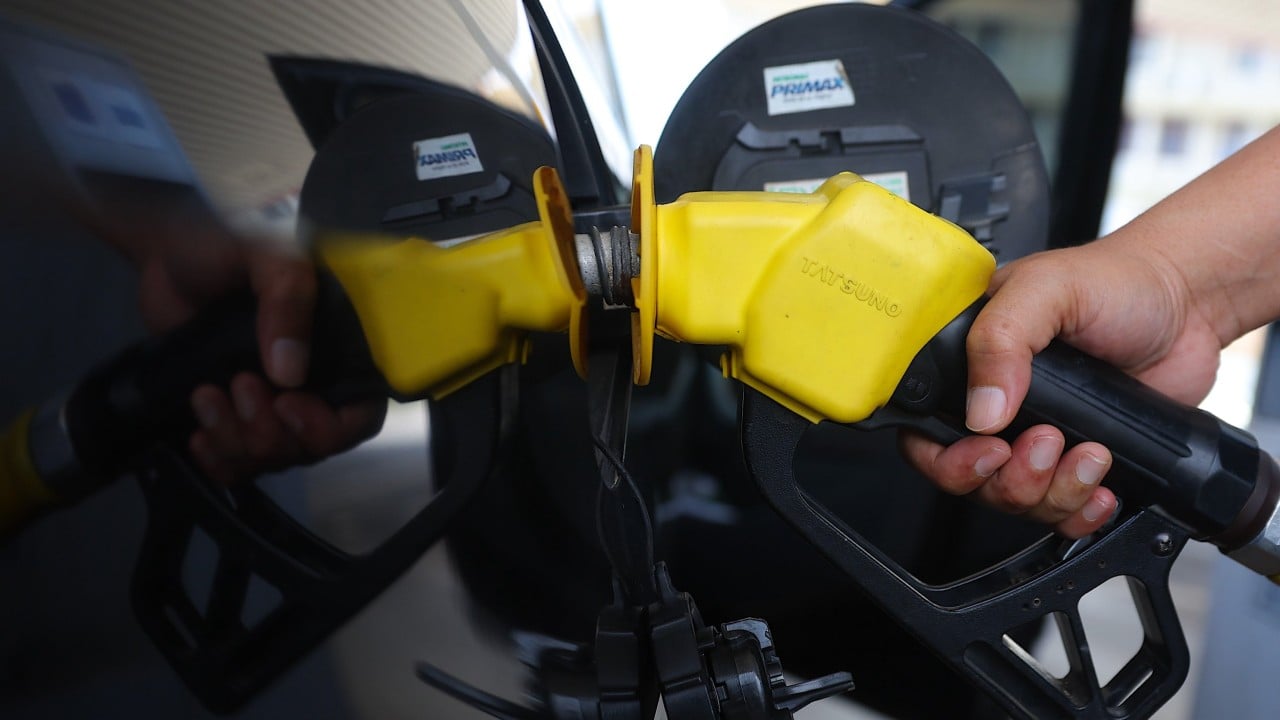
Price disparity across sovereign borders creates an immediate and irresistible incentive for commodity smuggling, a phenomenon currently testing the limits of Malaysian domestic policy. When the Malaysian government maintains retail fuel prices significantly below the market rate found in neighboring Thailand or Singapore, it effectively subsidizes the operating costs of foreign logistics and private transport. The deployment of the Royal Malaysia Police (PDRM) and the Ministry of Domestic Trade and Cost of Living (KPDN) to border petrol stations is not merely a policing action; it is a late-stage intervention in a failed economic equilibrium.
The Economic Engine of Fuel Leakage
Fuel leakage at the border is driven by a simple arbitrage calculation. The incentive to smuggle is a function of the price delta between two jurisdictions minus the transaction costs of the illegal activity. Transaction costs include transport, storage, and the "risk premium"—the probability of being caught multiplied by the severity of the legal penalty.
The Arbitrage Formula
The profit margin for a smuggler can be expressed through the relationship:
$$P_{margin} = (P_{foreign} - P_{subsidized}) - (C_{logistics} + C_{risk})$$
In this model, $P_{foreign}$ represents the market price in Thailand, while $P_{subsidized}$ is the fixed ceiling price in Malaysia. As the global price of crude oil rises, the delta increases, making the $P_{margin}$ so lucrative that it overcomes even aggressive enforcement measures ($C_{risk}$).
Structural Vulnerabilities in Retail Distribution
The decision to station police officers at individual petrol stations highlights a systemic failure in the "targeted subsidy" framework. Retail stations are designed for high-throughput consumer access, not for the rigorous verification of end-user eligibility. This creates three primary points of failure in the distribution chain.
- Volume Manipulation: Smugglers utilize modified fuel tanks—often referred to as "tankers" or "fiber tanks"—that exceed the legal capacity of a standard passenger vehicle. Even with police presence, identifying a modified internal tank without physical inspection is time-intensive and slows the flow of legitimate commerce.
- Frequency of Purchase: A vehicle may comply with the liter limit per transaction but return ten times a day. Without a centralized, real-time database linked to vehicle registration and biometric identification, a single station attendant cannot effectively monitor "looping" behavior across multiple shifts.
- Point-of-Sale Collusion: The retail model relies on station operators to act as the first line of defense. However, the commission-based revenue model of petrol stations creates a moral hazard; operators are incentivized to move volume, regardless of the destination of the fuel.
The Three Pillars of Enforcement Strategy
The current surge in police activity at the border is an attempt to manually correct a systemic leak. For this enforcement to yield a positive Return on Investment (ROI) for the taxpayer, it must address the three pillars of the smuggling ecosystem: Physical Interdiction, Intelligence-Led Auditing, and Legislative Friction.
Physical Interdiction and Deterrence
The presence of uniformed officers at the pump serves as a visual deterrent intended to increase the perceived $C_{risk}$ for casual smugglers. However, this is the most resource-heavy and least scalable form of enforcement. It requires a high ratio of officers to pumps and is subject to "leakage" itself if officers are stationed at one point while smugglers pivot to a less monitored station five kilometers away.
Intelligence-Led Auditing
Effective enforcement requires moving upstream from the pump to the distribution hubs. By analyzing the delivery manifests from oil companies to retail stations, the KPDN can identify "outlier" stations—those whose sales volumes are statistically inconsistent with the local population density and vehicle registration data.
- Variable 1: Normal Local Demand (Historical Average)
- Variable 2: Seasonal Flux (Tourism/Festivals)
- Variable 3: Unexplained Variance (Smuggling Proxy)
Stations showing a high Unexplained Variance are the high-yield targets for sting operations and license revocations.
Legislative Friction and Penalties
The Control of Supplies Act 1961 provides the legal framework for these actions. To be effective, the penalty must exceed the lifetime profit of the smuggling operation. Current enforcement focuses on seizing the "tools of the trade"—the vehicles and the fuel. While this creates a temporary bottleneck, it is often viewed by organized smuggling rings as a manageable cost of doing business.
The Diminishing Returns of Manual Supervision
Static policing at petrol stations suffers from the Law of Diminishing Returns. In the initial phase, the presence of police significantly reduces blatant smuggling. However, as smugglers adapt by using smaller "scout" vehicles or moving operations to nocturnal hours, the cost of maintaining a 24/7 police presence eventually exceeds the value of the fuel being saved.
Furthermore, this strategy creates a "Squeeze Balloon" effect. When enforcement tightens at the retail pump, smuggling syndicates pivot to industrial-grade theft. They intercept fuel at the wholesale level, using illegal depots hidden in palm oil plantations or industrial zones. This moves the problem from a visible, public-facing retail issue to a more dangerous, organized crime operation that is harder to track.
The Technological Solution: PADU and Targeted Subsidies
The reliance on police officers at the pump is a stop-gap measure while the government transitions to the PADU (Pangkalan Data Utama) system. The goal is to move from a Product-Based Subsidy to a Person-Based Subsidy.
In a person-based system, the price at the pump is the market price. Eligible citizens receive a direct cash transfer or a digital credit to offset the cost. This removes the arbitrage opportunity entirely. If the price in Malaysia is $R$ and the price in Thailand is $R+1$, there is no profit in moving fuel across the border because the "subsidy" stays in the Malaysian citizen's bank account or digital wallet, regardless of whether they buy fuel or not.
The current police action is essentially a defensive maneuver to protect the national treasury until the digital infrastructure for targeted subsidies is fully operational.
Strategic Operational Forecast
The escalation of police presence at the border indicates an imminent shift in policy. The government cannot sustain the high personnel cost of manual station monitoring indefinitely. The next logical move is a "Geofenced Restriction" policy.
- Immediate Action: Integration of CCTV systems at border stations with AI-driven license plate recognition (LPR) to flag high-frequency refueling events without requiring a physical officer at every pump.
- Intermediate Action: Mandatory "Fuel Pass" requirements for all foreign-registered vehicles, limiting them to non-subsidized grades (e.g., RON97) or capped volumes of RON95, enforced via digital verification at the point of sale.
- Long-term Action: Total removal of the price cap at the pump, replaced by the PADU-driven cash rebate system. This is the only move that permanently destroys the arbitrage incentive.
The "police action" is a signal of political will, intended to stabilize the situation and signal to smuggling syndicates that the era of easy arbitrage is closing. However, the success of the operation will be measured not by the number of arrests, but by the speed at which the government can transition away from physical enforcement and toward an automated, data-driven subsidy model. The most effective border guard is not a man with a gun, but an economic policy that renders smuggling unprofitable.