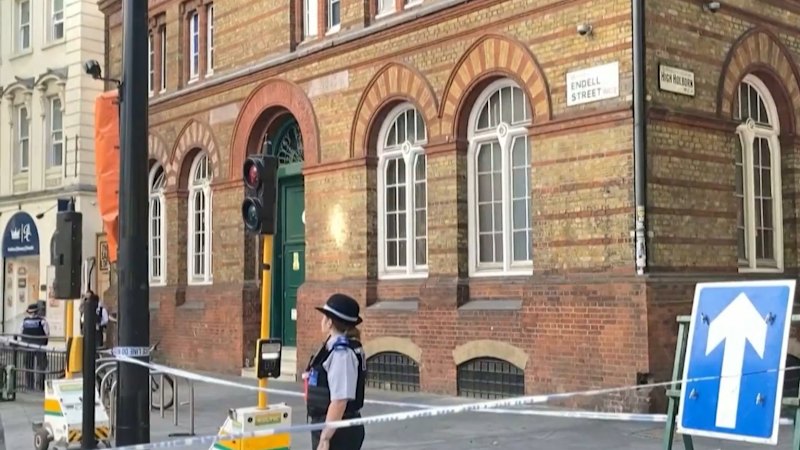
Urban security infrastructure undergoes its most severe stress test not during coordinated threats, but during acute, unpredicted public safety disruptions. When a 47-year-old woman detained on Endell Street near Covent Garden injured four men using an improvised instrument—specifically a pair of scissors—the operational efficacy of London's emergency response network was exposed to immediate measurement. Deconstructing the timeline, spatial containment protocols, and institutional categorizations reveals how metropolitan authorities manage high-density urban friction points.
The Response Function and Spatial Containment
The spatial configuration of central London presents distinct operational bottlenecks. Endell Street and the surrounding Covent Garden corridor combine high pedestrian density, commercial venues, and constrained thoroughfares.
The Metropolitan Police logged the initial emergency call at approximately 12:27 BST, with tactical intervention occurring within minutes. This response velocity depends on three core variables:
- Asset distribution density across high-footfall tourist zones.
- Communications routing from civilian dispatch to ground units.
- Dynamic perimeter establishment to prevent escalation and secure evidentiary chains.
Eyewitness accounts and official reports indicate that the suspect moved from near the Shaftesbury Theatre down toward Endell Street before being neutralized and detained. The containment perimeter was established rapidly, restricting civilian access while enabling clinical triage units to deploy resources directly to the friction point.
Medical Triage Metrics and Trauma Center Allocation
The physical toll of the incident involved four male victims aged 34, 39, 42, and 52. The logistical response executed by the London Ambulance Service highlights the triage hierarchy utilized in multi-casualty urban events.
Responders dispatched a combination of standard ambulance crews, rapid response vehicles, incident response officers, and the regional air ambulance. The decision matrix for patient transport prioritized rapid movement via road to a major trauma center rather than immediate air evacuation, mitigating the operational risks associated with helicopter transfers in dense urban airspace.
Clinical outcomes split into distinct operational brackets:
- Two victims sustained non-life-threatening injuries requiring short-term observation before discharge within hours.
- Two victims required extended inpatient care at a major trauma facility, though their conditions were confirmed to be neither life-threatening nor life-changing.
Institutional Categorization and Behavioral Pathology
Metropolitan Police leadership classified the event as an isolated, mental health-related incident. In municipal security analysis, categorizing an event as "isolated" serves a distinct functional purpose: it halts the allocation of defensive city-wide security postures, prevents speculative public panic, and narrows the investigative scope to individual clinical and social history rather than systemic threat vectors.
Local reports indicated that the suspect was unhoused and frequently exhibited erratic behavior in the immediate neighborhood. This highlights a structural vulnerability in urban management frameworks: the friction between municipal social support systems and acute psychiatric intervention thresholds. When street-level behavioral volatility crosses into physical violence, the burden of intervention shifts entirely from social welfare structures to emergency law enforcement and trauma medicine.
Asset Deployment Optimization for High-Density Corridors
[Incident Initiation]
       │
       ▼ (Minutes: T+0 to T+3)
[Civilian Reporting & Communications Routing]
       │
       ▼ (Minutes: T+3 to T+10)
[Tactical Containment & Taser/Physical Interdiction]
       │
       ▼ (Minutes: T+10 to T+30)
[Multi-Agency Medical Triage & Road Transit to Trauma Center]
The mechanics of neutralizing an active, unpredictable threat in a crowded commercial zone rely on minimizing the time delta between detection and physical control. The deployment of tactical physical interdiction—in this case, utilizing specialized non-lethal compliance tools such as tasers amidst chaotic civilian movement—prevents geometric increases in casualties.
Future threat mitigation in high-density districts requires shifting from reactive containment models to predictive behavioral monitoring. Municipal authorities must integrate real-time CCTV analytics with localized mental health outreach teams to identify high-risk behavioral anomalies before they manifest as kinetic physical assaults.


