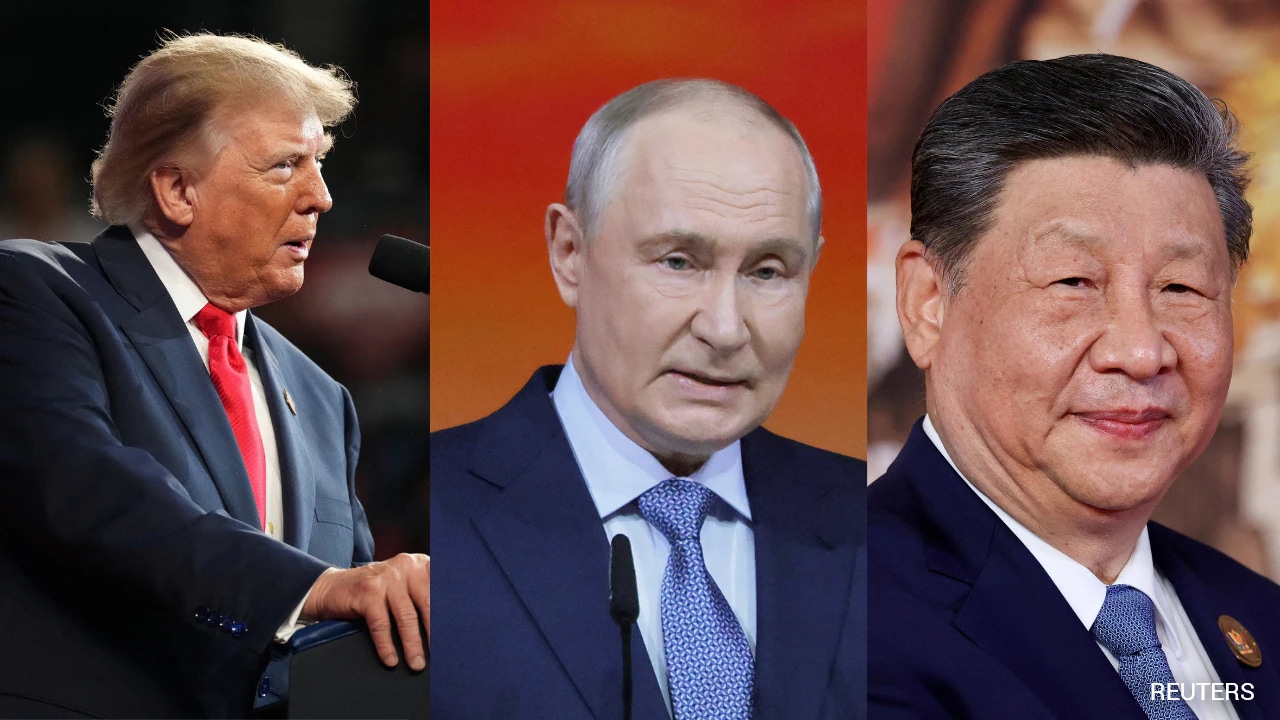
Thousands of miles from the frontline, inside a hall with high ceilings and heavy drapery, three men are being asked to sit in the same room.
Vladimir Putin wants a summit. He wants Donald Trump on one side, Xi Jinping on the other, and a map of Eastern Europe spread flat between them. On paper, it sounds like the classic geometry of grand strategy—three power brokers sitting beneath crystal chandeliers, negotiating the terms under which a war might finally stop. But step away from the diplomatic statements and look closely at what is actually happening.
War is not a abstract equation. It is mud. It is cold coffee in a trench at 4:00 AM. It is a mother in Kharkiv listening to the high-pitched whine of an incoming drone, calculating whether she has eight seconds or four to pull her child into the hallway.
When a head of state proposes a three-way summit to end a war, the headline makes it sound clean. A meeting. A date next month. A handshake.
It is never clean.
The Cold Logic of the Offer
To understand why this proposal exists right now, you have to look at the pressure building behind closed doors.
Russia’s proposal for a high-level summit involving Moscow, Washington, and Beijing is not a sudden gesture of goodwill. It is a calculated move on a chessboard that has grown increasingly crowded and expensive. For months, the conflict in Ukraine has ground down human lives and industrial capacity at a pace unseen in Europe since 1945.
Consider the arithmetic of the war. Tens of thousands of artillery shells fired every week. Millions of barrels of oil re-routed through shadow fleets. Sanctions that squeeze, but do not snap, a national economy.
By suggesting a three-way summit with the incoming U.S. administration and China, the Kremlin is attempting to redraw the diplomatic table itself. The implicit message is clear: the future of European security should be decided by superpowers, over the heads of smaller nations, in a setting where hard power holds all the cards.
Imagine a hypothetical room in a neutral capital like Geneva or Riyadh.
On one side sits Trump, who has repeatedly claimed he could settle the conflict in a single day, eager to deliver a dramatic geopolitical breakthrough. Across from him sits Xi, representing a nation that has supplied the economic lifeline keeping Russia afloat while carefully maintaining enough distance to avoid total Western isolation. And at the center sits Putin, proposing a framework where his territorial gains are accepted as the starting point for peace.
The structure of the meeting is the strategy. By framing the resolution of the war as a tri-polar deal, Russia seeks to turn a unilateral aggression into a broad geopolitical settlement.
The Invisible Seat at the Table
There is a glaring absence in this diplomatic blueprint.
Where is Kyiv?
Any agreement negotiated strictly between Washington, Beijing, and Moscow carries an unsettling echo of twentieth-century history. It recalls Yalta. It recalls Potsdam. It imagines a world where boundaries are drawn with grease pencils by leaders who will never have to live in the towns they slice in two.
For Ukrainians, the prospect of a summit held without their direct control over the terms is not a diplomatic opportunity. It is an existential threat.
Think of a small farming community in the Zaporizhzhia region. The people there do not measure the war in draft communiqués or diplomatic press releases. They measure it in the silence of the neighboring house whose roof was taken off by a guided bomb last September. They measure it in the fields that cannot be plowed because the soil is seeded with submunitions.
If a summit produces a frozen conflict—a line drawn on a map that leaves millions under occupation—it does not bring peace. It merely pauses the clock.
This is the central dilemma that every Western leader faces when evaluating a proposal from Moscow. Is the offer an opening for genuine diplomacy, or is it an operational pause designed to buy time, ease economic sanctions, and fracture the transatlantic alliance?
What Each Player Needs
Diplomacy at this level is rarely about absolute victory. It is about managing domestic survival and international leverage.
For Moscow, time is both an ally and an enemy. While Russia has converted its economy to a war footing, the long-term strain on its financial reserves and demographic core is staggering. A summit offers a potential exit ramp that consolidates territorial control while presenting the Russian domestic audience with a image of their leader dictating terms alongside the presidents of the United States and China.
For Washington, the calculation is intensely volatile. Donald Trump’s return to the political center stage brings a sharp disruption to traditional foreign policy norms. His rhetoric favors direct, transactional deals over long-standing institutional alliances. Yet, accepting a deal that looks like a capitulation carries immense domestic and international risks. It tells allies in Asia and Europe that American security guarantees have an expiration date.
For Beijing, the summit is a delicate balancing act. China benefits from a Russia that is dependent on Chinese trade, but it suffers when European markets become hostile and global supply chains fracture. Xi Jinping wants stability on his northern border, but he also wants to avoid pushing NATO into a permanent, highly militarized posture that stretches all the way into the Indo-Pacific.
The Human Equation Behind the Headlines
It is easy to get lost in the political theater. We read about dates, venues, and diplomatic protocols, and we forget what is actually being traded.
Every week the war continues, the quiet attrition compounds.
Picture an underground clinic in a city near the front. The lights flicker because the local substation was hit by a missile strike three hours ago. A surgeon, operating by the glow of a battery-powered headlamp, picks shrapnel out of a young soldier’s shoulder. The surgeon does not know if a summit will happen next month. He only knows that his shift ends in two hours, and there are four more gurneys waiting in the hallway.
This is the human weight that sits on every document draft.
When news breaks that a proposal has been put forward for a three-nation summit, the immediate reaction is often a mixture of exhaustion and hope. People desperately want the killing to stop. They want the power grids restored, the refugees returned, the sirens silenced.
Strategic peace and durable peace are not the same thing. A quick deal negotiated in haste to satisfy political timelines can lay the groundwork for a far larger disaster five years down the road.
The Real Test
The proposal is on the table. The invitation has been floated.
What happens next will not be determined by the elegance of the press releases or the size of the motorcades arriving at a summit venue. It will be determined by whether the international community understands the difference between ending a war and simply hiding it under the rug.
The high-ceilinged rooms in Moscow, Washington, and Beijing will continue to churn out proposals. Advisers will draft talking points. Spokespersons will field questions behind podiums.
Out in the open air of Eastern Europe, the wind continues to blow across frozen mud, carrying the smell of burning diesel and pine wood. The people living there do not need another grand spectacle between world powers. They need a peace that allows them to rebuild their homes without watching the sky for the next shadow.