Oil burns black.
Anyone who has ever stood near an industrial spill or watched raw crude ignite knows it does not look like the clean, cinematic orange flames of a Hollywood backlot; it is a suffocating, greasy wall of soot that clings to your eyelashes, coats the back of your throat, and turns daylight into a choking midnight within seconds. For a different view, read: this related article.
On the morning of December 7, 1941, at 7:55 AM, the water around Ford Island in Pearl Harbor turned into a boiling cauldron of burning bunker fuel. Most men, faced with a wall of liquid fire rushing across the surface of the Pacific, did the only rational thing human biology permits. They ran. They swam away from the heat, gasping for pockets of clean air between the slicks, praying their lungs wouldn't blister before they reached the shore.
Gebhard Galle drove a boat straight into the smoke. Further coverage on the subject has been shared by The Washington Post.
He was twenty years old. Just a kid from New Braunfels, Texas, a town known more for German bakeries and quiet river tubing than global warfare. He held the rank of Fireman First Class aboard the USS Maryland, a Colorado-class battleship moored along Battleship Row, wedged tightly against the hull of the USS Oklahoma. When the Japanese torpedo bombers swept low over the harbor, the Oklahoma took the brunt of the punishment, absorbing nine torpedoes in rapid succession and rolling belly-up in the mud like a wounded whale, trapping hundreds of sailors inside her steel compartments.
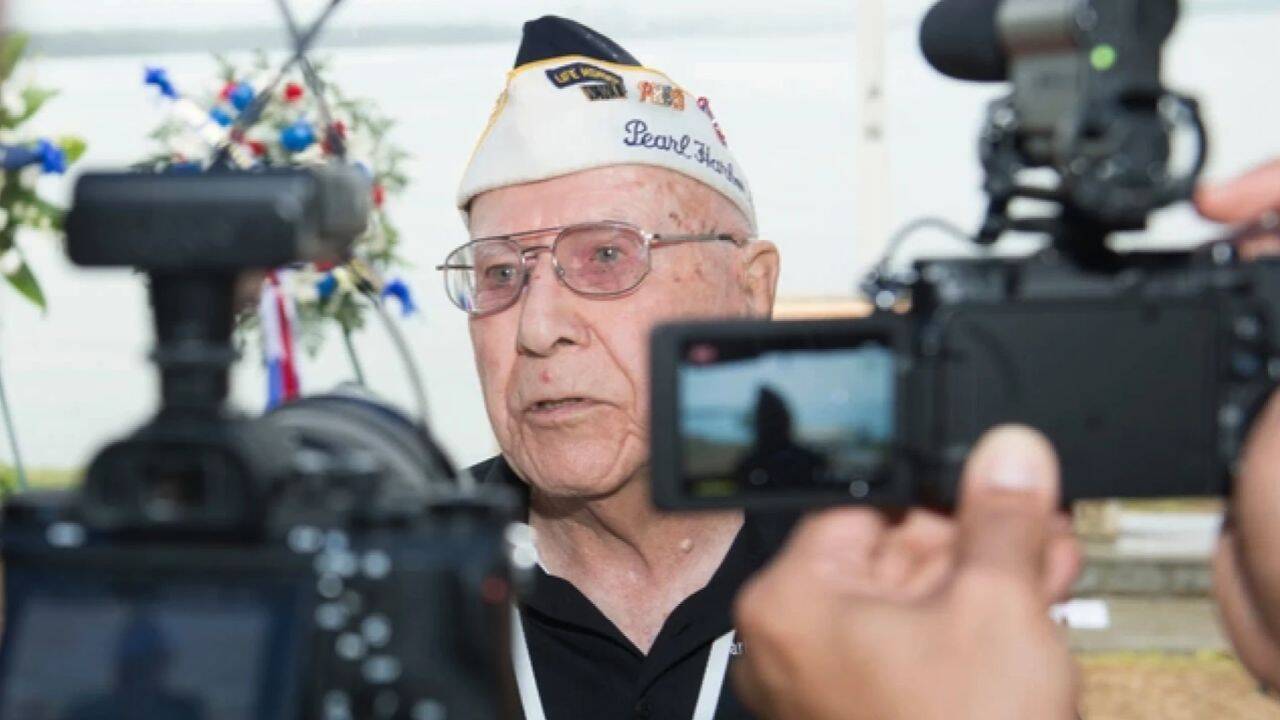
When Gebhard Galle died at the age of 105, the standard obituaries reduced his century of breathing to a crisp, three-line summary. Born in Texas. Survived Pearl Harbor. Rescued four sailors.
Clean. Efficient. Forgettable.
That is the tragedy of how we record history. We strip away the sweat, the terror, and the sheer, agonizing weight of time until a human being becomes a bronze plaque on a wall nobody stops to read. If you want to understand what we actually lost when Gebhard Galle closed his eyes for the final time, you cannot look at a timeline of World War II. You have to look at the mechanics of a twenty-year-old boy's hands gripping a wooden tiller while the world ends around him, and then you have to trace the eighty-five years he spent carrying that morning inside his chest.
The Arithmetic of Panic
To understand what happened on Battleship Row, imagine—purely as a thought experiment to bridge the gap between our quiet screens and that Sunday morning—standing inside a crowded subway car when the lights go out, the floor tilts forty-five degrees, and freezing water begins pouring through the ceiling vents. Your brain doesn't write poetry in that moment. It defaults to primal arithmetic: me versus the exit.
Aboard the Maryland, Galle wasn't even supposed to be on a rescue mission. The ship was boxed in. Because the Oklahoma had capsized right beside her, the Maryland was pinned against the concrete mooring quays, protected from direct torpedo hits by the dying bulk of her sister ship, though still pounded by armor-piercing bombs that blew holes through her forecastle.
Chaos reigned on the decks. Men were screaming, anti-aircraft guns were rattling the rivets loose from the bulkheads, and black smoke was pouring off the Arizona just a few hundred yards astern.
Galle saw sailors floundering in the harbor. They were blinded by oil, weighed down by wet wool uniforms, and surrounded by patches of burning fuel that drifted with the tide. Climbing down into a small motor launch, Galle didn't wait for a committee meeting or a formal citation. He steered the small craft out into the debris-choked water.
Four times, he maneuvered that launch alongside men who were seconds away from drowning or burning alive.
Think about the physical reality of pulling a grown man out of oil-slicked water. A waterlogged sailor weighs well over two hundred pounds. His skin is coated in thick, slippery bunker oil that makes his wrists feel like greased eels. The boat is pitching violently from the concussion of five-hundred-pound bombs exploding nearby, while machine-gun bullets from strafing Zeros stitch lines of white foam across the surface ten feet away. Every second you linger is a statistical invitation to die.
Galle hauled one man over the gunwale. Then a second. Then a third. Then a fourth.
Four lives. Four men who went on to have birthdays, weddings, children, grandchildren, and quiet Sunday mornings of their own because a twenty-year-old Texan refused to turn his boat toward the safety of the pier.
The Invisible Weight of the Living
We love hero stories because we like to pretend the story ends when the rescue boat hits the dock. We want the music to swell, the credits to roll, and the hero to walk away unscathed.
Reality is far messier.
After Pearl Harbor, the war didn't pause to let Gebhard Galle catch his breath. The Maryland was patched up at the Puget Sound Navy Yard and sent straight back into the teeth of the Pacific campaign. Galle served through the brutal island-hopping grind that defined the war against Imperial Japan—Tarawa, Kwajalein, Saipan, Leyte Gulf, Okinawa. He watched kamikazes slam into decks. He felt the shudder of naval artillery barrages that lasted for days without sleep.
When he finally came home to Texas, he didn't demand a parade. Like millions of men from that generation, he took off the uniform, hung it in the closet, and went back to work. He returned to New Braunfels, built a life, worked a steady job, and blended into the fabric of a country that was busy inventing suburbs, interstate highways, and color television.
For decades, nobody outside his immediate circle knew what he had done in that motor launch.
I have spent years interviewing combat veterans, and there is a specific, unmistakable cadence to the way men from the 1940s talk about trauma—or rather, how they refuse to talk about it. They don't use the clinical vocabulary we rely on today. They don't talk about triggers, hypervigilance, or moral injury. Instead, they develop a quiet, stoic compartmentalization. They lock the worst days of their lives inside an iron box in the back of their minds, weld the lid shut, and focus entirely on fixing a leaky faucet or mowing the lawn.
Yet the box is never truly weightless. You carry it everywhere. You carry it when you smell diesel exhaust on a hot summer afternoon. You carry it when a door slams unexpectedly in a quiet hallway. You carry it every December 7th, when the calendar flips to a date that feels just like any other Tuesday to the kids walking down the street, while inside your own head, the harbor is still burning.
What Happens When the Witnesses Leave
Here is the uncomfortable truth we rarely confront when a centenarian veteran passes away: we aren't just mourning a person. We are losing our collective immune system against historical amnesia.
Right now, there are fewer than fifteen known survivors of the Pearl Harbor attack still alive on Earth. Fifteen. Out of the roughly 80,000 military personnel stationed on Oahu that morning, the living memory of the event has narrowed down to a handful of men and women well past their hundredth birthdays.
Why does that matter? You can read a thousand books about December 7, 1941. You can watch high-definition documentaries, tour the USS Arizona Memorial, and memorize the exact casualty count—2,403 Americans killed, 1,178 wounded, nineteen Navy ships destroyed or damaged.
None of that replaces a living human witness.
Books are static. Once a book is printed, the words sit on the page forever, immune to your questions, unable to look you in the eye. When you stand in front of a man like Gebhard Galle—a man who stood on a trembling steel deck, smelled the sulfur, and felt the skin slip through his fingers as he dragged four drowning strangers into a boat—history stops being an academic subject. It becomes biological. You realize that the people who saved the world in the twentieth century weren't marble statues or mythical demigods. They were scared, twenty-year-old kids with grease under their fingernails who decided, in a split second of pure terror, that someone else's life mattered more than their own comfort.
Without those witnesses in the room, our culture slowly begins to treat war like a video game and sacrifice like an abstract political slogan. We start arguing about history as if it were a theoretical debate rather than something written in real blood on real water.
A Century of Quiet Grace
What strikes me most about Gebhard Galle isn't just the ferocious courage he showed at twenty; it is the sheer endurance of his spirit across the eighty-five years that followed.
Living to 105 is an anomaly in itself. To reach that milestone, you have to outlive almost everyone you ever knew. You bury your parents, your siblings, your childhood friends, your commanders, and often your own spouse. The world changes around you so radically that the country you fought to defend begins to look like a foreign planet. When Galle was born in 1920, Woodrow Wilson was in the White House, commercial radio had barely begun broadcasting, and horses still outnumbered cars on many Texas roads. By the time he died, people were carrying supercomputers in their pockets and arguing with artificial intelligence.
Through all of it, Galle remained grounded in the simple virtues that had carried him through the harbor in 1941. In his later years, as the ranks of Pearl Harbor survivors thinned to a precious few, he finally began sharing his story—not out of vanity, and never to brag, but out of a sense of duty to the men who never made it out of the oil.
When people asked him about rescuing those four sailors, he didn't frame it as a moment of cinematic heroism. To him, it was simply what needed to be done. Men were in the water. He had a boat. End of story.
There is a profound lesson buried in that simplicity, especially for an era like ours that is obsessed with personal branding, loud declarations, and performative virtue. Real courage rarely announces itself beforehand. It doesn't pause to check the cameras or calculate the social return on investment. It happens in the dark, in the smoke, when nobody is keeping score and the odds are stacked entirely against you.
The Empty Chair
Next December 7th, the bugler will still play "Taps" over the calm blue water of Pearl Harbor. Tourists will still lean over the white railing of the memorial, looking down at the rusted hull of the Arizona where oil droplets—the "black tears" of the ship—still rise to the surface one by one, eighty-five years after the explosions stopped.
The ceremonies will go on. The speeches will be delivered.
There will just be one fewer pair of eyes in the crowd that actually saw the sky turn black.
Gebhard Galle spent over a century on this earth. He arrived in a world still recovering from the First World War, stepped into the inferno of the Second, and lived long enough to become one of the very last living bridges between our comfortable present and the crucible that forged it. Four men lived entire lifetimes because he refused to turn his boat around, and thousands more walked away with a clearer understanding of what true grit looks like simply by standing in his presence.
The harbor in Oahu is quiet now, blue and sunlit under the trade winds, with nothing left on the surface to show where the fire used to be.