Chalk.
That was the thin, fragile line separating a priceless nineteenth-century British monument from a chaotic pile of useless desert rubble.
Imagine standing in the middle of the Mojave Desert in the late 1960s, squinting against a sun that feels like a blowtorch against your skin, staring at ten thousand blocks of gray granite scattered across the sand. To the untrained eye, it looked like the aftermath of an ancient quarry explosion. To the men sweating through their shirts in Lake Havasu City, Arizona, it was the world’s largest, heaviest, and most expensive jigsaw puzzle. And if even a dozen of those chalk-painted numbers washed off in a sudden flash flood, the puzzle would never fit together again.
History books tend to flatten this story into a quirky piece of trivia. They tell you that an American oil tycoon bought London Bridge, dismantled it, shipped it across the ocean, and rebuilt it in Arizona. It sounds neat. Clean. Almost effortless.
It was none of those things. It was an act of magnificent, borderline-reckless audacity that required hundreds of workers to obsess over millimeters, battle bureaucracy on two continents, and perform a feat of structural alchemy that still defies common sense.
The Sinking Giant of the Thames
To understand why a piece of Victorian London ended up spanning a man-made canal in the American Southwest, you first have to understand why London wanted it gone.
By the early 1960s, John Rennie’s 1831 granite bridge was dying. Designed in an era of horse-drawn carriages and iron-rimmed wheels, the five-arch structure was never meant to bear the crushing, vibrating weight of twentieth-century double-decker buses and commercial lorries. The bridge wasn't just old; it was literally sinking into the soft London clay at a rate of roughly one inch every eight years.
To picture the problem, think of a heavy oak dining table resting on a damp, muddy lawn. Over decades, the legs sink unevenly, the joints groan, and the tabletop begins to warp. Engineers in the City of London Corporation realized that patching the bridge was no longer enough. They needed a modern concrete-and-steel replacement capable of handling surging commuter traffic.
That left them with a massive, ten-thousand-ton headache. What do you do with a famous landmark when you replace it? Demolishing it and dumping the rubble into a landfill felt like cultural vandalism, yet keeping it wasn't an option.
Enter Ivan Luckin, a member of the London Common Council with a flair for the theatrical. Instead of paying a demolition crew to destroy the bridge, Luckin suggested selling it. His colleagues laughed. Who on earth would buy a used bridge?
A Wild Gamble in the Mojave
Three thousand miles away, a man named Robert P. McCulloch was looking for a miracle.
McCulloch was a restless, barrel-chested entrepreneur who had made a fortune manufacturing chainsaws and outboard motors. In 1963, he had purchased twenty-six square miles of barren, scorching scrubland along the eastern shore of Lake Havasu, a reservoir created by the Parker Dam on the Colorado River. His dream was to build a self-sustaining master-planned community from scratch—a desert oasis of resorts, marinas, and suburban homes.
There was just one problem. Nobody wanted to move there.
In the mid-1960s, Lake Havasu City was little more than an airstrip, a handful of trailers, and endless miles of creosote bushes where summer temperatures routinely topped 115 degrees Fahrenheit. McCulloch needed something so outrageous, so undeniably famous, that it would force the world to look at his empty patch of sand and take it seriously.
When McCulloch’s real estate partner, C.V. Wood—the legendary planner who had helped Walt Disney design Disneyland—heard that London Bridge was up for auction, he saw the ultimate theme-park centerpiece without the theme park.
On April 18, 1968, McCulloch submitted the winning bid: $2,460,000.
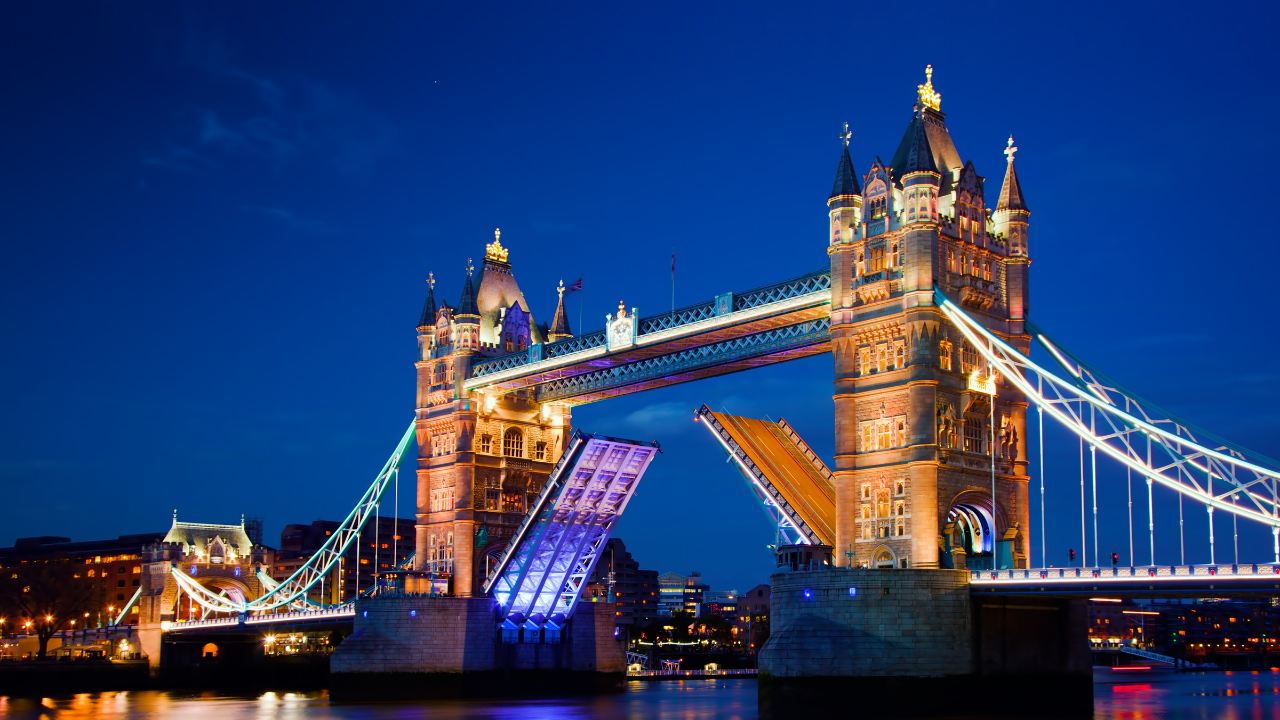
The reaction on both sides of the Atlantic was immediate and brutal. British newspapers sneered at the vulgarity of an American chainsaw magnate carrying off their heritage like a souvenir trinket. American pundits called it "McCulloch's Folly," mocking the absurdity of building a bridge over dry land in the middle of nowhere. Even a persistent urban legend sprang up—one that still refuses to die—claiming McCulloch thought he was buying the ornate, twin-spired Tower Bridge and got duped into buying the plainer stone structure instead. (For the record, both McCulloch and Luckin repeatedly debunked this; McCulloch knew exactly what he was buying, down to the last block of Dartmoor granite.)
Buying the bridge, however, was the easy part. Moving it was where sanity went to die.
The Anatomy of a Numbered Stone
Consider the sheer physical reality of what McCulloch had just purchased. You cannot simply unbolt a masonry arch bridge. A stone arch stays standing because every wedge-shaped block—known as a voussoir—presses against its neighbor with immense compressive force, channeling the weight downward into the piers. Remove one stone carelessly, and gravity wins.
Before a single crane could lift a block off the River Thames, a small army of British engineers, masons, and surveyors had to turn the entire bridge into a three-dimensional map.
Picture a hypothetical London mason named Arthur, standing on a swaying wooden scaffold above the cold, gray water of the Thames in the autumn of 1968. His breath plumes in the damp morning air. In one hand, he holds a thick architectural blueprint; in the other, a pot of durable paint and a stencil brush. Every single exterior stone he touches has been carved specifically for its exact spot in the curve of an arch or the flare of a cutwater. Slight variations in stone height, worn edges from a century of river barges scraping past, and subtle shifts from decades of settling meant that no two blocks were truly interchangeable.
If Arthur painted the wrong number on a three-ton block of granite, a crew in Arizona two years later would spend days trying to force a square peg into a round hole.
The coding system had to be foolproof, capable of surviving ocean salt spray, dockworker cranes, desert heat, and months of open-air storage. Workers painted a strict alphanumeric code onto the concealed faces of every stone—the sides that would eventually be buried inside the mortar, hidden from view once rebuilt.
The code told a precise story:
- Which of the five arches the stone belonged to.
- Which row, or course, it sat in from the waterline up.
- Its exact sequential position from east to west.
As soon as a section was cataloged and photographed, heavy cranes swung into action. Slowly, methodically, London Bridge vanished from the skyline it had anchored for nearly 140 years. Over ten thousand individual blocks of granite—weighing anywhere from half a ton to five tons each—were eased onto barges, trucked to the Surrey Commercial Docks, and loaded into the holds of cargo ships bound for the Panama Canal and the Port of Long Beach, California.
From Long Beach, flatbeds hauled the stones three hundred miles east across the desert to Lake Havasu. And here is a detail that rarely makes the history books: McCulloch didn't actually buy the entire bridge. Shipping the solid, unseen interior core of the bridge would have bankrupted even an oil and chainsaw tycoon. Instead, workers only sliced off the outer facing stones—roughly six to twelve inches thick—leaving behind the internal masonry. What arrived in Arizona was essentially the outer skin of London Bridge, waiting to be wrapped around a brand-new, hollow reinforced-concrete skeleton.
Building a Bridge on Dry Land
If you walk across London Bridge in Lake Havasu City today, you feel the cool breeze off the water beneath your feet and watch speedboats glide under the arches. It looks entirely natural, as if the river had always been there and the bridge was built to cross it.
That is an illusion. When construction began in Arizona, there was no water under the bridge at all.
Because Lake Havasu’s shoreline formed a wide peninsula that jutted out into the reservoir, engineers realized it would be vastly cheaper and safer to build the bridge on solid, dry desert floor first, and then dredge a mile-long channel underneath it afterward.
Think about the mental gymnastics required for that. Workers were building a massive maritime bridge in the middle of a dust bowl.
The reconstruction process was a masterclass in reverse-engineering. First, crews poured colossal concrete piers deep into the sandy soil. Next, they mounded millions of tons of local desert sand into the exact curved shapes of the five arches, creating giant earthen molds. Over those mounds of sand, they constructed hollow concrete box girders—the modern structural spine that would carry the actual weight of traffic.
Only then did the sorting begin.
Out in a sprawling storage yard beside the construction site, thousands of numbered granite blocks lay baking in the Arizona sun like prehistoric artifacts. Cranes crawled up and down the rows, hunting for specific serial numbers called out by engineers holding yellowing British blueprints.
Arch Three, Course Fourteen, Stone Twenty-Two.
When a stone was located, riggers strapped it into heavy slings, hoisted it into place against the concrete core, and anchored it with stainless-steel cramps and mortar. Whenever a block had chipped during its ten-thousand-mile journey, skilled stonemasons—several of whom had been flown in from Britain specifically for the job—trimmed and dressed the granite by hand so the seams remained razor-thin.
It took three years of grueling, sun-bleached labor. Whenever summer temperatures soared past 110 degrees, the granite became too hot to touch with bare hands, forcing crews to start their shifts in the pitch black of 3:00 a.m. and quit before noon.
By the autumn of 1971, the final keystone was lowered into place. Bulldozers and dredges moved in, carving away the earth beneath the arches and allowing the blue-green waters of Lake Havasu to rush through, transforming the peninsula into an island and turning a desert mirage into a functioning landmark.
Why We Still Obsess Over the Numbers
When London Bridge officially reopened in Lake Havasu City on October 10, 1971—complete with fireworks, marching bands, and the Lord Mayor of London in full ceremonial regalia—the skeptics went quiet.
McCulloch’s outrageous gamble worked. Curiosity seekers poured into the desert by the hundreds of thousands. Within a decade, Lake Havasu City exploded from a dusty outpost of a few hundred residents into a thriving resort town of tens of thousands. Today, the bridge remains Arizona's second-most-visited tourist attraction, trailing only the Grand Canyon.
Yet the enduring magic of this story isn't really about real estate development or billionaire eccentricities. It lives in those faint, hidden numbers painted onto the backs of ten thousand granite blocks.
There is something deeply moving about the care required to preserve something piece by piece. In an era where we treat buildings, devices, and even neighborhoods as disposable—tearing them down in days and replacing them with soulless glass boxes—the relocation of London Bridge stands as a stubborn monument to craftsmanship and continuity. Every block had an identity. Every stone had a home it was meant to return to.
If you stroll down to the water’s edge beneath the bridge at dusk, when the desert heat finally breaks and the western sky turns bruised purple and gold, you can run your hand along the rough, pitted surface of the Dartmoor granite. You are touching rock quarried by nineteenth-century British laborers, blackened by Victorian coal smoke, rattled by the blitz of World War II, and rescued from obscurity by a pencil, a paintbrush, and a leap of faith.
Somewhere on the hidden backside of the stone beneath your fingers, locked away in the dark behind a layer of Arizona mortar, a faint painted number is still doing its quiet job—holding the past together, one piece at a time.