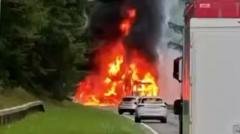
The standard breaking news alert went out exactly as expected. An articulated heavy goods vehicle catches fire on the A9. The police close the road in both directions. The media rushes to publish standard copy about gridlock, travel delays, and diversion routes.
It is predictable. It is reactive. It is entirely missing the point.
Mainstream reporting treats infrastructure failures like isolated acts of God. A lorry bursts into flames, traffic grinds to a halt, and the public is told to wait patiently until the asphalt cools. We are conditioned to look at a 50-mile tailback as a temporary logistical inconvenience.
That is a lie. These incidents are predictable symptoms of a systemic failure in logistics planning and infrastructure design. By treating every arterial bottleneck crisis as a random accident, we shield the logistics industry and transport planners from the accountability required to modernize the network.
The Myth of the Unforeseen Accident
Every time a major transport artery shuts down, the immediate narrative centers on bad luck. But look at the data surrounding heavy goods vehicle (HGV) fires and major trunk road closures. These are not statistical anomalies. They are mathematical certainties built into an over-stressed system.
The A9 serves as the backbone of Scottish transit, cutting through challenging geography with limited alternative routes. When you funnel thousands of multi-ton freight vehicles onto a route with long stretches of single-carriageway and limited physical separation, you are not managing a highway. You are running a high-stakes game of roulette.
Mechanical failures happen. Brakes overheat on long descents. Electrical faults trigger engine bay fires. In a resilient transport network, a single vehicle failure creates a localized delay. In a fragile, single-artery network, a single vehicle failure paralyzes an entire region's economy for twelve hours.
I have spent twenty years analyzing supply chain resilience and infrastructure vulnerability. I have seen logistics firms lose hundreds of thousands of pounds in a single afternoon because their entire fleet was trapped behind a single burning trailer. The corporate response is always a shrug and a complaint about the government's failure to dual the road faster.
That is lazy thinking. Dual carriageways reduce head-on collisions, but they do not magically solve the vulnerability of a single-corridor logistics strategy.
The True Cost of Just-In-Time Delusions
The modern economy operates on a razor-thin margin of error called Just-In-Time (JIT) manufacturing and distribution. Supermarkets hold less than 48 hours of inventory. Factories rely on component deliveries arriving within specific two-hour windows.
When a major route closes, the economic damage ripples far beyond the drivers sitting in the queue.
- Perishable cargo spoilage: Refrigerated units caught in a standstill consume fuel to keep units running, or worse, experience failure, rendering the entire load useless.
- Missed maritime windows: Freight destined for ports misses departure times, delaying international supply chains by weeks, not hours.
- Driver tachograph violations: Drivers run out of legally permitted driving hours while trapped in stationary traffic, forcing fleets to deploy relief drivers to remote locations just to move the vehicle once the road opens.
Logistics managers love to blame the road network for these losses. But the blame lies squarely on their refusal to price infrastructure fragility into their operational models. If your entire business model collapses because one HGV catches fire on a northern trunk road, you do not have a supply chain. You have a wish list.
Stop Asking When the Road Will Open
Whenever a major disruption occurs, public queries focus on a single, short-sighted question: When will the road reopen?
This is the wrong question. The premise assumes that returning to the status quo is a victory. The real question we should be asking is: Why are we still moving bulk freight via heavy trucks on a vulnerable, historic road network?
Look at the alternative. Rail freight produces up to 76% less carbon dioxide than road transport per ton-mile. More importantly, it removes high-risk heavy loads from shared civilian infrastructure. A freight train experiencing a mechanical failure does not cause a head-on collision with a family car, nor does it block a public commuter route in both directions.
Yet, the shift to rail remains painfully slow. Why? Because road transport is artificially cheap. The public purse bears the cost of maintaining the asphalt torn up by forty-ton vehicles. The public bears the cost of the emergency services deployed to handle the fallout when those vehicles ignite.
Imagine a scenario where logistics companies were forced to pay the true economic cost of the societal disruption caused by their vehicle failures. If a fleet operator faced a bill for every hour thousands of citizens were trapped on a closed highway due to a poorly maintained brake caliper, fleet maintenance standards would skyrocket overnight. Instead, the cost is socialized, while the profits remain private.
The Flawed Logic of Regional Diversions
When the media broadcasts diversion routes during a major closure, they are often directing drivers toward a secondary catastrophe.
Trunk road diversions frequently send heavy, long-distance traffic onto minor, rural roads that were never engineered to sustain that level of axle weight or traffic volume.
- Structural degradation: Weak bridges and narrow lanes suffer immediate, sometimes permanent, structural damage.
- Localized gridlock: Small towns and villages find their main streets choked with oversized vehicles that cannot clear tight corners, creating secondary bottlenecks.
- Increased accident risk: Forcing fatigued long-haul drivers onto unfamiliar, unlit, winding secondary roads increases the probability of a secondary incident.
Diversion routes are a psychological band-aid. They exist to give drivers the illusion of progress, making them feel better because their wheels are turning, even if they are traveling thirty miles out of their way at fifteen miles per hour.
The Hard Truth About Infrastructure Resilience
Building more lanes will not save us from these systemic failures. Induced demand dictates that more tarmac simply attracts more vehicles, scaling the size of the eventual disaster when something inevitably goes wrong.
True resilience requires a brutal reassessment of how we move goods and information.
First, we must end the obsession with centralized distribution hubs that require goods to be trucked hundreds of miles up and down the country daily. Regional self-sufficiency and localized inventory buffers are expensive to implement, but they are far cheaper than the systemic paralysis of an entire transport corridor.
Second, regulatory bodies must enforce aggressive, real-time thermal monitoring on commercial fleet vehicles traveling on critical infrastructure corridors. We possess the technology to detect binding brakes and overheating bearings long before they spark a catastrophic fire. Waiting for a driver to notice smoke in their rearview mirror is a medieval approach to safety management.
The downside to this contrarian approach is obvious: consumer costs will rise. Fast shipping will slow down. The convenience of ordering an item at midnight and receiving it by noon requires an unsustainable volume of high-risk freight movement on our roads. We must decide whether we value cheap, instant gratification over a stable, resilient infrastructure network.
The next time you see a headline about a major highway closed in both directions due to a dramatic vehicle fire, do not look at it as an unfortunate accident. Look at it as a systemic design failure. Demand better than a reactive cleanup crew and a press release about diversion routes.
Stop waiting for the lanes to clear. Demand a system that doesn't break down when a single truck gets hot.