Red.
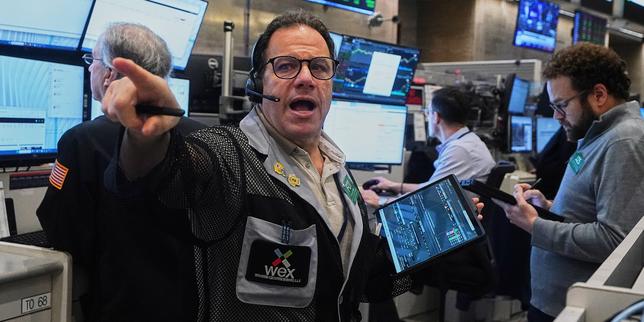
So much red on the glass walls of Lower Manhattan that even the fluorescent lights above the cafeteria tables seemed to carry a faint, copper tint when I walked past at four in the afternoon. Nobody was shouting. That was the first thing that struck me, years ago, during a sell-off that felt eerily like this one—the quietness. Traders don't yell like movie extras when trillions of dollars of implied future value start evaporating in real time. They lean closer to their monitors. Their coffee goes cold in paper cups. Someone taps a pen against a legal pad with a rhythm that sounds suspiciously like a pulse slowing down.
When markets tremble over artificial intelligence, headlines tend to reduce the whole thing to a single mechanical gesture: Wall Street plunges. A ticker symbol drops four percent. A pundit blames stretched valuations, or rising energy bills for data centers, or software seats being hollowed out by autonomous agents before anyone even signed a renewal contract. Dry. Clinical. As if money were just rain falling on a roof, with no roots underneath it.
Money isn't rain. Money is memory and expectation braided together, and when investors panic over artificial intelligence, they aren't merely repricing silicon chips or cloud contracts. They are arguing in public about what human labor is worth five years from now, whether the factories we are building today will turn into gleaming cathedrals of productivity or expensive monuments to overconfidence, and who gets stuck holding the bill when the hype collides with a quarterly earnings call.
Let me be honest with you right out of the gate: I don't have a crystal ball that tells me whether a given AI stock is a bargain or a trap on any given Tuesday, and anyone who claims absolute certainty about a technology rewriting the cost of cognition is selling you a story thicker than mine. What I can do is trace the human nerves wired directly into those red screens, explain the mechanics behind the jitters without burying you in financial jargon, and look closely at what happens when the machine begins to look suspiciously like a mirror of our own anxieties.
The Quiet Tremor Behind the Ticker
To understand why Wall Street flinches whenever artificial intelligence hits a speed bump, picture a hypothetical portfolio manager named Nadia. Nadia isn't a cartoon villain twirling a mustache over someone's pension. She is forty-one, drinks oat lattes she forgets to finish, and spends her evenings trying to remember whether she signed her son's permission slip while her brain is still chewing through three hundred pages of earnings transcripts and supply-chain notes.
Let's be clear: Nadia is a composite character, a stand-in for the thousands of analysts, fund managers, and risk officers trying to price an invisible future. Still, the pressure she feels is as real as a migraine.
For the past few years, the market narrative around artificial intelligence followed a clean, intoxicating arc. Spend more on compute. Build bigger clusters. Train smarter models. Watch revenue follow like night follows day. Every time a tech giant announced tens of billions of dollars in capital expenditure—for servers, transformers, fiber cables, and power agreements—Wall Street cheered, because big spending was read as proof of conviction and moat-building.
Then the mood shifted. Not all at once, not with a single gunshot, but like ice cracking on a pond before you actually fall through.
Investors started asking sharper, harder questions. If a company pours eighty billion dollars into infrastructure over a couple of years, how many years of software subscriptions or ad clicks does it take to earn that back with a healthy return? What happens if a breakthrough makes training or running models dramatically cheaper, turning yesterday's scarce supercomputers into tomorrow's abundant commodities? And what if enterprise buyers—the banks, hospitals, logistics firms, and retailers supposed to buy all this intelligence—move slower than Silicon Valley's keynote slides assume?
That shift is a metaphor for growing up—moving from wide-eyed infatuation with a shiny new toy to the sobering math of keeping the lights on. Except in financial markets, growing up doesn't look like a quiet reflection on a porch. It looks like sharp red candles on a chart, margin calls, nervous whispers on trading desks, and billions of dollars of market capitalization vanishing before lunch.
Why does a single rumor about a delayed chip rollout, a regulatory snag, or a software company losing pricing power send shockwaves across the entire index? Because artificial intelligence isn't sitting in a corner of the economy like a niche hobby. It has become the central thread tying hardware makers, cloud providers, utilities, software vendors, and everyday index funds into one giant, interlocking web. Pull one strand hard enough, and the whole net shudders.
Inside the Tug-of-War Between Hype and Math
When people ask why artificial intelligence makes Wall Street so jumpy, they usually expect a single villain. Is it bubble fever? Is it fear that AI won't work well enough? Or is it fear that AI will work too well and blow up existing business models?
Annoyingly, the answer is all three pulling in different directions at the same time.
Think of it like a tug-of-war on a slick floor. On one side stands the capex and payback rope: companies spending staggering sums upfront on physical infrastructure—data centers, cooling systems, specialized chips, electricity—hoping customer demand scales fast enough to justify the outlay. On another side stands disruption anxiety: traditional software and service businesses watching autonomous tools chip away at per-seat pricing or automate routine workflows, wondering whether their customers will need fewer human logins next year.
And right in the middle sits valuation gravity. When expectations are priced for perfection—when a stock already assumes years of rapid growth and fat margins—even "pretty good" news can feel like a disappointment. Markets don't just punish failure; they punish anything that falls short of a sky-high story.
A market correction isn't always proof that a technology is fake. Often, it's the price of discovering that the timeline is messier than the pitch deck.
Let's strip away the wall of acronyms and look at the three tensions driving these sudden drops:
- The spending-versus-revenue gap: Building physical AI capacity costs real money today, while broad enterprise monetization often unfolds in messy pilots, integration headaches, and cautious budget cycles. Investors get twitchy whenever cash outflows look certain and cash inflows look distant.
- The cannibalization paradox: If AI makes coding, customer support, legal review, or marketing dramatically faster and cheaper, who captures the value? Sometimes the end user saves money, sometimes a new entrant takes share, and sometimes an incumbent's old pricing model starts to look like a buggy whip.
- The concentration effect: When a handful of massive companies account for an outsized share of major stock indexes, a wobble in their outlook drags down broad passive funds that millions of ordinary people own through retirement accounts without even realizing how concentrated their exposure has become.
Consider what happens next when a headline hits saying enterprise adoption is stalling or power bottlenecks are delaying new data centers. Algorithmic funds react in milliseconds. Human traders react in minutes. Suddenly, a rational debate about return on invested capital turns into a stampede for the exit, dragging down stocks that barely have a working AI strategy alongside ones that built the whole wave.
The Invisible Stakes for People Who Never Check a Ticker
It is easy to treat a Wall Street sell-off like weather on another planet—something happening to men and women in tailored jackets while the rest of us try to buy groceries and fix a leaky sink.
That is a mistake. A dangerous one.
Picture a hypothetical nurse named Tomas working a night shift in a busy regional hospital. Tomas doesn't spend his breaks staring at stock charts. His hands smell like sanitizer, his calves ache from twelve hours on hard tile, and his biggest concern is whether the ward is short-staffed again tomorrow. Yet the hospital where he works is evaluating AI tools to cut down charting time, flag patient deterioration earlier, and manage scheduling. Meanwhile, his retirement savings sit in a target-date fund heavily weighted toward major market indexes.
When AI worries rattle Wall Street, Tomas feels the ripples in two quiet ways. First, if markets swing wildly and stay rattled, confidence tightens across corporate boards—budgets get scrutinized, hiring freezes pop up, and capital gets more expensive. Second, if AI adoption is bumpy—full of false positives in software, workflow friction, or overpromising vendors—frontline workers like Tomas end up bearing the cost of half-baked tools forced onto already strained teams.
There is an even deeper human stake here, one that rarely makes it into a thirty-second market recap. Every time investors reassess artificial intelligence, society is quietly negotiating a social contract. We are asking: When a machine can draft the memo, write the code, summarize the contract, or diagnose the pattern faster and cheaper than a person, what happens to entry-level jobs, wages, and human dignity?
Wall Street isn't asking that question out of moral philosophy. It asks it through discounted cash flows and margin forecasts. Still, the cold math of the market often smells smoke before the rest of us notice the fire. If software firms can do more with smaller teams, headcount growth slows. If power grids strain under massive server farms, local electricity rates and environmental trade-offs enter the room. Nothing in modern finance exists in a vacuum; every line item connects back to a human life somewhere.
I've watched smart people get burned on both extremes during waves like this. Some treat every dip as the end of the world, selling good long-term assets in sheer panic because the screen turned crimson. Others treat every drop as a guaranteed free lunch, ignoring real risks like overpaying for hype, weak customer retention, or businesses whose competitive edges are thinner than they look.
Fear is loud. Greed is seductive. Both are terrible guides on their own.
History Rhymes, Even When the Machines Are New
If you feel dizzy watching technology stocks whip back and forth on every rumor, take a breath and step back a few decades. Panic around transformative technology is practically a family trait of modern capitalism.
Think back to the late 1990s internet boom, or the railroad expansions of the nineteenth century. In both eras, the underlying technology wasn't a mirage. Trains genuinely changed how goods and people moved across continents; the internet genuinely transformed communication, commerce, and media. Yet along the way, investors poured mountains of money into overbuilt capacity, shaky business models, and wildly optimistic timelines. Many companies went bust even as the technology itself reshaped the world.
That distinction—between technological reality and financial pricing—is the single most important lens you can bring to AI market jitters. A technology can change civilization and still produce terrible returns for investors who bought at peak euphoria or picked the wrong players. Conversely, a market pullback can scare people out of durable businesses right before real earnings catch up.
There is another pattern worth noticing too: crowd psychology. Humans are social creatures wired to watch what the herd is doing. When everyone is buying, buying feels safe—even when prices are stretched. When everyone is selling, selling feels smart—even when prices are starting to look reasonable. Markets amplify human emotion like a megaphone aimed at a canyon wall.
So when a headline screams that AI fears are sinking Wall Street, pause before you let your stomach decide what to do. Ask a few grounding questions instead:
- Did the fundamental business actually break today, or did expectations simply cool off from nosebleed territory?
- If you are a long-term investor, does your time horizon span years—or are you reacting to a single week of noise?
- If you work in an industry being reshaped by AI, what skills—judgment, trust, physical craft, human connection, cross-disciplinary problem-solving—remain hard to automate?
Notice how those questions bring the power back from the ticker tape to your own life. You don't have to outsmart every high-frequency trader in New Jersey or predict every earnings surprise to navigate an uncertain era thoughtfully. You just need clarity about what you own, what you do, and what you can actually control.
Reading the Red Glow Without Losing Your Head
A few days after that quiet, copper-tinted afternoon in Lower Manhattan, the red on the screens began to soften. Not into instant celebration—markets rarely bounce in a straight line—but into something steadier. Analysts went back to reading balance sheets. Executives started talking less about cosmic grandiosity and more about unit economics, deployment timelines, and real customer value.
That is usually how these storms pass: not with a grand speech that settles every argument forever, but with the slow return of proportion.
Artificial intelligence will keep pushing into our hospitals, offices, factories, and screens, whether Wall Street cheers on Monday or panics on Wednesday. The tension between grand promises and hard financial math isn't a bug in the story; it is the story, because real transformation always has to survive the transition from dream to balance sheet.
Next time the markets stumble over artificial intelligence and the headlines sound like the sky is falling, picture that quiet cafeteria at four in the afternoon—cold coffee, tapping pens, and millions of human hopes tangled up in numbers on a screen—and remember that a flickering red light is a signal to look closer, not a reason to lose your mind.