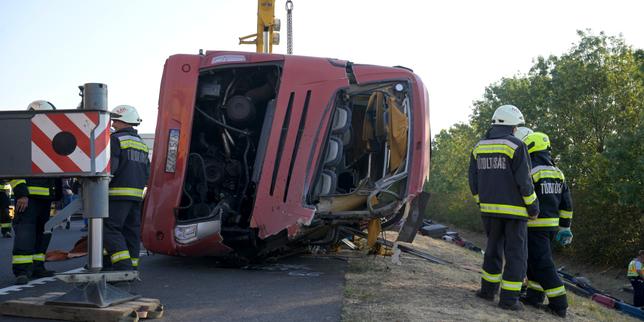
The headlights of a Polish-registered bus cut through the pre-dawn darkness of a Hungarian highway, painting brief, frantic streaks across the asphalt. Inside, the hum of the engine was a familiar lullaby. Passengers slept against the cold glass windows, wrapped in heavy coats, dreaming of home, of families waiting, of the ordinary rhythm of a Monday morning.
Distance is measured in miles, but tragedy is measured in seconds.
Without warning, the metal sanctuary ruptured.
Twelve lives ended on that stretch of road. Ten more fractured, hanging in the balance between survival and the long, grueling rehabilitation of the body and mind.
We read these numbers in morning briefings. We scroll past them on glowing screens while waiting for our coffee to brew. Twelve dead. Ten injured. The cold administrative statistics of catastrophe. But statistics are only the skeleton of a disaster. The flesh and blood are found in the empty chairs at Sunday dinner, the unread text messages, and the profound, echoing silence left behind in apartments across Poland.
Consider what happens when a journey meant to bridge two points instead becomes a permanent stop.
The Geography of Sudden Absence
Roads are arteries of human connection. We build them to bring people closer, to shorten the distance between here and there, between love and labor. Yet, every highway carries a quiet, persistent hazard—the fragility of momentum.
When a heavy vehicle collides with disaster, the sheer physics involved are terrifying. A bus is not merely a mode of transport; it is a shared room moving at seventy miles per hour, carrying dozens of distinct universes. On that bus were workers returning from journeys abroad, travelers seeking familiar streets, people with specific plans for the upcoming week.
Morning arrived differently in Hungary that day. For the local emergency responders, it meant sirens, flashing amber lights, and a grim choreography practiced too often by those whose job is to pick up the pieces. For families hundreds of miles away in Poland, it meant the kind of phone call that splits a life cleanly into two parts: before and after.
We often talk about road safety in terms of speed limits, road maintenance, and tire tread depth. These are the mechanical truths. But there is a human truth that escapes the safety manuals. Every driver is a human being prone to exhaustion; every vehicle is a machine subject to the brutal laws of inertia. When those forces collide, the abstraction of road safety becomes intensely personal.
The Weight of Surviving
Ten people survived.
Survival, in the immediate aftermath of a violent crash, is rarely a clean victory. It is a chaotic scramble of twisted metal, sirens, sterile hospital rooms, and the overwhelming confusion of consciousness returning in an unfamiliar place.
To understand what those ten survivors face, one must look beyond the physical fractures. Bones heal with plates and screws, scars fade into silver lines, but the mind keeps its own score. The sudden screech of brakes becomes a permanent tenant in the subconscious. The memory of darkness and impact replays behind closed eyelids long after the hospital monitors stop beeping.
Recovery is a lonely marathon. It is learning to walk again with a limp that serves as a daily monument to a Tuesday you wish never happened. It is the survivor's guilt—that heavy, unearned burden that whispers: Why them and not me?
We rarely speak of this secondary trauma. We celebrate the rescue, we tally the hospital discharges, and we assume the ledger is balanced. It never is. The ripple effect of a highway collision extends outward like a stone dropped in a pond, touching coworkers, neighbors, children, and friends who now look at every highway journey with a quiet, lingering dread.
The Unseen Passengers
Every long-distance traveler carries invisible baggage. We pack hope, duty, fatigue, and anticipation.
Imagine looking out the window of a bus at midnight, watching the blurred lights of foreign towns slip past. You are physically present in the seat, but mentally you are already home. You are thinking about what to cook for dinner, the project waiting on your desk, the embrace of a child. That cognitive distance—the gap between where our bodies are and where our minds live—is where vulnerability thrives.
Drivers battle the crushing weight of monotony and exhaustion. Hours behind the wheel blur into a hypnotic tunnel of white lines and passing semi-trucks. The human body was not engineered to pilot heavy machinery through the dead of night at high speeds, yet modern commerce and human migration demand it of millions every single day.
When things go right, it is a miracle of sustained concentration. When things go wrong, the margin for error is measured in centimeters and milliseconds.
Twelve families in Poland are now navigating a reality they never budgeted for. Funerals replace homecomings. Bureaucracy steps in with death certificates, consular phone calls, repatriation logistics, and insurance claims—a cold, bureaucratic machinery that grinds forward while hearts are still breaking.
The Resonance of the Road
We cannot un-happen the night on the Hungarian highway.
We can only look at the wreckage with clear eyes and acknowledge the profound stakes of our interconnected mobility. Every time we board a bus, cross a border, or set out on a long drive, we place our lives in the hands of strangers, mechanics, engineers, and fate.
The news report fades. The headlines shift to tomorrow's crises. But for those twelve souls and their surviving companions, the journey ended abruptly in the dark, leaving the rest of us to walk the remaining miles with a heavier, more tender awareness of how fragile our daily transits truly are.