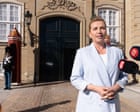
The coffee in the Danish Parliament, Christiansborg, has a reputation for being thick, bitter, and relentless. By the third day of failed negotiations, it tastes like copper and defeat. Mette Frederiksen, a leader known for a certain iron-willed pragmatism, finally stepped away from the table. The air in the room didn't just feel stale; it felt heavy with the realization that the center could no longer hold.
Denmark is often viewed from the outside as a clockwork orange of social democracy—efficient, predictable, and calm. But beneath the surface of the "Nordic Model," the gears have been grinding. The collapse of Frederiksen’s attempt to bridge the gap between the left and the right isn't just a parliamentary hiccup. It is a fracture in the very idea of the "broad middle" that has governed the nation for years. When the Prime Minister informed Queen Margrethe II that she could not assemble a coalition, she wasn't just handing back a mandate. She was admitting that the tribalism currently sweeping across Europe has finally breached the dikes of Copenhagen. For a closer look into this area, we recommend: this related article.
Now, the King’s Negotiator role shifts. The spotlight turns to the right.
The Architect of the New Right
Enter the challenger. To understand the shift, you have to look past the press releases and into the eyes of the voters in the Jutland peninsula. These are people who feel the distant hum of Copenhagen’s bureaucracy as a vibration that rarely brings good news. They see a rising cost of living, a debate over immigration that never seems to reach a resolution, and a green transition that feels like an expensive burden placed on the shoulders of the working class. To get more information on this issue, detailed reporting is available at USA Today.
The right-wing bloc didn't win by being louder; they won by being specific. While Frederiksen spoke of "stability," her opponents spoke of "identity."
Imagine a small-scale dairy farmer near Aarhus. For him, the "broad middle" represents a series of compromises that slowly erode his way of life. When a right-wing leader promises to prioritize the "Danish heartland" over international accolades, that isn't just a political stance. It’s a lifeline. The mandate to form a government has now moved to this side of the aisle because they successfully tapped into a vein of silent resentment that the coalition builders simply ignored.
The Geometry of a Broken Circle
Forming a government in a multi-party system is an exercise in high-stakes geometry. You are trying to fit triangles into circular holes, hoping the wood doesn't splinter. Frederiksen’s failure was a result of the Moderate Party and the Liberals finding the price of her leadership too high. They wanted a shift in economic policy that her own base on the left viewed as a betrayal.
Politics is the art of the possible, but in Denmark this week, the "possible" ran out of room. The right-wing leader now tasked with the formation of a government faces the same math, just flipped. He must court the skeptics within his own camp while preventing the far-right elements from making demands that would alienate the moderate voters he needs to maintain a majority.
It is a fragile dance performed on thin ice. If he fails, the country heads back to the polls, a prospect that exhausts the public and terrifies the markets. The stakes are invisible until they aren't—until the social services start to lag, or the energy policy stalls in the middle of a cold winter.
The Human Cost of Deadlock
We often talk about "coalitions" as if they are abstract entities. They are not. They are rooms full of tired people arguing over the price of a liter of milk and the definition of a citizen. When these rooms fall silent, the country holds its breath.
There is a specific kind of tension that exists in a democracy when the leadership is in flux. It’s the feeling of being on a ship where the engine has cut out. You’re still moving forward because of the momentum, but you know the steering is gone. For the average Dane, this isn't about the drama of the "Blue Bloc" or the "Red Bloc." It’s about whether the government will actually function.
Consider the young professional in Odense, struggling with a housing market that seems designed to keep her out. She doesn't care about the ego clashes between party chairmen. She cares about whether the new government will follow through on tax reforms or if the whole system will remain paralyzed by ideological purity tests.
The failure of the center-left coalition wasn't a lack of effort; it was a lack of common ground. The ground had moved while they were still standing on it.
A Different Kind of Power
The move to ask the right-wing leader to form a government is a tectonic shift. For years, the narrative of Danish politics was one of consensus. That consensus is dead. We are entering an era of "adversarial stability," where the goal is no longer to agree, but to outmaneuver.
The right-wing bloc's approach is visceral. They focus on the borders—both literal and metaphorical. They talk about the "true" Denmark. This language is polarizing, but it is also magnetic. It provides an answer to the disorientation of the modern world. While the left tries to manage the decline of the old world, the right is promising to build a fortress around what remains.
The negotiator now walks the halls of Christiansborg with a different weight on his shoulders. He isn't just trying to win a vote; he is trying to prove that his vision of the country is more than just a protest. He has to turn "no" into "how." He has to convince the skeptics that a right-wing government won't tear the social fabric, but will instead re-weave it with stronger thread.
The Silence After the Storm
As the sun sets over the spires of Copenhagen, the tourists outside the palace take photos, unaware of the frantic phone calls and the hushed deals being brokered behind the stone walls. The transition of power is rarely a loud event in Denmark. It happens in the quiet exchange of folders and the formal announcements to the press.
But the silence is deceptive.
The failure of Frederiksen is a warning. It says that the old ways of governing—the polite compromises and the "middle-way" solutions—are no longer enough to satisfy a restless public. The right-wing leader has been handed the keys to a house that is currently on fire. He has to find a way to put out the flames without blowing out the walls.
History doesn't usually turn on a single day. It turns on the weeks of exhaustion that follow a collapse. The coming days will decide if Denmark finds a new path or if it simply wanders deeper into the woods of political fragmentation.
The bitter coffee is still brewing in the committee rooms. The lights in the palace will stay on long past midnight. Somewhere in those halls, a man is looking at a list of names and numbers, trying to find a version of Denmark that everyone can live with, even if no one is truly happy.
The dikes are holding, for now, but the water level is rising.



