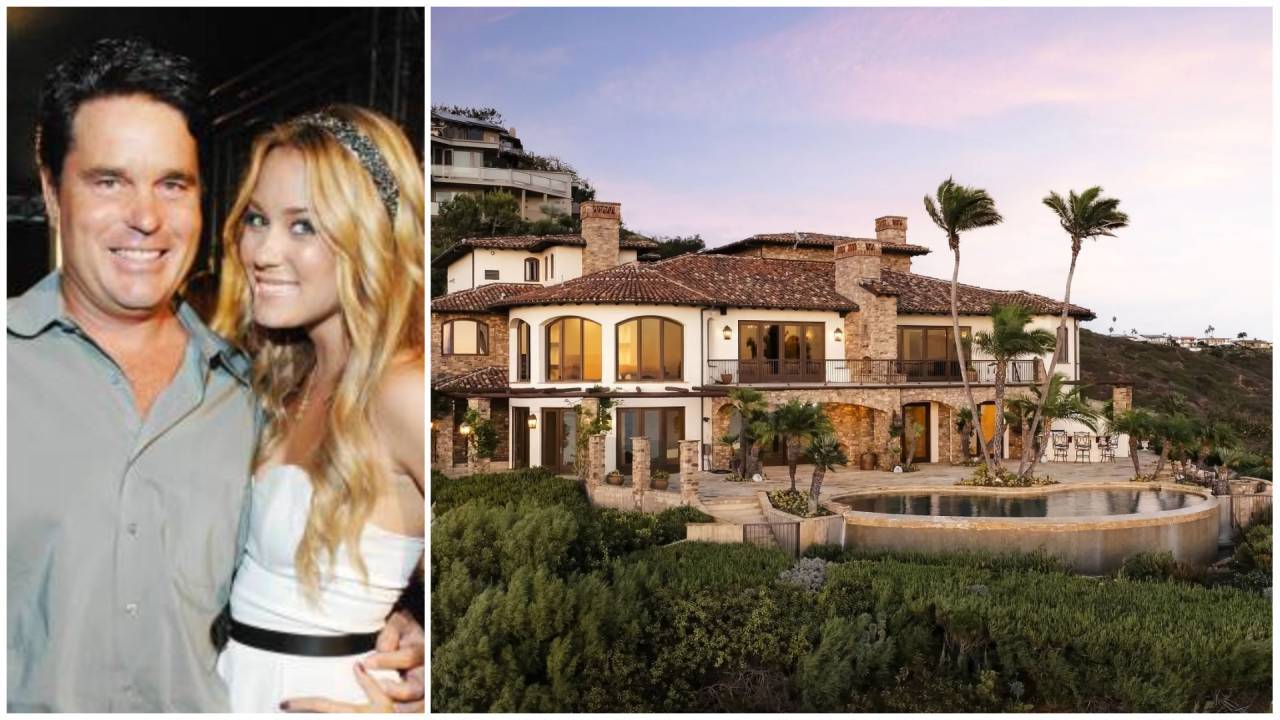
The Lauren Conrad family mansion in Laguna Beach—designed and built by her father, architect James Conrad, in 2004—has returned to the market at $26.5 million, more than double the $11.9 million the family got for it in 2008.
Twenty-two years of coastal inflation. Two decades of reality-television nostalgia.
Sitting atop the guarded Three Arch Bay enclave at 29 Vista Del Sol, the property spans roughly 11.4 acres and encloses nearly 7,800 square feet of living space across six bedrooms and seven bathrooms. Most real estate coverage treats the relisting like a glossy scrapbook tour: look at the curved infinity pool, remember the MTV hot-tub drama, marvel at the ocean view. That approach misses the real story. Beneath the Santa Barbara plaster, wood-beamed ceilings, and Italian stone finishes lies a sharp test of whether early-aughts television fame still commands a price premium in ultra-luxury Orange County real estate—or whether a buyer in 2026 is really paying for a giant piece of scarce coastal land that happens to carry a famous zip code and a twenty-year-old television pedigree.
The Nostalgia Premium Meets Hard Coastal Economics
Reality television sold a very specific version of Southern California in 2004. Back then, Laguna Beach: The Real Orange County turned upper-middle-class and wealthy teen life into a weekly broadcast export, framing ocean views, custom pools, and guarded gates as an attainable fantasy right up until the housing market cracked. The Conrad house became shorthand for that era. Its infinity edge seemed to spill straight into the Pacific, and its location on a quiet stretch of Three Arch Bay gave it the aura of an untouchable coastal sanctuary.
Real estate agents love nostalgia when it brings eyeballs to a listing. Buyers at the $25 million-plus tier rarely write checks out of sentimentality.
At $26.5 million—roughly $3,400 per square foot—the property competes against newer trophy builds and ultra-prime bluff and cove parcels across Laguna Beach and neighboring Dana Point. A buyer spending that kind of capital is evaluating land scarcity, carrying costs, architectural upkeep, and resale liquidity. Even public tax and automated valuation figures sit well below the asking price, underscoring the gap between an aspirational list number and what cold math supports on paper.
| Metric / Factor | Public & Listing Reality | Buyer & Market Takeaway |
|---|---|---|
| Asking Price | $26.5 million (listed fall 2026) | More than double the $11.9 million 2008 sale price |
| Lot Footprint | ~11.36 to 11.4 acres in Three Arch Bay | Rare scale where 2.5-acre lots are considered large |
| Structure Size | 7,784 sq. ft., 6 beds, 6 full & 1 half baths | Built in 2004; twenty-two years of coastal exposure |
| Ownership Trail | Conrad family to tech founder Ming Hsieh | Shifts story from MTV fame to institutional-grade net worth |
| Rental Fallback | Also marketed for lease (reported around $45k/mo) | Signals willingness to generate carrying offset while testing price |
Why Eleven Acres Changes the Math in Three Arch Bay
Strip away the MTV episodes and the math becomes much more interesting. In coastal California, land—not drywall—holds the deepest long-term leverage. Three Arch Bay is a tightly held, guard-gated community known for private beach access, club amenities, and strict physical limits on expansion. Parcels measured in double-digit acres simply do not materialize there with any regularity; listing commentary notes that the next-largest parcels in the enclave are a fraction of that size.
That acreage is the strongest defense of the asking price. A buyer who wants genuine buffers from neighbors, canyon and coastline views, and privacy behind a guarded gate cannot manufacture eleven acres out of a standard subdivision lot. In high-end coastal markets, unreplicable land often outlasts design trends.
Still, large acreage along the California coast is not free money. It is a liability machine if neglected. Steep coastal topography, brush clearance, drainage, salt air corrosion on exterior hardware and glazing, and ongoing maintenance of terraces, stone masonry, and pool systems add steady annual expense on top of six-figure property taxes and hefty estimated monthly debt service if financed. A house built in 2004 is old enough that mechanical systems, waterproofing, and interior finishes face serious scrutiny from any sophisticated buyer.
From Reality TV Backdrop to Tech Billionaire Balance Sheet
Most entertainment coverage treats the house as if it belonged in a time capsule marked 2005. In reality, the Conrads sold the estate in 2008—right as the broader American housing and credit boom was unraveling—for $11.9 million. That exit timing matters. Selling at $11.9 million in 2008 spared the family the worst of the post-crash trough that crushed many Southern California luxury sellers over the next several years, even if the house had only been in their hands for a few years after completion.
Over the intervening years, the property has been tied to entrepreneur Ming Hsieh, founder of biometrics firm Cogent Systems and leader of Fulgent Genetics. That detail quietly reframes the narrative. This is no longer a family offloading a childhood trophy home on the open market. It is a long-held coastal asset stepping out at a moment when its television origin story has gained fresh twenty-year anniversary attention, while the underlying real estate play rests on wealth preservation and coastal scarcity.
Consider a hypothetical example to see how two buyers look at the exact same address:
- Buyer A (The Nostalgia Buyer): Enamored with Laguna Beach, willing to stretch on price because the house looks familiar from television clips. When inspection reports, coastal maintenance realities, and appraisal comps arrive, enthusiasm usually cools fast.
- Buyer B (The Land & Privacy Buyer): Cares little about MTV and everything about having roughly eleven acres inside a guarded coastal enclave with ocean and canyon views, treating the existing 2004 structure either as a livable legacy compound or a candidate for future remodeling.
In ultra-luxury real estate, Buyer B is the one who actually closes—and usually negotiates hard on price per square foot unless the land itself leaves zero substitutes.
What a $26.5 Million Tag Really Tests Right Now
Putting a property on the market at $26.5 million—while also having rental availability in the mix—is a classic price-discovery move in high-end coastal brokerage. Sellers at this tier rarely need a quick distress sale. They test the top of the market to see whether a wealthy buyer values privacy, acreage, and architectural roots enough to clear a steep hurdle.
If you are tracking this listing as an investor, a coastal homeowner, or a student of celebrity real estate, look past the headline number and watch three concrete signals:
- Days on market and price adjustments: Luxury listings in Orange County that miss their initial mark often linger quietly or step down incrementally rather than clearing at full ask.
- Comparison to newer coastal inventory: Watch how buyers weigh an older 2004 build on massive acreage against smaller lots with modern glass, indoor-outdoor systems, and turnkey finishes.
- Final recorded sale price versus 2008: The true measure of the Lauren Conrad estate's twenty-year arc will not be the brochure copy or the 2004 television footage—it will be the closing figure on the deed once the dust settles.
Watch the spread between the $26.5 million asking price and the eventual closing deed to see whether coastal land or television memory carries the heavier weight.