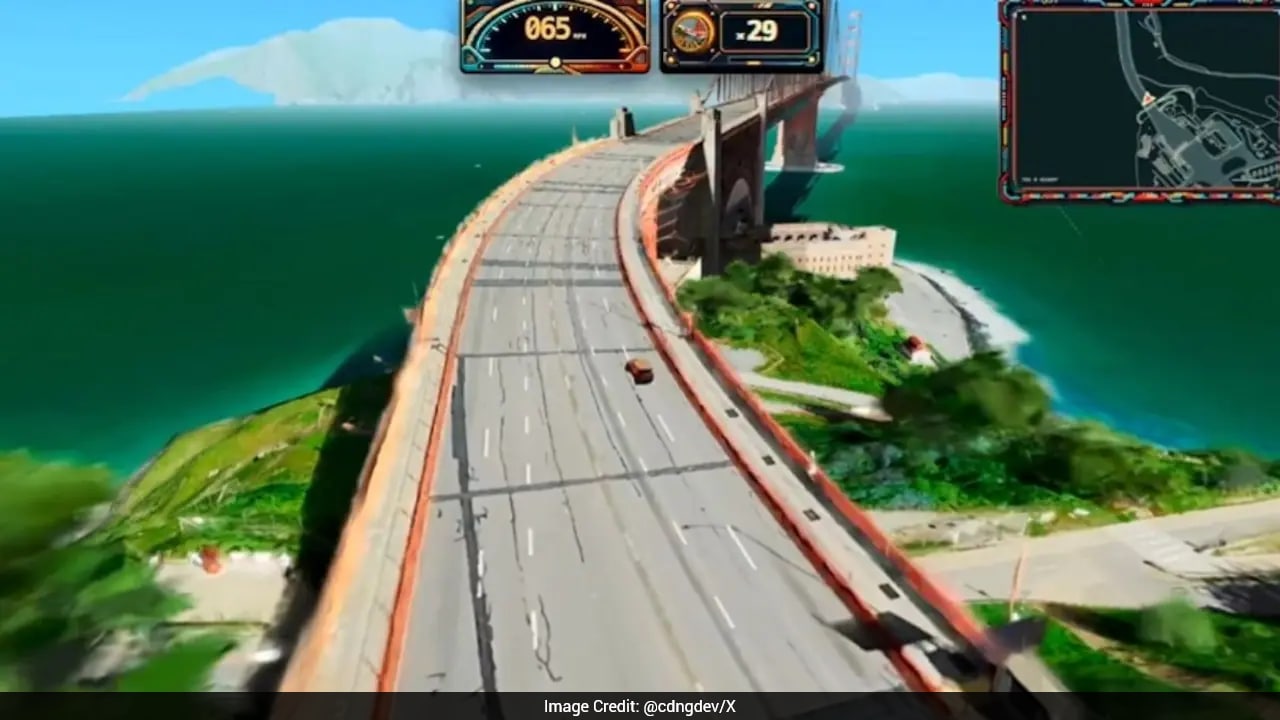
The desk smelled like dry erase markers and cheap Earl Grey tea. Outside, the night traffic hummed against the glass, a rhythmic, monotonous roar that usually meant nothing to anyone except the people stuck in it. But inside the room, lit only by the violet glow of a dual-monitor setup, that traffic had a shape. It had a direction. It had code.
Meet Leo. He is not an industry titan. He does not have a venture capital firm backing his garage experiments, nor does he wear a turtleneck to give keynote addresses. He is twenty-two, his posture resembles a bent paperclip, and for the past eighteen months, his entire universe has been pinned to the foggy, steep, dizzying contours of San Francisco.
He didn't just build a map. He built an obsession.
Concrete and Coordinates
Most people look at a city and see a place to live. A programmer looks at a city and sees a puzzle box waiting to be picked. When you boot up standard open-world crime simulators, the asphalt is usually an anonymous gray grid designed to funnel fast cars from one skyscraper district to another. They are synthetic cities. They feel heavy, but they feel hollow.
Leo wanted something different. He wanted the real grit.
He started with public elevation data. Millions of geographic information points mapping every dip in the sidewalk along Market Street, every brutal incline of Lombard, every rusted rivet on the Golden Gate Bridge. To translate real-world geography into a playable environment, you have to perform a kind of digital alchemy. You take raw, cold numbers from satellite surveys and breathe geometry into them.
Imagine trying to sculpt a mountain range out of salt using only a pair of tweezers. That is what coding a faithful urban scale looks like. Every street corner has a personality. The way the fog rolls over the Twin Peaks at precisely 4:30 PM isn't just a weather effect in his engine; it is a structural challenge of rendering volumetric particles without turning a consumer graphics card into a toaster oven.
People talk about scale in gaming as if it were just a matter of square miles. It is not. Scale is texture. Scale is the exact angle at which the afternoon sun hits the Victorian row houses on Steiner Street, casting long, bruised shadows across the pavement.
The Physics of Freedom
Why San Francisco? Why not Tokyo, or London, or a sprawling, made-up metropolis where you can blow up bridges without annoying the historical preservation society?
Because San Francisco is theatrical. It is a city built on vertical extremes. You cannot drive a stolen sports car down a forty-degree slope without physics screaming at you.
When Leo uploaded his early alpha footage to an online developer forum, the response was not polite applause. It was stunned silence, followed immediately by an avalanche of skepticism. Big studios spend hundreds of millions of dollars and employ thousands of people across three continents to render urban sandboxes. How did a kid with a single mid-tier rig and a stubborn streak manage to capture the exact weight of the city's steepest hills?
The secret wasn't raw computing power. It was obsession with detail.
He didn't model every single building from scratch—that would take lifetimes. Instead, he wrote procedural generation scripts that understood architectural logic. The scripts knew that if a building was a 1920s Edwardian, it needed specific bay windows, specific cornices, specific brick coloration. If it sat on a slope, the foundation had to step down into the dirt rather than floating above it like a bad hologram.
Drive a vehicle through his digital creation, and you feel the suspension groan. The tires lose traction on the cable car tracks if you take a corner too fast in the rain. It borrows the chaotic, lawless DNA of Grand Theft Auto, but it injects it with a hyper-local geography that makes anyone who has ever missed a Muni bus wince in recognition.
The Invisible Stakes
We live in an era where our digital spaces are increasingly corporate, sanitized, and walled off. Every virtual world you visit is likely owned by a conglomerate that wants to sell you digital sneakers or monthly battle passes.
What Leo did is an act of quiet rebellion.
He didn't build his San Francisco to monetize user engagement or optimize retention metrics. He built it because he wanted to see if he could capture a ghost in a machine. He wanted to take a living, breathing, deeply troubled, endlessly beautiful city and shrink it down until it fit inside a laptop, waiting for someone to press the start button.
There is a vulnerability in putting your work out like that. Coding is a lonely discipline. You spend thousands of hours staring at syntax errors, arguing with compilers, and wondering if anyone will ever care about the precise angle of a streetlamp on Mission Street. You are shouting into an empty canyon, hoping the echo sounds like applause.
And then the internet wakes up.
Suddenly, thousands of strangers are streaming themselves careening down Nob Hill, screaming with laughter as their virtual sedans flip end-over-end into a construction barrier. They are exploring alleys they have never visited in real life. They are noticing the graffiti tags Leo slipped into the alleyways as Easter eggs for his friends.
The Horizon
The project is far from finished. Optimization is an endless war of attrition. Every frame per second gained is a victory fought over discarded memory leaks and uncompressed texture files.
Yet, looking at the way the digital fog creeps over the digital bay at dusk, something shifts in the room. The hum of the real traffic outside fades away, replaced by the low, steady drone of a physics engine rendering a sunset that never happened, over a city that exists entirely because one person refused to accept the limits of what a single human being is supposed to be able to build alone.
The streetlights flicker on in the virtual Marina district. The cable cars begin their ghostly climb up the grade.
Nobody is driving them yet. They are just waiting for the key to turn in the ignition.


