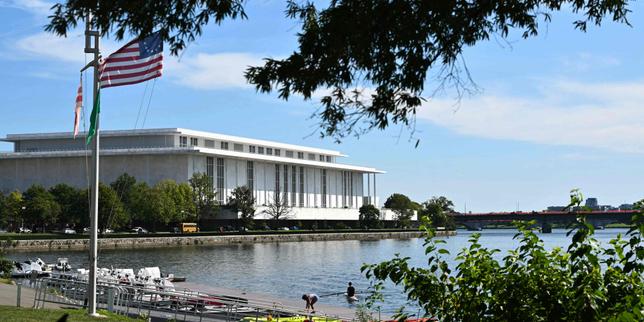
Institutional cowardice rarely arrives with a dramatic explosion. More often, it slips into a boardroom wearing a polite smile, nodding along as basic operational standards are traded away for short-term peace. The decision by the Kennedy Center board of trustees to entertain demands regarding its naming rights represents a textbook study in how elite cultural bastions surrender their independence long before the first shovel ever hits the ground or the first sign is unscrewed.
When reports surfaced that Donald Trump threatened to block or refuse the reopening of the John F. Kennedy Center for the Performing Arts unless his own name was prominently affixed to the institution, the correct institutional response should have been swift
The Kennedy Center Armtwist Exposes the Fractured Politics of Cultural Patronage
entertainment, news
Cultural institutions in the United States have always existed in an uneasy alliance between state-sanctioned prestige and partisan politics. When Donald Trump reportedly demanded his name be affixed to the John F. Kennedy Center for the Performing Arts under threat of withholding federal administrative support or administrative cooperation, it was not merely an eccentric administrative demand. It was a calculated stress test of institutional resilience. The subsequent acquiescence of the Kennedy Center's board of directors reveals a quiet structural surrender. Federal landmarks dedicated to national memory are increasingly treated as personal brand assets by political actors, and boards designed to protect them are proving structurally incapable of standing firm.
For decades, the board of trustees at the Kennedy Center operated under a quiet consensus. Federal funding, structural upkeep, and cultural programming were meant to function insulated from the daily crosswinds of executive whims. That insulation is gone. When political loyalty or personal vanity supersedes institutional stewardship, the governance model breaks down entirely. The board's decision to support or accommodate such naming ultimatums exposes a deep structural vulnerability. These bodies rely heavily on presidential appointments, political appointments, and donor networks that bend easily when pressure is applied from the Oval Office.
The mechanism of this pressure is rarely subtle. The Kennedy Center receives critical federal operating support alongside private philanthropic contributions. Threatening the operational viability or future expansion of a national cultural monument creates an immediate crisis for administrators whose primary job is financial survival. When faced with a choice between defending a historical moniker honoring a assassinated Democratic president or securing the administrative cooperation of a vengeful executive branch, survival instinct wins. Board members appointed to safeguard public trust routinely choose institutional appeasement over public confrontation.
This dynamic highlights a broader decay within American institutional norms. We have moved past the era where unwritten rules protected civic architecture from partisan narcissism. The naming of public infrastructure has transformed into a zero-sum game of dominance. If a president can demand his own name on a national performing arts center built as a memorial to John F. Kennedy, no monument, federal building, or cultural archive remains safe from ideological branding. The precedent set here alters the baseline of what is permissible in American public life.
Consider the historical parallel. Monuments are physical manifestations of a nation's collective narrative. When that narrative is rewritten overnight to satisfy the ego of a sitting politician, the historical contract with the public is breached. The Kennedy Center was established through a bipartisan congressional enactment in 1958 as a living memorial, funded by a mix of public and private dollars. It was designed to transcend individual administrations. Subverting that design for temporary political peace demonstrates that our cultural guardians are no longer wardens of history. They are caretakers of convenience.
The financial reality of maintaining these massive spaces compounds the problem. Mega-venues require millions in annual upkeep, security, and operational subsidies. When political interference threatens those revenue streams or administrative relationships, boards fold because they lack independent financial sovereignty. They are tethered too closely to the federal apparatus they are ostensibly meant to monitor and manage. Without an endowment insulated from political retaliation, cultural institutions will always capitulate when a powerful executive applies direct leverage.
Public outcry over these maneuvers tends to follow a predictable, exhausting cycle. Outrage spikes on social media, cable news cycles churn for forty-eight hours, and policy analysts write urgent columns about democratic norms. Then the news cycle shifts. The sign gets painted, the board issues a carefully worded statement about moving forward, and the permanent compromise becomes the new normal. Each iteration lowers the bar for what future administrations can demand without facing systemic resistance.
True reform would require an absolute structural overhaul of how cultural boards are constituted. As long as trustees serve at the pleasure of the executive or rely on political patronage for their positions, they will function as extensions of the administration rather than independent checks on power. True independence requires fixed, unalterable terms, self-perpetuating board selections, and diversified funding streams that cannot be turned off with a stroke of a presidential pen.
Until those structural safeguards are built, our national monuments remain vulnerable to whoever holds the levers of state power. The Kennedy Center board thought they were making a pragmatic compromise to preserve their institution's immediate future. Instead, they validated a transactional model of culture where heritage is cheap, institutional memory is negotiable, and public property can be rebranded to order.