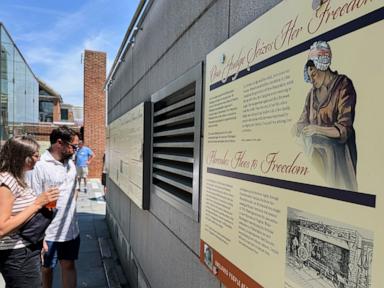
The reconfiguration of interpretive text at the President's House Site in Philadelphia isolates a critical operational friction point between federal administrative mandates and municipal governance frameworks. Statutorily executing changes to public-facing historical narratives is rarely a function of academic consensus; it is driven by regulatory jurisdiction, executive enforcement mechanisms, and contract law. When the National Park Service (NPS) removed the original 2010 exhibition panels detailing the lives of nine enslaved persons held by George Washington and replaced them with altered narratives, the underlying structural cause was a direct alignment of executive authority intersecting with federal property rights.
To evaluate this transition accurately, one must look past the standard rhetorical debates surrounding historical presentation and analyze the legal mechanics, funding models, and structural constraints governing federal monuments. This paradigm shifts the discussion from ideological disagreement to a concrete evaluation of administrative power. For a more detailed analysis into similar topics, we recommend: this related article.
The Tri-Partite Structural Framework of Federal Interpretive Control
The operational transformation of the President’s House site rests on three distinct pillars: federal property superiority, executive standard-setting, and contractual boundary limitations.
1. Federal Supremacy and Title Control
The primary driver of the physical replacement of the panels is the legal designation of the site itself. Although the City of Philadelphia collaborated significantly in the early 2000s to design the installation and directly contributed $1.5 million toward its physical completion, ownership of the land was transferred to the federal government. Under the Property Clause of the United States Constitution, Congress—and by extension, the federal agencies authorized to manage public lands—maintains plenary power over federal property. For broader details on this issue, comprehensive reporting can be read on NPR.
The U.S. 3rd Circuit Court of Appeals crystallized this dynamic by confirming that the Department of the Interior and the NPS retain ultimate authority over properties within their portfolio. The city’s $1.5 million financial capital expenditure bought participation in the initial creation phase but did not secure permanent editorial control over the real estate asset.
2. Executive Orders as Regulatory Directives
The catalyst for the content alteration was an executive order issued in 2025 targeting the narrative focus of federally owned or managed historic landmarks. The order mandates that historic locations emphasize civic achievements and progress while explicitly prohibiting displays that "disparage Americans past or living".
Executive orders function as administrative law for federal agencies. Once an order is issued, the Department of the Interior must translate that policy into tangible operational protocols. The removal of titles like “The Dirty Business of Slavery” and their replacement with “Celebrating Independence Throughout the Years” represents the direct implementation of this directive by agency staff.
[Executive Order Issued] ──> [NPS Operational Mandate] ──> [Content Modification Applied]
3. The Contractual Maintenance Bottleneck
Philadelphia’s legal strategy relied heavily on the argument that a cooperative agreement over Independence National Historical Park obligated the federal government to consult municipal authorities prior to executing modifications. The municipal legal argument stalled on the specific definition of property maintenance.
The appellate court clarified that a contractual obligation to "maintain" an installation governs structural and physical upkeep rather than narrative preservation. The legal distinction means that while the federal government must physically preserve the pavilion structure, it is not contractually bound to lock the 2010 text into perpetuity against changing administrative priorities.
Quantifying Narrative Adjustments: Content Metrics Shift
Evaluating the new panels requires a clear comparison of what content was removed versus what content was added. The shift does not completely eliminate historical facts, but it alters the focus of the information provided.
| Original Framework (2010 Design) | Revised Framework (2026 Installation) |
|---|---|
| Primary Focus: Micro-history of 9 specific enslaved individuals. | Primary Focus: Macro-history of the executive mansion and early presidency. |
| Contextual Tools: Global slave trade route maps, clear timelines. | Contextual Tools: Structural development of early constitutional law. |
| Editorial Tone: Direct focus on systemic economic drivers ("Dirty Business"). | Editorial Tone: Evolutionary focus on gradual legislative and individual shifts. |
The replacement panels retain mention of the nine enslaved workers but alter their characterization, describing them as "dynamic participants in the daily life of the family and the city". This wording shifts the narrative from their legal status as property to their functional contributions to the household.
The second major adjustment involves contextual rebalancing. The 2010 panels framed Washington’s household within the broader transatlantic slave trade. The 2026 panels counter-balance Washington's record by highlighting his role in drafting the 1774 Fairfax Resolves, framing his personal trajectory as one of becoming "increasingly committed to the gradual abolition of slavery".
The Operational Reality of Public Space Control
A key aspect of this transition was how the changes were physically implemented. The municipal government noted that federal workers swapped the exhibit components overnight under Park Police surveillance. From an operational standpoint, this method reveals how agencies handle controversial public property adjustments.
- Mitigation of Public Disruption: Modifying physical components outside of peak operating hours minimizes the potential for public demonstrations or active interference on federal land.
- Enforcement of Legal Supremacy: Executing the swap immediately after a favorable appellate court ruling prevents municipal authorities from filing emergency injunctions or counter-claims before the changes are completed.
- Physical Asset Control: Deploying law enforcement assets to secure the site during and immediately after installation reinforces federal property rights on the ground, creating a practical barrier to any local efforts to reverse the changes.
This approach highlights a clear structural reality: administrative bodies with clear title ownership and police power can implement policy changes quickly, regardless of local political opposition.
Risk Allocation and Municipal Vulnerability
The legal battle in Philadelphia highlights a major risk for cities and private donors who fund projects on federal land. When local entities spend money on federal historic sites, they often assume their initial agreement guarantees long-term control over how the history is told.
The 3rd Circuit's ruling shows that this assumption is legally flawed. Unless a contract explicitly gives a donor or city permanent editorial veto power over future content, the federal government retains the right to change things down the road. This creates a structural risk where local investments can be redirected by a new presidential administration using executive orders.
Future municipal partnerships with federal agencies must account for this vulnerability. Local governments face a choice: either accept that federal agencies have final narrative control, or change how they write their contracts to include explicit clauses protecting the content of the exhibits from future administrative shifts.
Given that the municipal administration has pledged to seek a rehearing from the full appellate bench, the current operational playbook dictates that local authorities shift their focus away from broader historical arguments. They must instead try to establish a narrower, binding interpretation of the joint management agreements. If that strategy fails, the current installation establishes a clear legal precedent: federal property rights allow the executive branch to shape the historical narratives presented at national landmarks.


:quality(90):format(webp)/_img_productos/labial-loreal-infallible-le-matte-resistance-120-foto1.jpg)