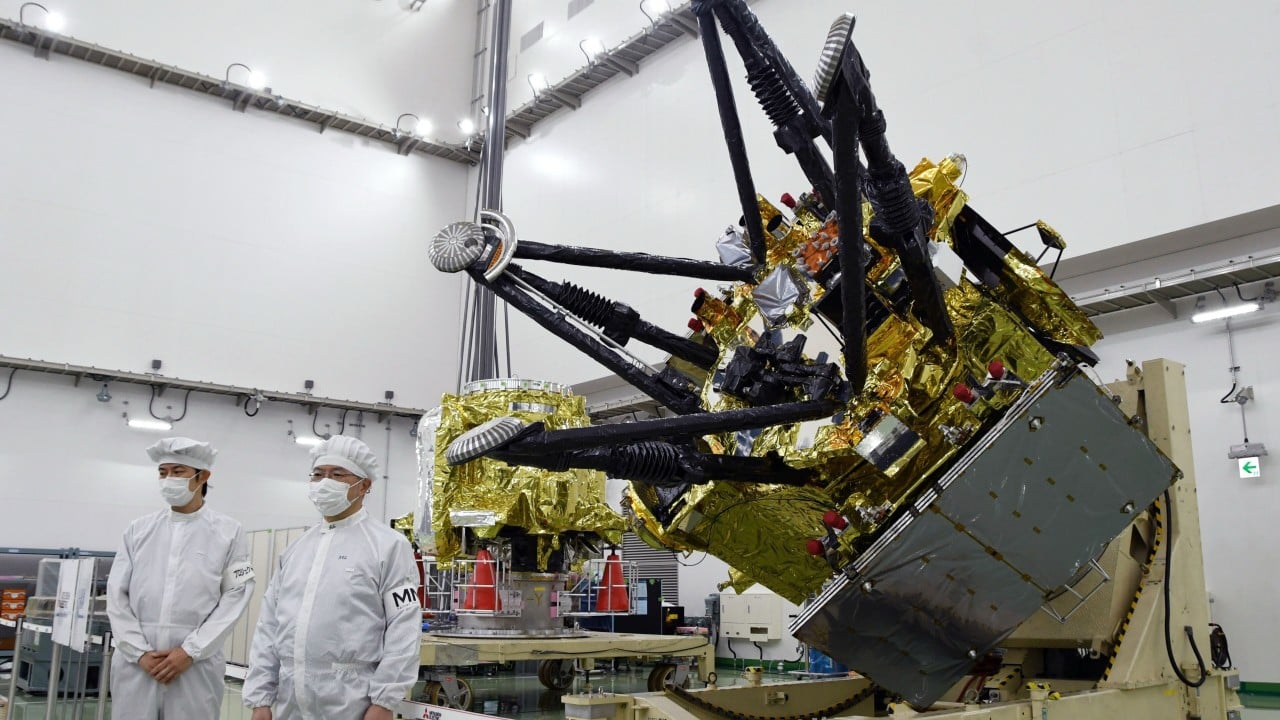
Most people assume that if you want clues about ancient life near Mars, you send a rover to dig into Martian mud. I used to think the exact same thing. Then I started looking closely at Japan's Martian moon mission, JAXA's Martian Moons eXploration (MMX), and the weirdest hypothesis in planetary science right now.
Tiny, potato-shaped Phobos might actually be holding blasted-off pieces of early Mars—and possibly organic ingredients from the wider solar system.
Sounds wild. It is.
Instead of wrestling with Mars's thick dust storms, steep canyons, and tricky landing terrain, MMX targets Phobos, the larger and inner of Mars's two moons. The spacecraft will orbit the moon, map its surface, deploy a small rover developed with CNES and DLR (IDEFIX), scoop up surface regolith, and bring samples back to Earth. If everything goes to plan, scientists will hold physical grains from the Martian system in terrestrial labs, where instruments are far bigger, sharper, and more sensitive than anything you can strap onto a deep-space probe.
Let's be honest about what's at stake here. We don't have proof that life ever existed on Mars. We don't even have a settled answer on how Phobos formed. Yet bringing back material from Phobos gives researchers a double shot at big questions: how moons around rocky planets form and evolve, and whether material—including prebiotic chemistry or even traces of past biosignatures—was tossed from early Mars and trapped on Phobos's surface.
Why Phobos Matters for the Martian Moon Mission
Look at the image above and notice how much orbital choreography this takes. Getting to Mars is hard enough. Settling into the neighborhood of a small moon about 22 kilometers across, touching down in low gravity, collecting enough sample mass, and flying back to Earth is a brutal engineering problem.
So why pick Phobos over Mars itself?
First, gravity and escape velocity change the math. Phobos is tiny, which means landing and taking off requires way less fuel than descending through Mars's thin atmosphere and climbing back out of a deep gravity well. Second, impact ejecta makes Phobos an accidental archive. When large asteroids slammed into ancient Mars billions of years ago, they blasted rock and soil skyward. Some of that debris escaped Mars and drifted across its orbital neighborhood, where Phobos—orbiting much closer to Mars than Deimos does—could sweep it up.
There's also the question of Phobos's own origin. Scientists have argued for decades over two main stories:
- Captured asteroid: Phobos and Deimos started as small bodies from the outer solar system or asteroid belt and got pulled into orbit around Mars.
- Giant impact debris: A massive collision knocked material off early Mars, and that ring of debris clumped together into moons.
Honestly, the debate isn't settled, and that's half the reason planetary geologists are so excited. Look at Phobos's dark, reddish-gray surface and grooves—some researchers see captured carbonaceous material, while others see impact-processed rock mixed with Martian material. Chemical and isotopic analysis back on Earth will test both ideas directly instead of relying only on remote spectroscopy.
In the view of Stickney crater above, you can see how battered and complex Phobos's surface is. Those streaks and slopes aren't just pretty scenery; they tell a story of impacts, landslides, and space weathering over eons. Every scoop of regolith is a mixture of local Phobos material, space-weathered dust, and potentially foreign debris.
How Sample Return Changes the Origins of Life Question
Let's clear up a common misconception right away. MMX is not a life-detection mission in the classic "look for microbes with a microscope" sense. If someone tells you Japan is bringing back alien bacteria from Phobos, push back gently—that's not what the mission is designed to claim.
Instead, MMX is about building blocks, environment, and transport.
To get life started—or even to test whether life ever got a foothold on early Mars—you need raw organic molecules, water or past water-rock interactions, energy sources, and time. On Earth, JAXA's Hayabusa2 mission already showed what sample return can do when it brought back grains from the asteroid Ryugu, revealing amino acids and other organic compounds that inform how prebiotic ingredients move around the solar system.
Applying that sample-return playbook to Phobos adds a Martian twist. If Martian ejecta landed on Phobos billions of years ago, those grains could preserve clues about ancient Mars before surface radiation and modern chemistry altered everything on the planet's surface. Even if the grains are mostly native Phobos regolith, studying volatile elements, carbon compounds, and mineral alteration helps scientists understand how water and organic matter were distributed in the inner solar system.
Here's where I think people get tripped up: absence of proof isn't proof of absence. Even if MMX finds zero signs of Martian material or zero complex organics in a given sample, that doesn't close the book on life on Mars. Space is big, sample mass is limited, and a few grams or tens of grams of moon dust is a tiny keyhole into a whole planet's history. Still, for the specific material MMX brings back, lab precision on Earth beats robotic guesswork every single time.
Real Risks and What Could Go Wrong
I love ambitious space missions, and I also know how unforgiving deep space can be. A sample-return mission has multiple single-point-of-failure moments, and pretending otherwise doesn't help anyone.
- Landing and sampling in microgravity. On a tiny moon, a gentle touch can turn into a bounce, a tilt, or a sampler that fails to grab enough material. Engineers have to design around unpredictable regolith texture—loose powder, pebbles, or harder crust.
- Orbital and thermal extremes. Navigating around Mars and Phobos requires tight timing and reliable propulsion, while keeping instruments and sample containers within strict temperature limits.
- Sample contamination. Once you bring extraterrestrial grains back to Earth, keeping them pristine so terrestrial dust or lab microbes don't muddle the results is an art form in itself. Cleanroom protocols and curation teams carry huge weight here.
- Schedule shifts. Deep-space programs live and die by launch windows and hardware testing. When a subsystem needs extra qualification, planetary alignments don't wait around—delays can push a mission to the next favorable window.
When you weigh those risks against the payoff, though, the gamble makes sense. We've already seen JAXA prove it can land on small bodies and return samples safely with Hayabusa and Hayabusa2. That track record is a big reason other space agencies—including international partners contributing instruments and the rover—are leaning in.
Practical Ways to Follow and Verify Mission Updates
If you want to track this story without getting swept up in clickbait headlines or AI-generated space rumors, stick to primary sources and technical briefings.
- Check official mission portals first: Follow JAXA's MMX mission site for verified mission milestones, instrument descriptions, and official announcements rather than relying on second-hand summaries.
- Read peer-reviewed context alongside news: When a new paper discusses Phobos ejecta, moon formation, or sample-return science, look up the study abstract or institutional press release to see whether the authors are modeling a hypothesis or reporting lab measurements.
- Watch for concrete milestones, not vague hype: Pay attention to launch readiness reviews, Mars orbit insertion plans, rover surface operations, sample collection confirmation, and Earth re-entry/curation updates. Those concrete checkpoints tell you far more than breathless speculation about "aliens."
Space exploration moves slowly, methodically, and sometimes messily—and right now, a small Martian moon is quietly becoming one of the sharpest lenses we have on early planetary history.