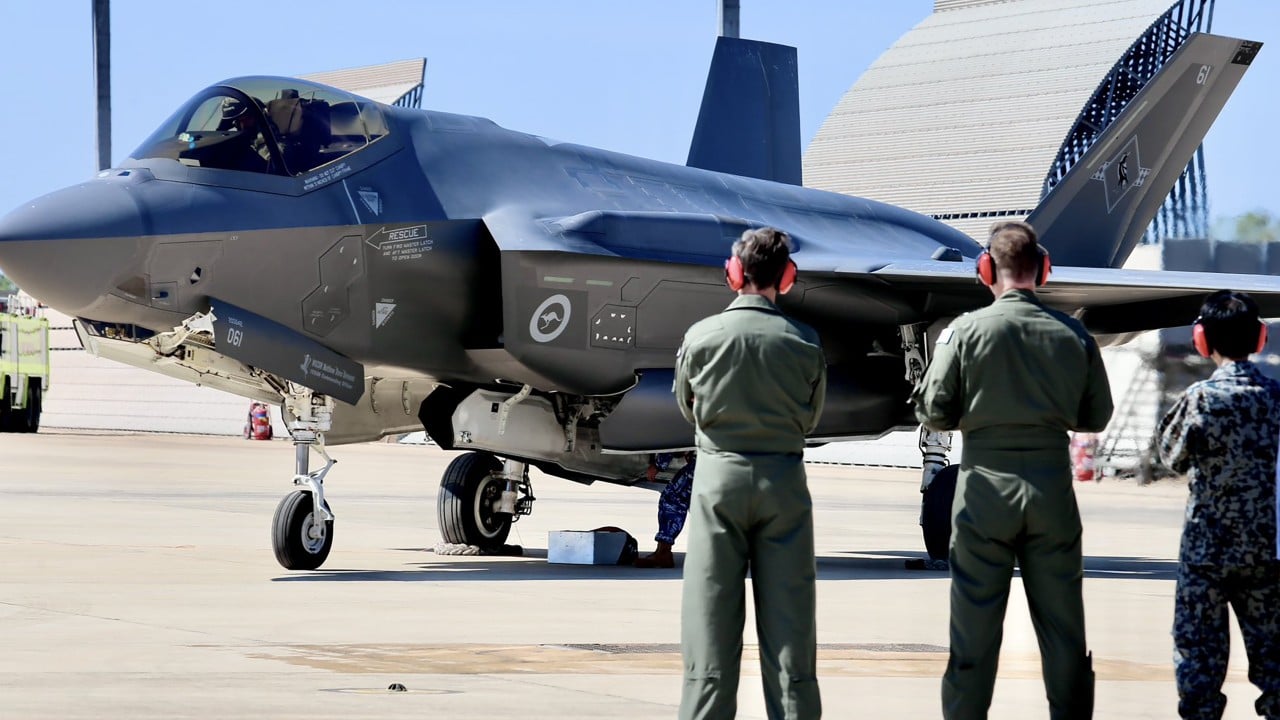
Every defense pundit in the Western hemisphere just wet themselves over Tokyo deploying F-35s to northern Australia. The lazy consensus prints itself: Tokyo and Canberra are locking arms against Beijing, forging an Asiatic NATO, drawing a literal line in the sand of the Indo-Pacific. It is a comforting narrative for think-tank analysts who prefer watching maps with colored markers to understanding how modern logistics actually break.
It is also completely backwards.
When Japanese warplanes touch down at RAAF Base Tindal, it does not signal a strategic pivot against China. It signals the quiet, terrifying unraveling of the American hub-and-spoke security architecture in the Pacific. Washington is not orchestrating a unified front. Washington is desperately outsourcing its regional exposure because the Pentagon is waking up to a basic mathematical nightmare: American bases in Japan and Guam are sitting ducks in a missile saturation scenario.
I have spent the last decade watching defense budgets burn on programs that look great in a PowerPoint presentation and fail the moment a logistics officer tries to order spare parts across three different sovereign jurisdictions with incompatible crypto-keys. Let us dismantle the fantasy.
The Geography Myth
Look at a flat map and the Australia-Japan axis looks like a natural choke point. Look at a globe, or better yet, look at a maintenance schedule, and it looks like a logistical suicide pact.
Tokyo sending stealth fighters south is not an aggressive projection of offensive power. It is an evacuation drill disguised as an exercise.
For decades, the American security guarantee rested on forward deployment. You put the planes right on the front doorstep—Okinawa, Yokosuka, Guam—so they can scramble in minutes. But precision-guided conventional rocketry has fundamentally mutated. The People's Liberation Army Rocket Force does not need amphibious fleets to ruin a regional strategy; they have thousands of medium-range ballistic and hypersonic glide vehicles designed to turn concrete runways into gravel pits within the opening twenty minutes of a conflict.
Japan knows this. Tokyo’s defense planners are not suicidal. They are looking for strategic depth because their own islands are too narrow, too close, and too vulnerable to saturation strikes. Australia offers vast landmass, wide spaces, and distance from the immediate mainland theater.
This is not a deployment to fight China. It is a relocation to survive the opening salvo.
The Interoperability Fairy Tale
Listen to the defense attachés talk and you would think a Japanese pilot can drop into an Australian airbase, plug into local ground support, and fly sorties using shared logistics.
It is a complete fabrication.
Let us define terms precisely. Interoperability is not a buzzword you slap on a press release after a joint photo-op. It is the agonizing, expensive, highly bureaucratic alignment of secure communications, maintenance protocols, munitions handling, and legal authorities.
Japan and Australia do not have a mutual defense treaty. They do not share a unified command structure like the US-ROK combined forces. When Japanese personnel service an F-35A on Australian soil, they are operating under strict constitutional self-defense constraints that forbid collective self-defense in certain kinetic contexts.
Imagine a scenario where a Chinese maritime militia vessel provokes an incident halfway between the South China Sea and the Australian coast. Does the Japanese pilot have the legal clearance under Article 9 of Japan’s pacifist constitution to fire on that vessel while operating from an Australian base? The answer is a messy legal labyrinth that would require emergency cabinet approval in Tokyo while missiles are already in flight.
Troops sharing tarmac does not equal an alliance. It equals an administrative headache that breaks down the second someone loses a secure radio frequency.
The Washington Blind Spot
The real story here is not about Tokyo or Canberra. It is about Washington’s diminishing capacity to be the sole guarantor of regional order.
For seventy years, the US acted as the sole manager of bilateral security arrangements in Asia. We told Tokyo what to buy. We told Canberra where to patrol. We held the keys to the intelligence locker.
Now, middle powers are bypassing Washington to build bilateral workarounds because they no longer trust the long-term durability of American domestic politics. Australia looks at the United States Congress, watches the cyclical paralysis over foreign aid and defense appropriations, and realizes they need an insurance policy. Japan looks at the same political instability and realizes they cannot rely solely on an American nuclear umbrella that might be questioned by the next administration.
So they are talking to each other. Bilaterally. Without Uncle Sam necessarily holding the pen.
This should terrify American strategists, but instead, the Pentagon is spinning it as a win for multilateralism. It is not. It is the fragmentation of the alliance system. When secondary actors start forming defensive ties independently of the primary superpower, it means the primary superpower's deterrent credibility is fraying at the edges.
The Industrial Reality Check
Let us talk about supply chains, because wars are won by logisticians, not pilots.
Japan’s domestic defense industrial base is famously sclerotic. Bound by decades-old self-imposed bans on arms exports—only recently and timidly poked at—Japanese defense contractors like Mitsubishi Heavy Industries do not possess the surge capacity to fight a protracted high-intensity war. They build exquisite, artisanal, hyper-expensive military hardware in small batches.
Australia, meanwhile, is canceling major land vehicle programs, struggling to crew its surface fleet, and waiting decades for nuclear-powered submarines that may or / may not arrive before mid-century under the AUKUS agreement.
Now take these two militaries, add language barriers, different software block configurations on their F-35s, distinct supply chains running back to Lockheed Martin in Texas rather than to each other, and try to run a sustained combat operation.
It is a paper tiger built out of press releases.
The Uncomfortable Truth About the Region
Beijing is not losing sleep over Japanese fighters in the Northern Territory. In fact, Chinese strategic analysts are likely thrilled.
By pulling Japanese tactical air assets further south, Tokyo is effectively withdrawing from the frontline battlespace of the First Island Chain. They are trading forward presence for strategic depth, which is a defensive retreat, no matter how many glossies the Australian Department of Defence prints to justify it.
The real question nobody in the mainstream media is asking: What happens when Australia’s northern bases become targets simply because they are hosting Japanese and American assets? Canberra is volunteering to become a primary target in a Sino-American war over Taiwan, absorbing strategic risk without gaining an ounce of independent strategic control.
The pivot isn't against China. It's away from American reliability. And nobody in uniform has the courage to say it out loud.
Stop looking at the jets on the tarmac. Look at the empty desks in Washington where the strategy used to be written.