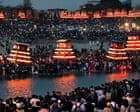
Four tons of carved hardwood moving at full sprint through a narrow street leaves zero margin for error. When three men died in separate festival float accidents across western Japan in October 2026, the shock wasn't just about the body count. It was about how familiar the script felt.
Two men were killed and 16 others injured on Saturday, October 10, 2026, during Danjiri float events in two cities in Osaka Prefecture. In Izumiotsu, a Danjiri overturned after a right turn at an intersection around 1:20 p.m., killing a 48-year-old corporate worker from neighboring Izumi and injuring nine male participants. Days later, in Saijo in western Japan, 62-year-old Deputy Mayor Nabae died after becoming trapped beneath a float during the annual harvest festival.
Look at those dates and details. That isn't a freak anomaly in Japanese festival culture. It's a recurring collision between raw civic pride and brutal physics.
What Makes Japanese Festival Float Accidents So Dangerous
Traditional matsuri (Japanese festivals) aren't polite, slow-moving parades with velvet ropes and marching bands. In places like Osaka Prefecture and Saijo, pulling a massive wooden shrine or float is an athletic, high-adrenaline test of endurance and coordination.
A typical Danjiri float is built from heavy timber and weighs roughly four to five metric tons. Teams of over 100 runners haul them along paved roads while musicians ride on board playing flutes, drums, and gongs. Saijo's autumn harvest festivals feature more than 100 floats weighing up to four tonnes each, pulled in honor of Shinto deities for abundant grain crops.
Now put four tonnes of top-heavy wood on wheels and ask a crowd to whip it around a 90-degree corner at speed. That maneuver—known in Danjiri culture as yarimawashi—is a crowd favorite precisely because it looks perilous. High center of gravity plus sharp lateral momentum equals tipping risk. If a wheel catches a curb, a seam in the asphalt, or a sudden shift in pulling force, the float can roll onto the very people steering or pulling it.
Participants riding on top or near the base face steep odds when balance fails. Even when spectators stay outside the immediate crush zone, the people inside the ropes are inches from several thousand pounds of unbraked timber.
Why Tradition Resists Safety Overhauls
If you ask outsiders why organizers don't just slow the floats down or add modern braking and roll cages, you get a blunt answer from locals: do that, and it isn't the festival anymore.
Honesty matters here. In tight-knit neighborhoods, participation isn't casual tourism. It's multigenerational identity. Families train for months, neighborhoods compete for prestige, and elders pass down unwritten rules about how to read the rope tension and corner angles. When a deputy mayor dies beneath a float, as happened in Saijo, local leaders feel the grief personally—Saijo Mayor Mitsuyoshi Ochi called the tragedy hard to believe right as they were starting work together on a new administration.
Still, tradition isn't a force field against momentum. Two real tensions keep stalling big reforms:
- Spectacle vs. control: Sharp high-speed turns draw cheers and cameras, yet speed is the exact variable that turns a controlled pivot into a rollover.
- Volunteer governance vs. municipal liability: Many neighborhood float committees operate on custom and peer pressure rather than strict engineering audits, even when local governments back the event.
When accidents happen, police open investigations and committees promise to review procedures. By next autumn, though, the drums start up again and the pull ropes tighten.
What Spectators and Travelers Get Wrong About Matsuri Safety
People planning a trip to Japan often assume every public event runs like a bullet train—punctual, sanitized, and low-risk. Most big tourist matsuri are well-managed for casual walkers. Smaller or more intense regional float festivals are a different beast.
A few assumptions trip visitors up fast:
- Thinking "no spectator injuries" means "safe nearby": Police noted that no spectators were hurt in the two October 2026 Osaka fatal rollovers, even though two participants died and nine were injured in the Izumiotsu crash alone. Being a bystander doesn't insulate you from a four-ton tip-over if a float swings wide into a crowd line.
- Standing on the outside of a sharp turn: Centrifugal force pushes outward. Corners are where momentum gets messy and crowds press tightest against barriers or parked obstacles.
- Treating pull teams like casual street performers: You aren't watching a choreographed dance. You're watching dozens of people sprinting with heavy gear and shouting signals in real time.
I've watched enough street crowds get squeezed against shopfronts during high-energy parades to know one simple rule: sightlines aren't worth standing at an apex. If a float loses control at a corner, the outer edge is the worst place to hold a camera.
Practical Ways to Stay Safe at a Float Festival
If you're attending a Japanese float festival—whether as a first-time visitor or a local supporter—a few concrete habits cut your risk dramatically without ruining the atmosphere.
- Pick straightaways over intersections. Watch from a straight stretch where pull teams have clear sightlines and room to steer, rather than a tight 90-degree turn where yarimawashi turns happen.
- Keep a wide buffer from the wheels and ropes. Don't lean over barriers or crowd right behind pulling lines just to get a closer shot.
- Map two exits before the parade starts. Narrow streets fill fast, and emergency vehicles or sudden crowd shifts can bottleneck one side of the route.
- Follow local stewards immediately. When organizers or police wave people back or halt a section, move right away instead of arguing for your spot.
Heavy timber and human muscle have carried these festivals for centuries. Keeping them alive shouldn't require burying another participant in the street.