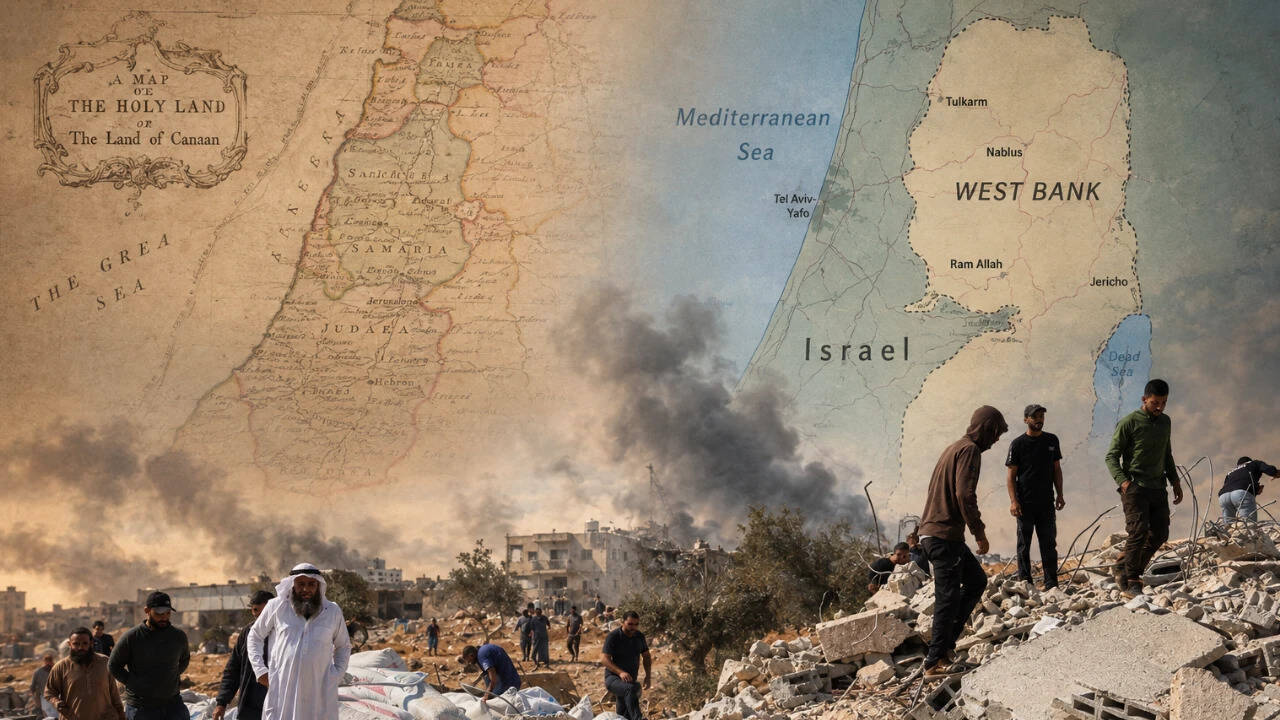
History doesn't start on a single calendar date, no matter how much television news tries to convince you it does. When the world woke up to the horrifying attacks by Hamas on October 7, 2023, millions of people scrambled to open search engines and maps, wondering how the world got to that exact moment of absolute devastation. Headlines screamed about an unprecedented escalation, casting the violence as a sudden spark in an otherwise quiet desert. That framing is not just lazy; it's historically illiterate.
If you want to understand why Gaza burns, why the West Bank remains choked by checkpoints, and why generations of families have grown up knowing only the hum of surveillance drones, you have to look back more than a century. You have to trace a tangled line through British colonial betrayal, displaced populations, broken treaties, and a "Promised Land" narrative that meant two entirely different things to two distinct peoples clinging to the exact same sliver of Mediterranean dirt.
Let's strip away the modern talking points and look at the actual mechanics of how this crisis was built, brick by broken brick.
The Colonial Blueprint and the Promised Land
To find the modern roots of this tragedy, you have to go back to World War I and the collapse of the Ottoman Empire. Great Britain and France carved up the Middle East like a holiday roast behind closed doors, ignoring tribal, religious, and historical realities on the ground. For Britain, Palestine was a vital strategic wedge guarding the route to India and the Suez Canal.
At the same time, the Zionist movement was gaining momentum in Europe. Driven by centuries of brutal antisemitism and pogroms that made Jewish life in Europe increasingly untenable, Theodor Herzl and other leaders argued that the Jewish people needed a sovereign home in their ancestral biblical homeland—the Promised Land of ancient texts.
The British government issued the Balfour Declaration in 1917, a fateful two-paragraph letter expressing support for "the establishment in Palestine of a national home for the Jewish people." Notice what the British left out. They didn't mention the hundreds of thousands of Arab Palestinians who had farmed those olive groves, built those coastal towns, and lived on that land for generations. The declaration referred to them merely as "existing non-Jewish communities."
That single omission set a tragic precedent. One empire promised a land already inhabited by one people to another people fleeing existential terror in Europe.
The Mandate Years and the First Explosions
Britain took formal control of Palestine under a League of Nations mandate after the war. For the next three decades, London tried to manage an impossible contradiction. Jewish immigration surged during the 1920s and 1930s, accelerating dramatically as Adolf Hitler tightened his grip on Europe and the Holocaust loomed on the horizon.
Palestinian Arabs watched their demographic weight shrink in real-time. They saw British authorities facilitate land purchases that often displaced tenant farmers who had worked the soil for generations. Tensions boiled over into the Arab Revolt of 1936 to 1939, a massive uprising against both British rule and Zionist immigration. Britain crushed the revolt with brutal military force, hanging leaders, destroying villages, and leaving the Palestinian national movement fractured, leaderless, and deeply suspicious of international promises.
By the end of World War II, Britain was exhausted, bankrupt, and desperate to dump the Palestine problem onto the newly formed United Nations.
1948 and the Catastrophe That Defines Today
In November 1947, the United Nations passed Resolution 181, proposing to partition Palestine into separate Jewish and Arab states, with Jerusalem under international administration. Jewish leaders accepted the plan, seeing it as international recognition and a vital refuge. Arab leaders rejected it entirely, arguing that it violated the fundamental rights of the majority population who owned most of the private land.
What followed was the 1948 Arab-Israeli War. When the fighting stopped, Israel declared its independence, having secured roughly seventy-eight percent of mandatory Palestine—significantly more than the UN partition map proposed.
For Palestinians, this era is known as the Nakba, meaning "the catastrophe." More than 700,000 Palestinians fled or were driven from their homes, becoming refugees in Gaza, the West Bank, Jordan, Lebanon, and Syria. Hundreds of villages were depopulated, renamed, or bulldozed.
This wasn't just a military conflict; it was a permanent fracture in human geography. Those refugees and their descendants didn't vanish. They spent decades living in crowded camps, holding onto the physical keys to homes they were forced to abandon, passing down the memory of their dispossession like a sacred inheritance.
The Six-Day War and the Permanent Occupation
For nearly twenty years after 1948, the West Bank was controlled by Jordan, and the Gaza Strip was administered by Egypt. But the map shattered again in June 1967.
During the Six-Day War, Israel launched a preemptive strike against a mobilizing coalition of Arab neighbors. In six days of intense combat, Israel captured the West Bank and East Jerusalem from Jordan, the Gaza Strip and the Sinai Peninsula from Egypt, and the Golan Heights from Syria.
Suddenly, millions of Palestinians who had lived under Jordanian and Egyptian rule found themselves under direct Israeli military occupation. This is the moment the modern occupation was born.
United Nations Security Council Resolution 242 called for Israel to withdraw from territories occupied in the conflict, in exchange for peace and recognition from its neighbors. It established the principle of "land for peace." Decades later, that land for peace formula remains a broken promise, buried under concrete, settlements, and political cowardice on all sides.
The Settlement Enterprise and the Death of Hope
If you walk through the West Bank today, you won't see a clear border. You’ll see a web of heavily fortified Israeli settlements connected by bypass roads that Palestinians aren't allowed to use, all carved into Palestinian hillsides.
Over the decades, successive Israeli governments treated the West Bank not as a bargaining chip for peace, but as Judea and Samaria—biblical territory to be reclaimed. The settler population grew from a few thousand religious ideologues in the 1970s to over half a million today. Each new housing block, each military checkpoint, and each concrete separation wall made a viable, contiguous Palestinian state look less like a diplomatic reality and more like a geographic fantasy.
In Gaza, the story took a different, darker turn. In 2005, Israel unilaterally pulled its settlers and soldiers out of the Gaza Strip. But instead of granting sovereignty, Israel, joined later by Egypt, imposed a suffocating land, air, and sea blockade after Hamas won legislative elections and violently seized full control of the strip in 2007.
Gaza became the world's largest open-air prison. An entire generation grew up knowing they couldn't leave, couldn't import basic building materials without military permission, and couldn't build a sustainable economy. When you trap two million people in an impoverished, densely populated enclave with contaminated water and failing infrastructure, you aren't neutralizing a threat; you're cultivating a time bomb.
Why October 7 Happened in the Shadow of History
When Hamas militants broke through the border fence on October 7, 2023, slaughtering civilians, kidnapping hostages, and committing atrocities that shocked the world, they didn't do it in a vacuum. They acted within a context of absolute despair, radicalization, and the total collapse of any diplomatic horizon.
For years, international leaders told Palestinians to wait. Wait for negotiations. Wait for the peace process. Wait for elections that never happened. Meanwhile, settlements expanded, land was confiscated, and the world largely moved on, treating the occupation as a permanent background condition rather than an active wound.
Hamas exploited that profound hopelessness, offering a horrific, violent alternative to a population that felt completely abandoned by the international community, by Arab governments normalizing ties with Israel, and by their own corrupt, ineffective leadership in the Palestinian Authority.
Israel responded with a military campaign in Gaza of historic devastation. Entire neighborhoods were leveled, tens of thousands of civilians were killed or injured, and the humanitarian crisis reached biblical proportions. The government in Jerusalem framed the war as an existential fight for survival against a terrorist network dedicated to its destruction. Palestinians around the world saw it as the continuation of the Nakba—another chapter in an endless cycle of displacement and erasure.
Moving Beyond the Endless Cycle
We are left with a grim reality. Military dominance cannot buy permanent security. Security for Israelis is utterly impossible without freedom and self-determination for Palestinians. Conversely, the destruction of Israel will not bring justice or a homeland to Palestinians.
The origin story of this conflict is a tragedy written in displacement, trauma, and the stubborn refusal of two peoples to disappear. Until the world stops treating October 7 as day zero and starts treating it as the inevitable, bloody symptom of a century-old disease, the killing will continue. Real peace requires dismantling the structures of apartheid, lifting the siege of Gaza, freezing illegal settlements, and finding the political courage to acknowledge two peoples' shared, undeniable history on the same piece of earth.


